
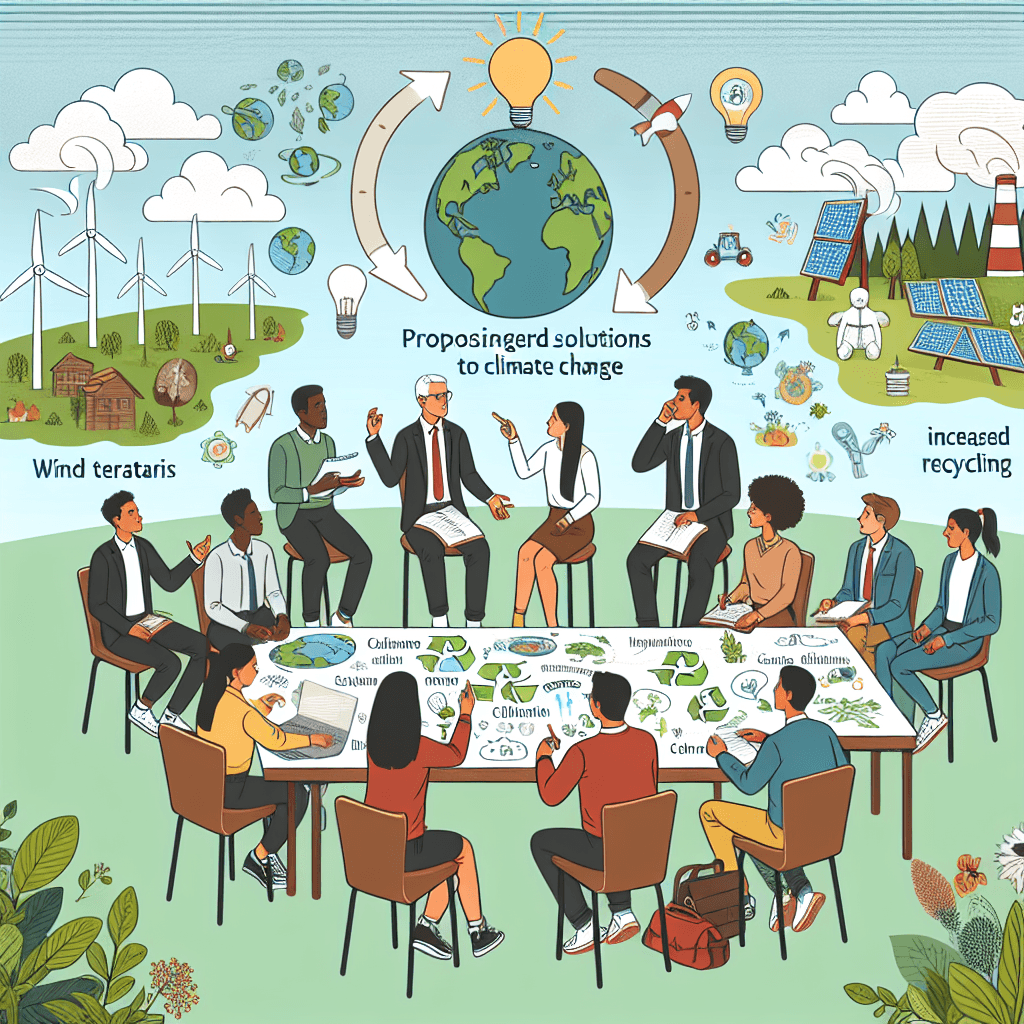
Past IF-Clauses: Proposing Solutions to Climate Change
Inquiry Framework
Question Framework
Driving Question
The overarching question that guides the entire project.How can we use Type 3 IF-clauses to analyze past actions and their potential impacts on climate change, and how might this understanding help us propose effective solutions for the future?Essential Questions
Supporting questions that break down major concepts.- How can using Type 3 IF-clauses help us understand the potential impacts of past actions on climate change?
- In what ways can we propose solutions for climate change using insights from past scenarios expressed in IF-clauses?
- How do conditional sentences allow us to explore cause and effect in environmental issues?
Standards & Learning Goals
Learning Goals
By the end of this project, students will be able to:- Understand and apply Type 3 IF-clauses in constructing hypothetical scenarios related to climate change.
- Analyze how past actions described using Type 3 IF-clauses could have impacted climate change.
- Propose solutions for future climate action based on insights gained from past hypothetical scenarios.
- Develop written and oral communication skills through presenting arguments and solutions related to environmental impacts.
Common Core Standards
California ELD Standards
Entry Events
Events that will be used to introduce the project to studentsThe Climate Detective Challenge
Set up a mock detective agency in the classroom. Present students with 'clues' from extreme weather events or habitat changes linked to climate change. They must use Type 3 IF-clauses to hypothesize how different actions in the past might have changed these events, piquing their curiosity to solve 'environmental mysteries.'Portfolio Activities
Portfolio Activities
These activities progressively build towards your learning goals, with each submission contributing to the student's final portfolio.If-Clause Clue Collector
Students will begin their exploration by identifying the structure and usage of Type 3 IF-clauses. They will gather 'clues' by reviewing sentences that describe hypothetical past scenarios, focusing on understanding the components of these clauses.Steps
Here is some basic scaffolding to help students complete the activity.Final Product
What students will submit as the final product of the activityA completed worksheet with highlighted IF-clause components and notes from class discussion.Alignment
How this activity aligns with the learning objectives & standardsAligns with CCRA.W.2 by examining complex sentence structures and 8.ELD.PII.3 by using verb tenses in hypothetical scenarios.Scenario Builder: Crafting Climate Stories
Using their understanding of Type 3 IF-clauses, students will create their own sentences to reflect hypothetical scenarios that could have influenced climate outcomes, demonstrating their grasp of cause and effect in environmental issues.Steps
Here is some basic scaffolding to help students complete the activity.Final Product
What students will submit as the final product of the activityA portfolio of original Type 3 IF-clause sentences illustrating potential climate impacts.Alignment
How this activity aligns with the learning objectives & standardsSupports CCRA.W.2, focusing on clear expression of ideas, and 8.ELD.PII.3 by using verb tenses to describe scenarios.Debate & Discuss: Environmental Hypotheticals
Students engage in structured discussions and debates on climate scenarios, utilizing their Type 3 IF-clause sentences to propose and analyze potential solutions, thereby enhancing their oral communication skills.Steps
Here is some basic scaffolding to help students complete the activity.Final Product
What students will submit as the final product of the activityRecorded group discussions and debates showcasing students' use of Type 3 IF-clauses to express complex ideas.Alignment
How this activity aligns with the learning objectives & standardsAligns with CCRA.SL.1 by enabling participation in collaborative discussions, and supports 8.ELD.PII.3 through verbal expression of hypotheticals.Solution Proposal Presentation
Building on debate insights, students will develop a comprehensive solution proposal addressing climate change, using Type 3 IF-clauses to underscore past lessons learned and future recommendations.Steps
Here is some basic scaffolding to help students complete the activity.Final Product
What students will submit as the final product of the activityA written proposal and presentation articulating a climate solution, incorporating Type 3 IF-clauses.Alignment
How this activity aligns with the learning objectives & standardsMeets CCRA.W.2 through structured writing and CCRA.SL.1 by developing presentation skills, also aligning with 8.ELD.PII.3 by using type-specific verbs.Rubric & Reflection
Portfolio Rubric
Grading criteria for assessing the overall project portfolioType 3 IF-Clauses in Climate Scenarios
Understanding of Type 3 IF-Clauses
Measures the student's grasp of the structure and purpose of Type 3 IF-clauses, including their ability to identify and use these clauses effectively in hypothetical scenarios.Identification of Clause Components
Ability to identify and highlight the components of Type 3 IF-clauses in given sentences.
Exemplary
4 PointsAccurately identifies and highlights all components of Type 3 IF-clauses in multiple sentences consistently.
Proficient
3 PointsCorrectly identifies and highlights most components of Type 3 IF-clauses in given sentences.
Developing
2 PointsPartially identifies components of Type 3 IF-clauses, missing some elements in the sentences.
Beginning
1 PointsStruggles to identify and highlight components of Type 3 IF-clauses accurately.
Application in Hypothetical Scenarios
Measures the ability to apply Type 3 IF-clauses to create hypothetical scenarios related to climate change.
Exemplary
4 PointsCreatively and accurately constructs hypothetical scenarios using Type 3 IF-clauses that effectively illustrate cause and effect.
Proficient
3 PointsAccurately constructs hypothetical scenarios using Type 3 IF-clauses to show cause and effect effectively.
Developing
2 PointsAttempts to construct hypothetical scenarios using Type 3 IF-clauses, with some inaccuracies affecting clarity.
Beginning
1 PointsStruggles to construct coherent hypothetical scenarios using Type 3 IF-clauses.
Analysis and Proposal Development
Evaluates the student's analysis of past climate actions and their ability to use insights from these analyses to propose effective solutions.Analysis of Past Actions
Capability to analyze scenarios using Type 3 IF-clauses to understand the impact of past actions on climate change.
Exemplary
4 PointsProvides comprehensive and insightful analysis of past actions, showing clear understanding of their impacts on climate change.
Proficient
3 PointsOffers a thorough analysis of past actions using Type 3 IF-clauses to demonstrate impacts on climate change.
Developing
2 PointsAnalyzes past actions superficially with some understanding of impacts, lacking depth in insight.
Beginning
1 PointsStruggles to provide meaningful analysis of past actions and their impacts using Type 3 IF-clauses.
Proposal of Future Solutions
Measures the ability to propose future climate solutions, informed by past hypothetical scenarios and expressed through Type 3 IF-clauses.
Exemplary
4 PointsProposes innovative and well-supported solutions, articulating a strong connection between past insights and future actions.
Proficient
3 PointsProposes clear and logical solutions using insights from past scenarios.
Developing
2 PointsOffers basic solutions that may lack depth or clear connections to past scenarios.
Beginning
1 PointsStruggles to propose feasible solutions or demonstrate connections to past insights.
Communication Skills
Assesses students' ability to clearly and effectively communicate ideas both in written and oral forms through structured arguments and presentations using Type 3 IF-clauses.Written Expression
Clarity, coherence, and effectiveness of written communication in proposals and analyses using Type 3 IF-clauses.
Exemplary
4 PointsWrites clearly, coherently, and effectively, utilizing Type 3 IF-clauses to enhance arguments and explanations.
Proficient
3 PointsWrites coherently and effectively with clear use of Type 3 IF-clauses, enhancing overall communication.
Developing
2 PointsWrites with some coherence and effectiveness; occasional use of Type 3 IF-clauses, affecting clarity.
Beginning
1 PointsStruggles to write coherently and effectively; limited use of Type 3 IF-clauses.
Oral Expression
Effectiveness of oral communication skills during presentations and discussions, particularly using Type 3 IF-clauses.
Exemplary
4 PointsCommunicates ideas clearly and persuasively in discussions and presentations, effectively using Type 3 IF-clauses.
Proficient
3 PointsCommunicates effectively in discussions and presentations with clear use of Type 3 IF-clauses.
Developing
2 PointsCommunicates with some clarity; uses Type 3 IF-clauses inconsistently, affecting expression.
Beginning
1 PointsStruggles to communicate ideas clearly; limited use of Type 3 IF-clauses in oral form.