
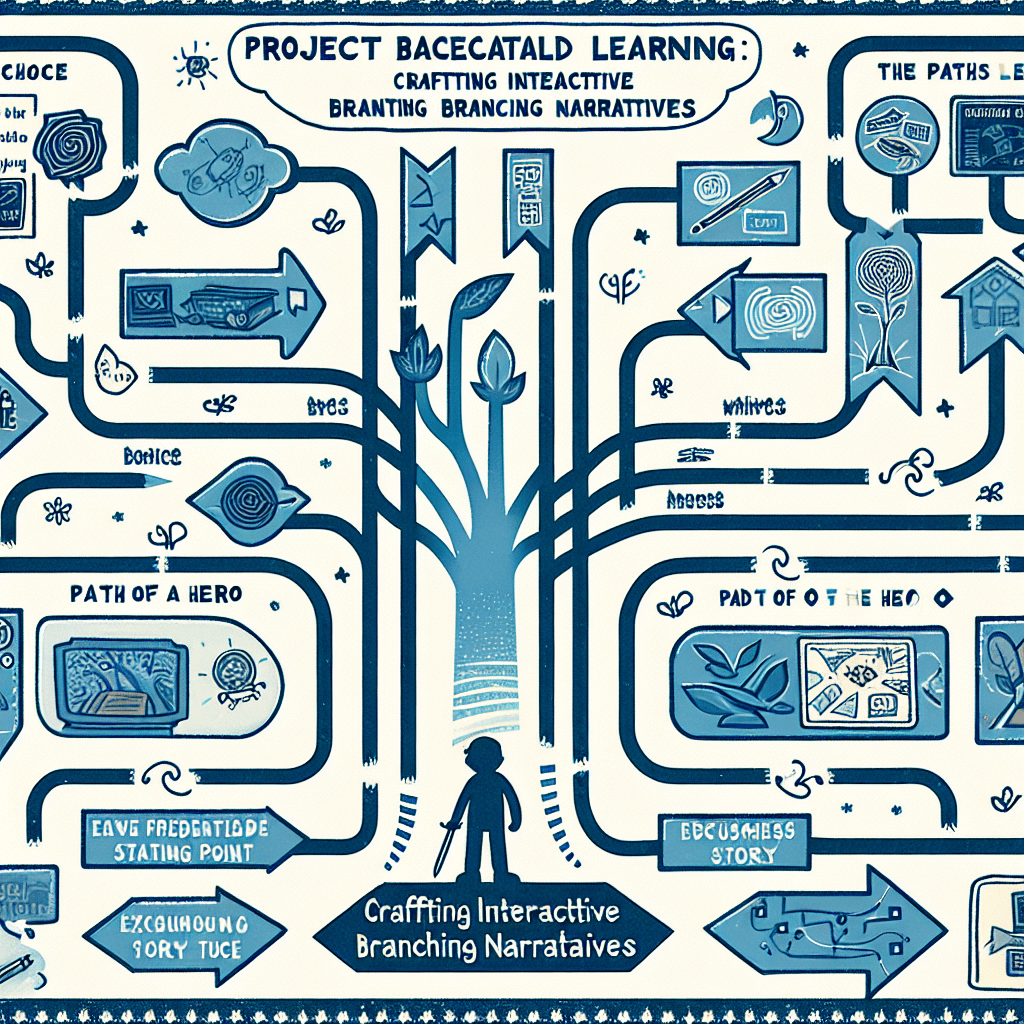
Path of the Hero: Crafting Interactive Branching Narratives
Inquiry Framework
Question Framework
Driving Question
The overarching question that guides the entire project.How can we design an immersive interactive adventure that uses the Hero’s Journey and sensory storytelling to show how a character’s choices shape their destiny across multiple paths?Essential Questions
Supporting questions that break down major concepts.- What are the key stages of the Hero’s Journey, and how do they create a compelling narrative arc?
- How do authors use descriptive details and sensory language to immerse a reader in a story's setting?
- How can a character’s internal traits and external choices lead to different consequences and plot developments?
- What techniques can we use to ensure a branching story remains organized and clear, no matter which path a reader chooses?
- How do we transition smoothly between scenes to maintain the pace and sequence of an adventure?
- How can we use 'show, don’t tell' strategies to develop character growth through multiple story paths?
Standards & Learning Goals
Learning Goals
By the end of this project, students will be able to:- Students will apply the Hero’s Journey framework to structure a multi-path narrative, ensuring a compelling story arc regardless of the reader's choices.
- Students will develop character-driven plot developments where specific internal traits and external choices lead to distinct, logical consequences.
- Students will use sensory details, descriptive language, and 'show, don’t tell' strategies to create immersive settings and develop character growth.
- Students will utilize digital tools to organize and publish a branching story that maintains clear transitions and narrative pacing across multiple sequences.
Common Core State Standards (ELA)
Entry Events
Events that will be used to introduce the project to studentsThe Glitch in the Tale
The classroom is transformed into a 'Choice Engine' simulation where a familiar fairy tale is projected on the screen. The story freezes at the first major decision point, offering three wildly different paths (e.g., the hero confronts the villain, flees to a secret city, or joins the villain). Students must vote on the direction, immediately seeing how one choice completely rewrites the setting, character development, and eventual climax.Portfolio Activities
Portfolio Activities
These activities progressively build towards your learning goals, with each submission contributing to the student's final portfolio.The Hero’s Origin: Drafting the Catalyst
Before the story branches, students must establish a strong foundation. In this activity, students will create their protagonist by defining their 'Ordinary World' and the 'Call to Adventure.' They will focus on internal traits (bravery, fear, curiosity) that will eventually influence the choices the reader makes for them later in the project.Steps
Here is some basic scaffolding to help students complete the activity.Final Product
What students will submit as the final product of the activityA Character & Catalyst Profile, including a 2-paragraph introduction to the story that establishes the hero's personality and the problem they must face.Alignment
How this activity aligns with the learning objectives & standardsThis activity aligns with CCSS.ELA-LITERACY.W.5.3.A (Orient the reader by establishing a situation and introducing a narrator and/or characters) and RL.5.3 (Drawing on specific details to describe characters).World-Building: The Sensory Settings Map
To make an interactive story immersive, the reader must feel like they are there. Students will use a sensory matrix to 'paint' the setting of their adventure. They will practice using the five senses to describe the first major location the hero enters after accepting their quest.Steps
Here is some basic scaffolding to help students complete the activity.Final Product
What students will submit as the final product of the activityA Sensory Map—a visual and written document where each part of the setting is described through at least three different senses.Alignment
How this activity aligns with the learning objectives & standardsThis activity focuses on CCSS.ELA-LITERACY.W.5.3.D (Use concrete words and phrases and sensory details to convey experiences and events precisely).The Fate-Maker’s Flowchart: Branching Logic
Now the story splits! Students will design the logic of their interactive narrative. They will identify a 'Crucial Choice' based on the hero's traits and map out two distinct paths: Path A (The Path of Courage) and Path B (The Path of Wit). This helps students see how different choices lead to different consequences.Steps
Here is some basic scaffolding to help students complete the activity.Final Product
What students will submit as the final product of the activityA Narrative Logic Flowchart that visually displays the branching paths, choice points, and the 'if/then' consequences of the story.Alignment
How this activity aligns with the learning objectives & standardsThis activity aligns with CCSS.ELA-LITERACY.W.5.3 (Organize an event sequence that unfolds naturally) and W.5.3.C (Use a variety of transitional words, phrases, and clauses to manage the sequence of events).Parallel Universes: Drafting the Dual Paths
Students will dive into the heart of their story by writing the climax for their two different paths. They will use dialogue and pacing to show how the character has changed. Path A might end in a physical victory, while Path B might end in a clever resolution, showing character growth in different ways.Steps
Here is some basic scaffolding to help students complete the activity.Final Product
What students will submit as the final product of the activityTwo 'Path Chapters' (the middle and climax of both Path A and Path B), written with dialogue and clear transitions.Alignment
How this activity aligns with the learning objectives & standardsThis activity aligns with CCSS.ELA-LITERACY.W.5.3.B (Use narrative techniques, such as dialogue, description, and pacing, to develop experiences and events).The Master Architect: Digital Assembly & Publishing
In the final stage, students will move their text into a digital platform (like Google Slides with hyperlinks, Twine, or a choice-based app). They will ensure that the endings of their paths are satisfying and tie back to the original theme. They will also peer-test each other's stories to ensure the 'buttons' or 'links' work correctly.Steps
Here is some basic scaffolding to help students complete the activity.Final Product
What students will submit as the final product of the activityA fully functional Digital Interactive Story with clickable choices, sensory descriptions, and two distinct, completed narrative endings.Alignment
How this activity aligns with the learning objectives & standardsThis activity aligns with CCSS.ELA-LITERACY.W.5.6 (Use technology, including the Internet, to produce and publish writing) and CCSS.ELA-LITERACY.W.5.3.E (Provide a conclusion that follows from the narrated experiences or events).Rubric & Reflection
Portfolio Rubric
Grading criteria for assessing the overall project portfolioThe Branching Hero’s Journey Portfolio Rubric
Character & Narrative Foundation
Focuses on the foundation of the story: character development and the initial catalyst.Characterization & Narrative Hook
Measures the student's ability to establish a protagonist through internal traits and external actions using 'show, don’t tell' techniques and a clear 'Call to Adventure.'
Exemplary
4 PointsCreates a multi-dimensional hero with deeply integrated strengths and flaws; 'show, don’t tell' techniques are used masterfully to reveal personality; the 'Call to Adventure' creates a sophisticated and compelling hook for the reader.
Proficient
3 PointsEstablishes a clear hero with distinct traits; uses 'show, don’t tell' consistently to describe emotions; the 'Call to Adventure' clearly establishes the main conflict and pulls the hero from the ordinary world.
Developing
2 PointsCharacter traits are present but may be stereotypical or inconsistent; uses some 'show, don’t tell' but occasionally falls back on 'telling' (e.g., 'he was scared'); the 'Call to Adventure' is present but lacks urgency or clarity.
Beginning
1 PointsCharacter is underdeveloped or lacks specific traits; relies heavily on 'telling' statements; the 'Call to Adventure' is missing or does not provide a reason for the hero to leave their comfort zone.
Immersive World-Building
Focuses on the ability to use descriptive language to build a believable and engaging world.Sensory Immersion & World-Building
Evaluates the use of sensory language and figurative language to create an immersive environment for the reader.
Exemplary
4 PointsSetting is vividly 'painted' using all five senses and sophisticated figurative language (personification, metaphors); descriptions create a distinct mood that enhances the narrative.
Proficient
3 PointsUses concrete words and sensory details for at least three senses to convey the setting clearly; includes at least one example of figurative language to enhance imagery.
Developing
2 PointsDescribes the setting using basic sensory details (mostly sight); imagery is present but lacks variety or depth; figurative language is attempted but may be confusing.
Beginning
1 PointsSetting description is minimal or relies on generic labels (e.g., 'it was a dark woods'); fails to use sensory details to immerse the reader.
Narrative Logic & Structure
Evaluates the student's ability to plan and organize a non-linear story.Branching Logic & Structural Pacing
Assesses the logical flow of the branching narrative, ensuring choices lead to meaningful and distinct consequences.
Exemplary
4 PointsFlowchart demonstrates complex narrative logic; choice points are deeply connected to the hero's traits; Path A and Path B offer wildly different but equally logical and satisfying outcomes.
Proficient
3 PointsFlowchart clearly displays branching paths and 'if/then' consequences; the sequence of events is logical and adheres to the Hero's Journey framework.
Developing
2 PointsFlowchart shows a branch, but the consequences of Choice A and Choice B are very similar; some logical gaps exist in how the story progresses from the choice point.
Beginning
1 PointsBranching logic is missing or disorganized; the sequence of events does not follow a narrative arc; choices do not lead to clear consequences.
Narrative Techniques & Pacing
Assesses the writing quality and technical execution of the parallel story tracks.Dual-Path Execution & Narrative Technique
Measures the use of narrative techniques like dialogue, pacing, and transitions to differentiate the two story paths.
Exemplary
4 PointsSkillfully varies pacing between paths (e.g., high-action vs. thoughtful puzzle-solving); dialogue is used to reveal character growth; transitions are seamless and enhance the reader's journey.
Proficient
3 PointsUses dialogue and description to develop events in both paths; employs a variety of transitional words to manage the sequence; pacing is appropriate for the story type.
Developing
2 PointsDialogue is present but functional rather than character-revealing; transitions are repetitive (e.g., using 'Then' or 'Next' repeatedly); pacing feels rushed in both paths.
Beginning
1 PointsNarrative is missing dialogue or descriptive details; transitions are absent, making the sequence difficult to follow; paths are underdeveloped or incomplete.
Digital Assembly & Publishing
Focuses on the final publication and the technical interactivity of the project.Digital Integration & User Experience
Evaluates the effective use of digital tools to publish the interactive story and ensure a functional user experience.
Exemplary
4 PointsDigital story is professional and intuitive; hyperlinks work flawlessly; multimedia elements (sound, images) are used purposefully to reinforce the sensory themes of the writing.
Proficient
3 PointsSuccessfully uses technology to produce and publish the story; hyperlinks correctly navigate the reader through the branches; the conclusion provides a satisfying resolution to both paths.
Developing
2 PointsStory is published digitally, but navigation is occasionally confusing or contains broken links; multimedia elements are present but feel disconnected from the text.
Beginning
1 PointsDigital assembly is incomplete or non-functional; links do not work; the story ends abruptly without a clear conclusion for the chosen paths.