
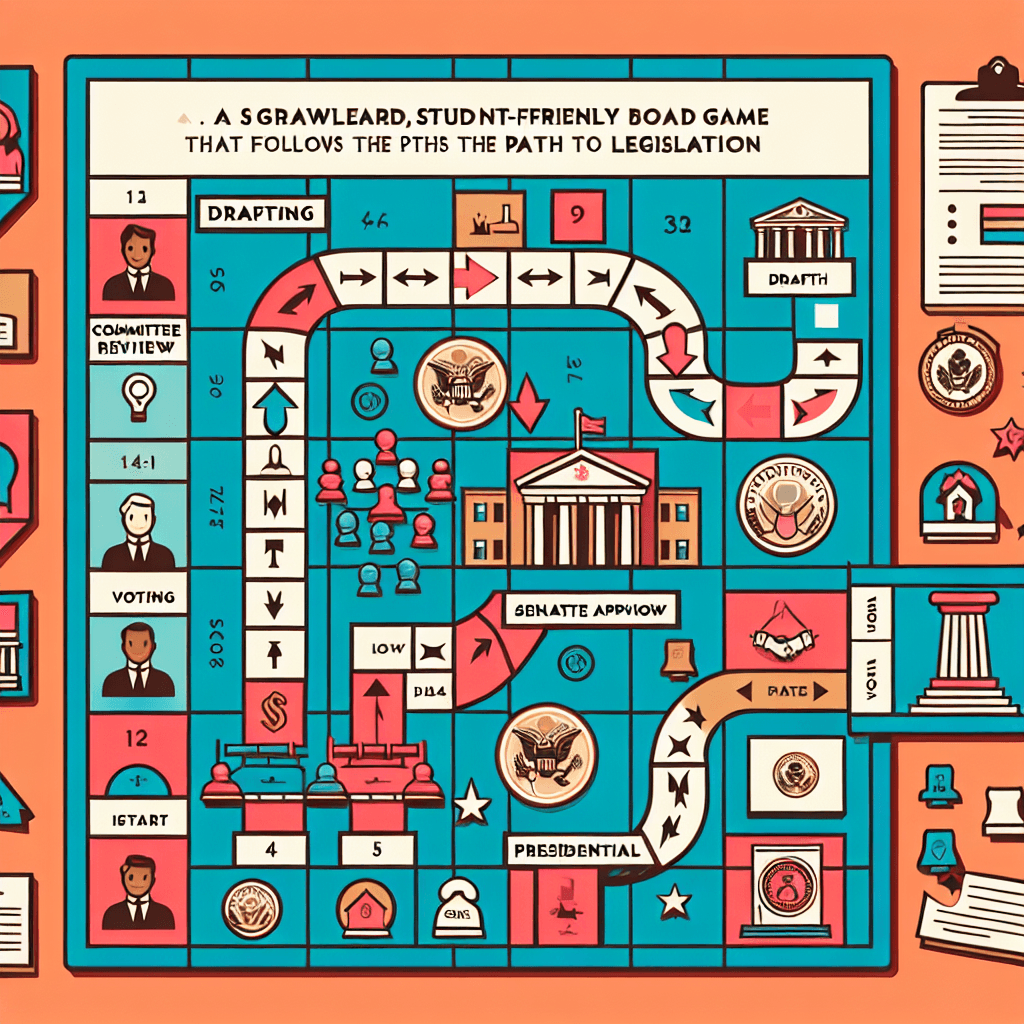
Path to Legislation: A Government Board Game
Inquiry Framework
Question Framework
Driving Question
The overarching question that guides the entire project.How can we design a board game that illustrates the process of how a bill becomes a law in the American government, while integrating the principles of democracy, the roles of different government branches, and encouraging civic engagement?Essential Questions
Supporting questions that break down major concepts.- What are the steps involved in a bill becoming a law in the United States government?
- How does the legislative process reflect the principles of democracy?
- What roles do different branches of government play in the process of making a bill into a law?
- How can understanding the legislative process help citizens engage with their government?
- Why is it important for a bill to go through multiple stages before becoming a law?
Standards & Learning Goals
Learning Goals
By the end of this project, students will be able to:- Understand the detailed process of how a bill becomes a law in the American government.
- Identify and describe the roles of the three branches of government in the legislative process.
- Explore the principles of democracy as reflected in the legislative process.
- Explain the importance of civic engagement and how understanding the legislative process can empower citizens.
- Design and create an educational board game that illustrates the legislative process and encourages learning and engagement.
Common Core Standards
C3 Framework for Social Studies State Standards
Entry Events
Events that will be used to introduce the project to studentsCongressional Shark Tank
Host a 'Shark Tank' style pitch event where students need to present their idea for a new bill. They must defend it to a panel of 'legislators' who question the bill’s feasibility and its journey through the legislative process, sparking curiosity and providing practical insights into bill refinement and negotiation.The Legislative Escape Room
Students enter a room set up like a congressional office, and find they have 30 minutes to 'pass a law' to escape. Various puzzles represent stages in the legislative process and require teamwork and critical thinking to solve, introducing the steps in passing a bill while engaging the competitive spirit.The Board Game Challenge
Reveal a mystery box containing a prototype of a board game with missing instructions that students must develop. Students can only move forward by learning about each step of the legislative process to fill in the gaps, tying in their interests in gaming with the project goal of understanding the legislative process.Portfolio Activities
Portfolio Activities
These activities progressively build towards your learning goals, with each submission contributing to the student's final portfolio.Bill Research Adventure
Students will delve into the complexities of how a bill becomes a law by researching each step of the legislative process. This foundational activity will provide students with the necessary background knowledge to construct their board game.Steps
Here is some basic scaffolding to help students complete the activity.Final Product
What students will submit as the final product of the activityA class-wide presentation summarizing each step of the legislative process.Alignment
How this activity aligns with the learning objectives & standardsAligns with CCSS.ELA-LITERACY.RH.6-8.2 by summarizing the legislative process from primary and secondary sources.Illustrative Legislative Maps
In this activity, students will visually represent their understanding of the legislative process through creating infographic maps that outline how a bill becomes a law, highlighting the interaction between governmental branches.Steps
Here is some basic scaffolding to help students complete the activity.Final Product
What students will submit as the final product of the activityA set of infographic maps that visually detail the legislative process.Alignment
How this activity aligns with the learning objectives & standardsAligns with CCSS.ELA-LITERACY.RH.6-8.7 by integrating visual information with the legislative process.Debate Democracy Dynamics
Students will engage in a structured debate to explore and understand the democratic principles and functions of political entities involved in turning a bill into a law.Steps
Here is some basic scaffolding to help students complete the activity.Final Product
What students will submit as the final product of the activityA classroom debate session and a follow-up reflection document.Alignment
How this activity aligns with the learning objectives & standardsAligns with D2.Civ.6.6-8 by debating the roles of governmental branches and understanding their political functions.Civic Engagement Exploration
This activity allows students to connect the legislative process with civic engagement, examining how understanding laws can empower citizens and their role in the democratic process.Steps
Here is some basic scaffolding to help students complete the activity.Final Product
What students will submit as the final product of the activityA multimedia presentation illustrating the impact of civic engagement on legislation.Alignment
How this activity aligns with the learning objectives & standardsAligns with D2.Civ.3.3-5 by explaining the function of laws and the role of civic engagement.Legislative Board Game Design
Students will work in teams to design a board game that effectively teaches players the process of how a bill becomes a law, incorporating the principles learned in previous activities.Steps
Here is some basic scaffolding to help students complete the activity.Final Product
What students will submit as the final product of the activityA functional board game prototype that educates players about the legislative process.Alignment
How this activity aligns with the learning objectives & standardsAligns with CCSS.ELA-LITERACY.RH.6-8.7 by integrating visual and textual information in a board game format, and with D2.Civ.3.3-5 by showcasing the functions of laws through gameplay.Rubric & Reflection
Portfolio Rubric
Grading criteria for assessing the overall project portfolioLegislative Process Board Game Rubric
Research and Understanding
Evaluates the depth of understanding and accuracy in summarizing the legislative process and the role of government branches.Comprehension of Legislative Process
Assesses the students' ability to accurately and thoroughly understand and describe how a bill becomes a law.
Exemplary
4 PointsDemonstrates a comprehensive and sophisticated understanding of the legislative process, which is accurately reflected in the board game.
Proficient
3 PointsShows a thorough understanding of the legislative process, with minor inaccuracies in the board game representation.
Developing
2 PointsShows a basic understanding of the legislative process with several inaccuracies or gaps in the board game representation.
Beginning
1 PointsDemonstrates minimal understanding, with significant inaccuracies in depicting the legislative process in the board game.
Integration of Government Branches
Assesses the understanding and effective integration of the roles of various government branches in the legislative process.
Exemplary
4 PointsEffectively integrates and clearly explains the roles and interactions of all three government branches in the legislative process through gameplay.
Proficient
3 PointsClearly integrates the roles of government branches in the legislation, with minor omissions or simplifications.
Developing
2 PointsShows an emerging understanding of government branches, with multiple inaccuracies or oversimplifications.
Beginning
1 PointsDisplays minimal understanding of the roles of government branches in the legislative process, with numerous inaccuracies.
Creative Design and Gameplay
Evaluates the creativity, engagement, and educational value of the board game design.Game Mechanics and Rules
Assesses the clarity, accuracy, and creativity of game mechanics in representing the legislative process.
Exemplary
4 PointsDevelops innovative game mechanics that are creatively crafted and closely aligned with the legislative process, enhancing both educational and entertainment value.
Proficient
3 PointsDesigns clear and accurate game mechanics that effectively represent the legislative process, with minor improvements needed for increased engagement.
Developing
2 PointsGame mechanics attempt to represent the process but contain inaccuracies or lack clarity, reducing educational value.
Beginning
1 PointsGame mechanics are unclear, inaccurate, and do not effectively represent the legislative process, hindering educational purpose.
Civic Understanding and Engagement
Assesses students' ability to connect the legislative process to concepts of democracy and civic participation.Connection to Democratic Principles
Measures how well the board game illustrates and emphasizes democratic principles and civic involvement.
Exemplary
4 PointsInsightfully connects the legislative process to democratic principles, highlighting civic engagement opportunities throughout the game.
Proficient
3 PointsEffectively links democratic principles to the legislative process, though opportunities for civic engagement could be enhanced.
Developing
2 PointsIdentifies some democratic principles related to legislation, but with missed opportunities for deeper connections to civic engagement.
Beginning
1 PointsMinimal connection between the legislative process and democratic principles, lacking clear opportunities for civic engagement.
Collaboration and Presentation
Evaluates teamwork and the effectiveness of the final game presentation to the class.Team Collaboration
Assesses the ability of students to work together effectively and show leadership in group tasks.
Exemplary
4 PointsExhibits outstanding teamwork and leadership skills, with all group members contributing significantly.
Proficient
3 PointsDemonstrates effective collaboration with equitable contributions from most group members.
Developing
2 PointsShows inconsistent collaboration, with some group members contributing more significantly than others.
Beginning
1 PointsMinimal collaboration noted, with limited contribution from several team members requiring facilitator intervention.
Presentation and Communication
Assesses the clarity, organization, and delivery of the board game presentation.
Exemplary
4 PointsDelivers a compelling, well-organized, and clearly articulated presentation that engages the audience effectively.
Proficient
3 PointsDelivers a clear and organized presentation with minor lapses in engagement or clarity.
Developing
2 PointsPresents information with occasional lack of clarity or structure, reducing audience engagement.
Beginning
1 PointsPresentation lacks clarity and organization, failing to effectively communicate the board game’s educational purpose.