
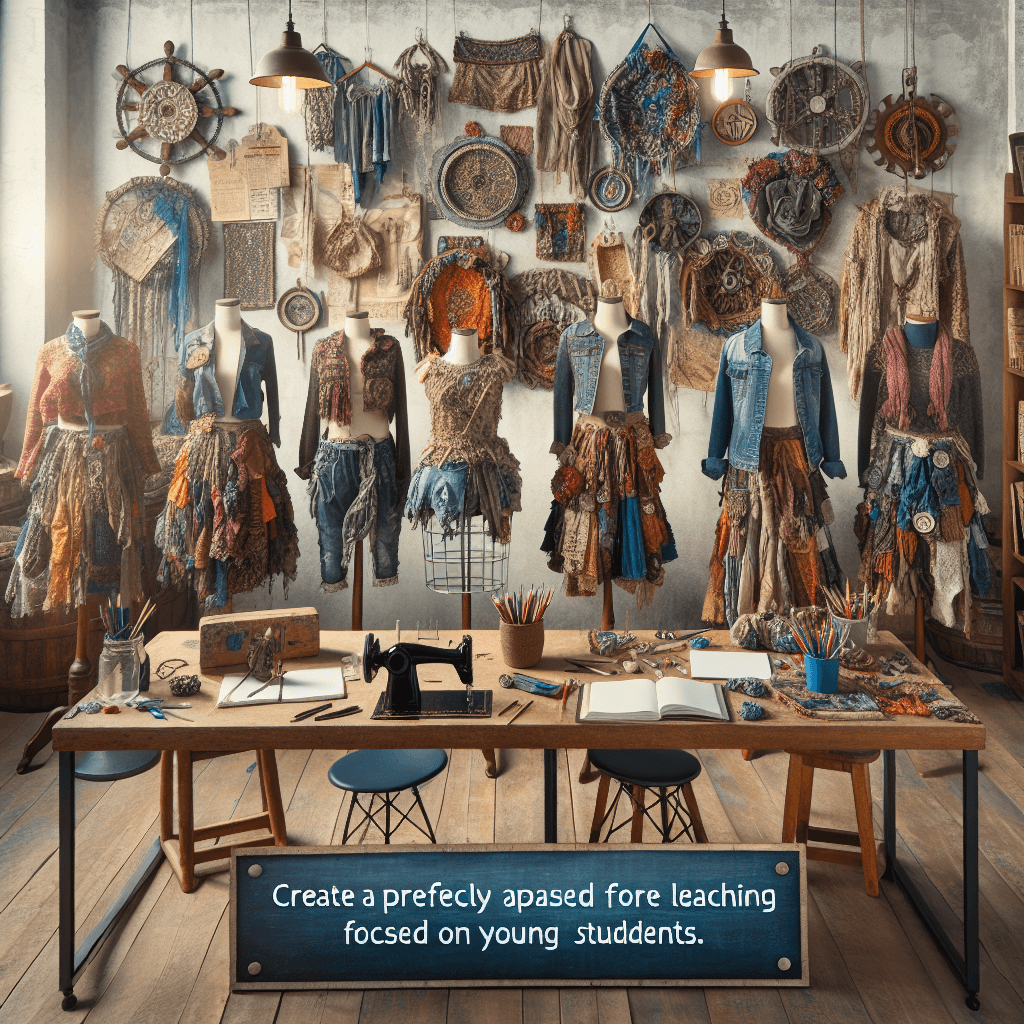
Patterned Past: A Recycled History Runway
Inquiry Framework
Question Framework
Driving Question
The overarching question that guides the entire project.How can we, as historical fashion designers, create a 'Recycled Runway' to tell the stories of people from the past using math patterns and recycled materials?Essential Questions
Supporting questions that break down major concepts.- How can we use patterns and recycled materials to tell the story of a person from history?
- Who are the people from the past, and what can their stories teach us?
- How can we use math to create repeating patterns for our clothing designs?
- How can we turn recycled materials into a 'new' historical outfit?
- What are the most important parts of a person's life story, and how do we share them?
Standards & Learning Goals
Learning Goals
By the end of this project, students will be able to:- Identify and describe significant people, places, and events from a specific person's life in history.
- Create, extend, and explain repeating mathematical patterns (e.g., AB, ABC, AAB) and incorporate them into a visual design.
- Engineer and construct a wearable historical outfit using various recycled materials to demonstrate sustainability and creative problem-solving.
- Orally present a narrative that connects specific design choices (patterns and materials) to the life story and historical context of a chosen individual.
- Collaborate with peers to organize a 'Recycled Runway' showcase, demonstrating an understanding of how fashion reflects history.
State Social Studies Standards
Common Core State Standards (ELA)
Common Core State Standards (Math)
National Core Arts Standards
Entry Events
Events that will be used to introduce the project to studentsThe Mystery Suitcase from the Attic
A mysterious, 'dusty' suitcase arrives in the classroom, supposedly found in a local attic. Inside, students find no clothes, only 'trash' like bubble wrap, old newspapers, and bottle caps, alongside a rhythmic letter from a great-great-grandparent explaining that these items are actually memories waiting for a pattern to hold them together.Portfolio Activities
Portfolio Activities
These activities progressively build towards your learning goals, with each submission contributing to the student's final portfolio.Once Upon a Patterned Past: Storyboarding Life
Every great outfit tells a story! In this activity, students will map out the 'plot' of their historical person's life. Using a simple 3-part storyboard, they will sequence the person's life events using temporal words like 'First,' 'Then,' and 'Last.' This helps students understand the chronological nature of history while practicing their narrative writing skills.Steps
Here is some basic scaffolding to help students complete the activity.Final Product
What students will submit as the final product of the activityA 3-Panel Life Storyboard that sequences the person's life events with simple sentences and illustrations.Alignment
How this activity aligns with the learning objectives & standardsAligns with CCSS.ELA-LITERACY.W.1.3 (Write narratives in which they recount two or more appropriately sequenced events, include some details, use temporal words, and provide closure).The Eco-Fashion Studio: From Trash to Treasure
It's time to build! Students will use the 'trash' from the mystery suitcase and other recyclables to construct their wearable historical outfit. They will focus on using materials that reflect the time period or personality of their historical figure. For example, a person who lived near the ocean might have 'scales' made of bottle caps. They must incorporate the math patterns from Activity 3 into the physical construction.Steps
Here is some basic scaffolding to help students complete the activity.Final Product
What students will submit as the final product of the activityA wearable historical outfit made entirely from recycled materials, featuring at least one clear repeating math pattern.Alignment
How this activity aligns with the learning objectives & standardsAligns with VA:Cr2.1.1a (Explore uses of materials and tools to create works of art or design).The Grand Recycled Runway: Sharing Our Stories
The project culminates in the 'Recycled Runway.' Students will walk the runway in their outfits and then present a short 'Designer Talk.' They will explain who their person was, what their life story was, and how their math patterns and material choices help tell that story. This activity builds confidence in public speaking and requires students to synthesize all their learning.Steps
Here is some basic scaffolding to help students complete the activity.Final Product
What students will submit as the final product of the activityA 'Designer Talk' presentation delivered during the Recycled Runway event.Alignment
How this activity aligns with the learning objectives & standardsAligns with CCSS.ELA-LITERACY.SL.1.4 (Describe people, places, things, and events with relevant details, expressing ideas and feelings clearly).History Detective: Seeking Stories of the Past
In this introductory activity, students become 'History Detectives' to select a person from the past they want to represent. They will explore various historical figures (e.g., through picture books, short videos, or photos) and identify the 'Who, Where, and What' of their person's life. The goal is to establish the foundation that history is made of real stories about real people.Steps
Here is some basic scaffolding to help students complete the activity.Final Product
What students will submit as the final product of the activityA 'History Detective Profile' featuring a drawing of the historical figure and three key facts about their life (Who they were, Where they lived, and One thing they did).Alignment
How this activity aligns with the learning objectives & standardsAligns with SS.1.H.1 (Understand that history involves stories of the past, including telling about people, places, and events).Rubric & Reflection
Portfolio Rubric
Grading criteria for assessing the overall project portfolioPatterned Past: Recycled Runway Portfolio Rubric
Historical Inquiry & Storytelling
Evaluates the student's ability to research, understand, and organize information about people from the past.Historical Literacy (SS.1.H.1)
Ability to identify a historical figure and accurately describe the 'Who, Where, and What' of their life story.
Exemplary
4 PointsIndependently identifies a historical figure and provides more than three rich, accurate details about their life, location, and contributions. Demonstrates a deep connection between the person's actions and history.
Proficient
3 PointsIdentifies a historical figure and accurately provides three key facts: who they were, where they lived, and a major event or action they are known for.
Developing
2 PointsIdentifies a historical figure but provides fewer than three facts, or facts are partially inaccurate/missing a major component (like location or action).
Beginning
1 PointsStruggles to identify a specific historical figure or provides facts that are unrelated to the historical context without significant teacher support.
Narrative Sequencing (CCSS.ELA-LITERACY.W.1.3)
Organization of the historical person's life events into a logical chronological sequence using temporal words.
Exemplary
4 PointsSequences events with exceptional clarity using varied temporal words (First, Next, Then, Finally). Illustrations and sentences provide specific details that enhance the story.
Proficient
3 PointsSequences three events in the correct chronological order using 'First, Next, Last.' Each section includes a matching illustration and descriptive sentence.
Developing
2 PointsSequences events but may miss one step in the timeline or omit temporal words. Illustrations may not clearly align with the written sentences.
Beginning
1 PointsEvents are out of order or incomplete. Storyboard lacks a clear beginning, middle, and end, or lacks descriptive sentences.
Artistic & Mathematical Integration
Assessment of the student's ability to integrate math and art through construction and pattern design.Mathematical Patterning (CCSS.MATH.CONTENT.1.G.A.1)
Accurate creation and application of repeating mathematical patterns (e.g., AB, ABC, AAB) within the outfit design.
Exemplary
4 PointsCreates complex repeating patterns (e.g., AABB or ABBC) using recycled shapes. Can explain the 'rule' of the pattern and why it was chosen for the design.
Proficient
3 PointsSuccessfully creates and extends at least one clear repeating pattern (e.g., AB or ABC) throughout the historical outfit using geometric shapes or materials.
Developing
2 PointsAttempts a pattern but it is inconsistent or breaks the 'rule' of repetition. May require assistance to identify the pattern type.
Beginning
1 PointsMaterials are placed randomly without a visible mathematical pattern. Does not demonstrate an understanding of repeating sequences.
Creative Engineering & Design (VA:Cr2.1.1a)
The innovative use of recycled materials to engineer a wearable 3D garment that reflects historical themes.
Exemplary
4 PointsDemonstrates superior craftsmanship and innovation. Materials are used in unexpected ways to mimic historical textures, and the outfit is sturdy and fully wearable.
Proficient
3 PointsUses recycled materials effectively to create a wearable outfit. The choice of materials clearly connects to the historical person's story or time period.
Developing
2 PointsConstructs a garment that is partially wearable or uses materials in a basic way. Connection to the historical figure is present but weak.
Beginning
1 PointsThe garment is not wearable or falls apart easily. Minimal use of recycled materials or no connection to the person's story.
Communication & Synthesis
Evaluation of the student's ability to present their learning and synthesize their work for a public audience.Oral Communication (CCSS.ELA-LITERACY.SL.1.4)
Effectiveness of the 'Designer Talk' in communicating the historical narrative and design choices to an audience.
Exemplary
4 PointsDelivers a confident, expressive presentation. Seamlessly connects the math patterns and material choices to the historical person's life story with relevant details.
Proficient
3 PointsDescribes the historical person and the outfit clearly. Explains at least one reason for a design choice and speaks with enough volume to be heard.
Developing
2 PointsProvides a basic introduction but struggles to connect the outfit's design to the person's history. May rely heavily on notes or teacher prompting.
Beginning
1 PointsSpeech is brief, quiet, or unrelated to the project. Cannot explain the connection between the person and the outfit.