
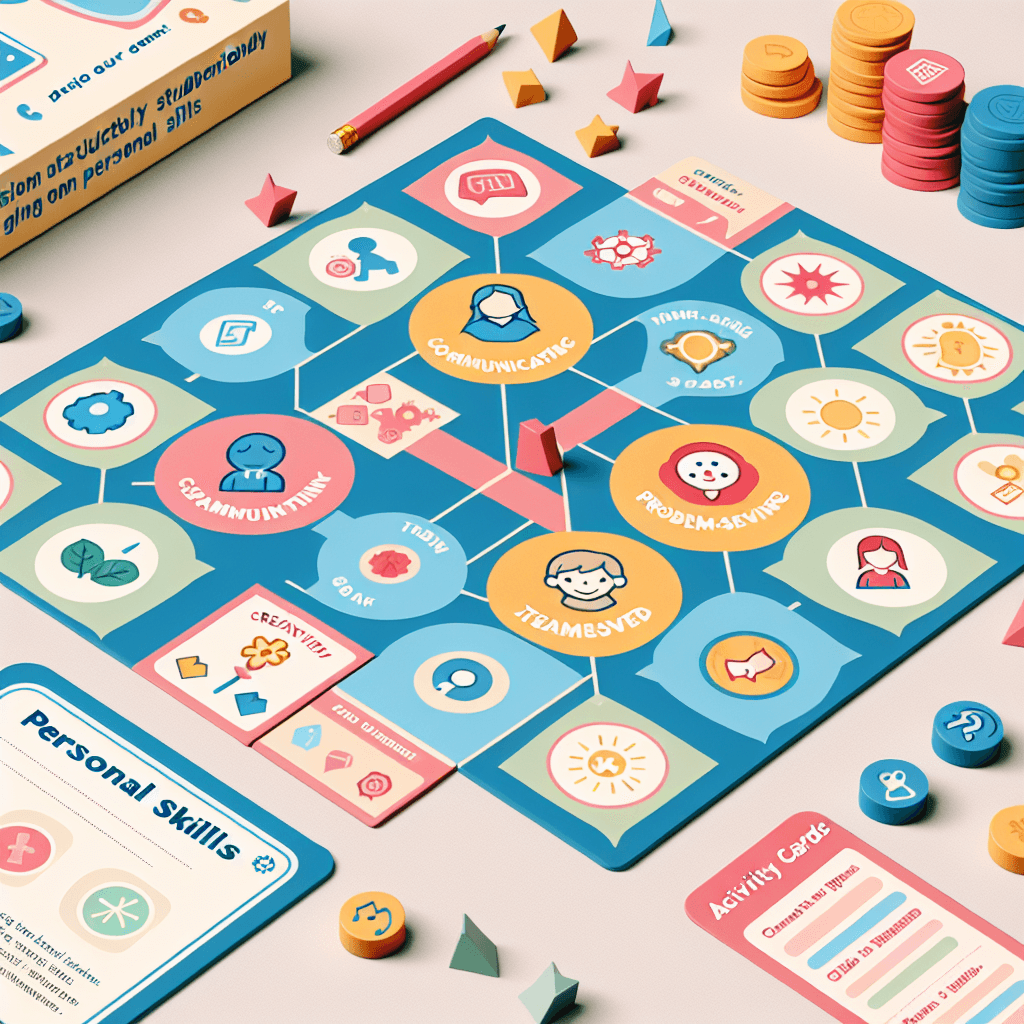
Personal Skills Game: A Board Game About I Can
Inquiry Framework
Question Framework
Driving Question
The overarching question that guides the entire project.How can we design a fun and fair board game that teaches important personal, social, and emotional skills while using math to balance the gameplay and helping players understand the power of "I can" and "I have to" statements?Essential Questions
Supporting questions that break down major concepts.- How can game design teach us about personal skills?
- How do 'I can' and 'I have to' statements reflect personal skills in a game?
- How can we use math to design a balanced and fair game?
- How does our game help players understand and practice social and emotional skills?
Standards & Learning Goals
Learning Goals
By the end of this project, students will be able to:- Understand and apply personal skills vocabulary.
- Construct sentences using 'I can' and 'I have to' structures.
- Use 'can,' 'cannot,' and 'has/have to' correctly in writing and speaking.
- Design a board game that teaches personal, social, and emotional skills.
- Apply mathematical concepts to balance game mechanics.
- Develop social and emotional learning skills through game design and play.
- Create a presentation, poster, or writing piece to explain the game and its mechanics.
- Evaluate the fairness and fun of the game through playtesting and feedback.
- Collaborate with peers to design and refine the game.
- Reflect on the design process and the personal skills learned through the project
Entry Events
Events that will be used to introduce the project to studentsThe Visiting Game Designer
A famous game designer visits the class to share their journey and challenges in creating successful games. They present incomplete game designs and ask students for initial ideas, sparking interest in game development and the personal skills needed to collaborate and problem-solve effectively. This event encourages students to think about what makes a game engaging and how personal skills play a role in that.Portfolio Activities
Portfolio Activities
These activities progressively build towards your learning goals, with each submission contributing to the student's final portfolio.Personal Skills Flashcard Fun
Students create flashcards illustrating personal skills. Each flashcard will have the skill's name, a drawing representing it, and a simple sentence using 'I can' or 'I have to'.Steps
Here is some basic scaffolding to help students complete the activity.Final Product
What students will submit as the final product of the activityA set of illustrated flashcards with personal skills, names, and sentences.Alignment
How this activity aligns with the learning objectives & standardsFocuses on introducing personal skills vocabulary and creating simple sentences.Game Scenario & Presentation Script
Students design 3-5 game scenarios that require players to use personal skills. They then write a script that explains a presentation of their game, the game scenarios, and how it promotes the use of personal skills while teaching the other students about the rules for their game.Steps
Here is some basic scaffolding to help students complete the activity.Final Product
What students will submit as the final product of the activityA presentation script that details game scenarios, how the game teaches personal skills, and its rulesAlignment
How this activity aligns with the learning objectives & standardsIntegrates math concepts to balance game mechanics and apply personal skills in real game situations. Writing a presentation script about the gameRubric & Reflection
Portfolio Rubric
Grading criteria for assessing the overall project portfolioPersonal Skills Game Design Rubric
Flashcard Creation
Assesses the creation of flashcards, focusing on vocabulary, sentence structure, and illustrations.Vocabulary Application
Accuracy and relevance of personal skills vocabulary used in the flashcards.
Beginning
1 PointsUses personal skills vocabulary incorrectly or irrelevantly; sentences are unclear or do not relate to the skill.
Developing
2 PointsUses basic personal skills vocabulary; sentences are somewhat relevant but lack detail or clarity.
Proficient
3 PointsUses appropriate personal skills vocabulary effectively; sentences are clear, relevant, and demonstrate understanding.
Exemplary
4 PointsUses a wide range of personal skills vocabulary accurately and creatively; sentences are insightful, well-crafted, and clearly demonstrate a deep understanding of each skill.
Sentence Structure
Correctness and variety in using 'I can' and 'I have to' sentence structures.
Beginning
1 PointsIncorrect or absent use of 'I can' and 'I have to' structures; sentences are grammatically incorrect or incomplete.
Developing
2 PointsUses 'I can' and 'I have to' structures with frequent errors; sentences are simple and lack variety.
Proficient
3 PointsUses 'I can' and 'I have to' structures correctly in most sentences; demonstrates a basic understanding of their usage.
Exemplary
4 PointsUses 'I can' and 'I have to' structures accurately and creatively in diverse sentences; demonstrates a thorough understanding of their nuanced meanings and applications.
Visual Representation
Quality and relevance of illustrations representing each personal skill.
Beginning
1 PointsIllustrations are missing, unclear, or do not relate to the personal skill.
Developing
2 PointsIllustrations are basic and loosely connected to the personal skill; lack detail or effort.
Proficient
3 PointsIllustrations clearly represent the personal skill; demonstrate effort and understanding.
Exemplary
4 PointsIllustrations are creative, detailed, and thoughtfully represent the personal skill; enhance understanding and engagement.
Game Design & Presentation
Assesses the design of game scenarios and the quality of the presentation script, with an emphasis on integrating math concepts.Scenario Design
Relevance and creativity of game scenarios designed to promote personal skills.
Beginning
1 PointsGame scenarios are irrelevant, illogical, or do not promote personal skills.
Developing
2 PointsGame scenarios are somewhat relevant but lack creativity and clear connections to personal skills.
Proficient
3 PointsGame scenarios are relevant, logical, and promote the use of personal skills effectively.
Exemplary
4 PointsGame scenarios are highly creative, engaging, and thoughtfully designed to promote deep understanding and application of personal skills.
Presentation Script Quality
Clarity, accuracy, and completeness of the game presentation script.
Beginning
1 PointsThe presentation script is unclear, incomplete, and lacks essential information about the game, scenarios, and rules.
Developing
2 PointsThe presentation script is somewhat clear but contains inaccuracies or omissions; difficult to understand the game mechanics.
Proficient
3 PointsThe presentation script is clear, accurate, and complete, providing a good understanding of the game, scenarios, and rules.
Exemplary
4 PointsThe presentation script is exceptionally clear, engaging, and detailed, offering a comprehensive and insightful understanding of the game, its mechanics, and its impact on promoting personal skills.
Mathematical Integration
Integration of math concepts for balancing game mechanics and point systems.
Beginning
1 PointsNo attempt to integrate math concepts or balance game mechanics.
Developing
2 PointsAttempts to integrate math concepts are weak, inaccurate, or do not effectively balance the game.
Proficient
3 PointsMath concepts are appropriately integrated to create a balanced and fair game.
Exemplary
4 PointsMath concepts are creatively and effectively integrated to enhance game balance and fairness; demonstrates a sophisticated understanding of mathematical principles.