
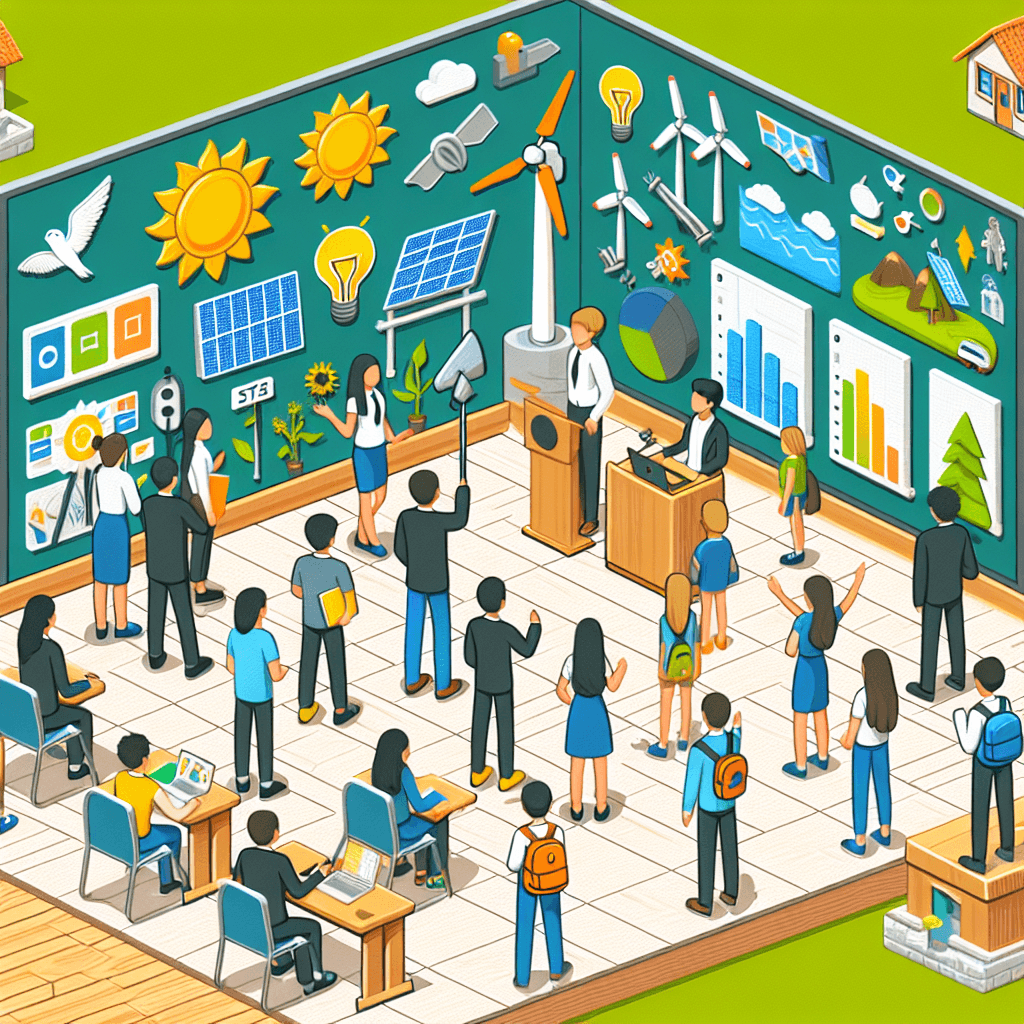
Persuasive Renewable Energy Presentation
Inquiry Framework
Question Framework
Driving Question
The overarching question that guides the entire project.How can we effectively persuade others to adopt renewable energy by understanding its forms, benefits, drawbacks, and the factors that influence its use?Essential Questions
Supporting questions that break down major concepts.- What are the main forms of renewable energy and how do they work?
- How does renewable energy compare to non-renewable energy in terms of environmental impact and sustainability?
- What are the benefits and potential drawbacks of using renewable energy?
- How do social and economic factors influence the adoption of renewable energy?
- What role does technology play in the advancement and efficiency of renewable energy resources?
- How can renewable energy solutions be tailored to fit different geographical locations and needs?
Standards & Learning Goals
Learning Goals
By the end of this project, students will be able to:- Students will understand the main forms of renewable energy, how they work, and their potential environmental impacts.
- Students will evaluate and communicate the benefits and drawbacks of various renewable energy sources in a persuasive format.
- Students will analyze how social, economic, and geographical factors influence the adoption of renewable energy solutions.
- Students will develop arguments to support the use of renewable energy, backed by valid reasoning and evidence.
Next Generation Science Standards
Common Core State Standards
Entry Events
Events that will be used to introduce the project to studentsEnvironmental Avatar Adventure
Launch the project with a simulation game where students assume the roles of renewable energy consultants tasked with saving a virtual community from an energy crisis. Employing storytelling and strategic decision-making, this immersive experience connects learners with real-life energy challenges and solutions.Portfolio Activities
Portfolio Activities
These activities progressively build towards your learning goals, with each submission contributing to the student's final portfolio.Renewable Energy Detective
Students explore various renewable energy resources, learning about their mechanisms and environmental impacts. This will set the foundation for understanding the basic concepts of renewable energy.Steps
Here is some basic scaffolding to help students complete the activity.Final Product
What students will submit as the final product of the activityA detailed graphic organizer summarizing the basic mechanisms and impacts of various renewable energy resources.Alignment
How this activity aligns with the learning objectives & standardsAligns with HS-ESS3-1, supporting understanding of factors influencing renewable energy adoption.Pros and Cons Analyzer
Students perform an analysis of the benefits and drawbacks of each type of renewable energy, critically examining social and economic factors.Steps
Here is some basic scaffolding to help students complete the activity.Final Product
What students will submit as the final product of the activityA comparison chart that lists the benefits and drawbacks of each renewable energy type.Alignment
How this activity aligns with the learning objectives & standardsAligns with HS-ESS3-4 by examining technological solutions and CCSS.ELA-LITERACY.W.9-10.1 through constructing arguments with evidence.Cultural Impact Evaluator
Students assess how various social, cultural, and economic factors can influence the adoption of different renewable energy sources.Steps
Here is some basic scaffolding to help students complete the activity.Final Product
What students will submit as the final product of the activityA brief report on the influence of social, cultural, and economic factors on renewable energy adoption.Alignment
How this activity aligns with the learning objectives & standardsAligns with HS-ETS1-3 by evaluating socio-economic impacts and CCSS.ELA-LITERACY.W.9-10.1 by supporting claims with research.Persuasive Presentation Planner
Students create a persuasive presentation plan that organizes their research clearly and logically to convince others of the benefits of a chosen renewable energy resource.Steps
Here is some basic scaffolding to help students complete the activity.Final Product
What students will submit as the final product of the activityAn organized outline and plan for a persuasive presentation promoting renewable energy adoption.Alignment
How this activity aligns with the learning objectives & standardsAligns with CCSS.ELA-LITERACY.SL.9-10.4 by organizing information clearly for persuasive purposes.Visual Appeal Designer
Students create the final visual presentation of their research in the form of slideshows, poster boards, or another creative medium, highlighting the persuasive elements.Steps
Here is some basic scaffolding to help students complete the activity.Final Product
What students will submit as the final product of the activityA visually appealing and informative presentation that effectively persuades an audience to adopt a renewable energy resource.Alignment
How this activity aligns with the learning objectives & standardsAligns with CCSS.ELA-LITERACY.W.9-10.1 in structuring arguments and CCSS.ELA-LITERACY.SL.9-10.4 in clear and logical presentation of information.Rubric & Reflection
Portfolio Rubric
Grading criteria for assessing the overall project portfolioRenewable Energy Persuasion Presentation Rubric
Research and Content Understanding
Assesses the depth of research and understanding of renewable energy types and their impacts.Breadth of Research
Extent to which research covers diverse renewable energy sources and their basic mechanisms.
Exemplary
4 PointsResearch covers all major renewable energy types in depth with a focus on mechanisms and impacts.
Proficient
3 PointsResearch covers most major renewable energy types sufficiently, reflecting solid understanding.
Developing
2 PointsResearch covers some renewable energy types, with partial understanding of mechanisms.
Beginning
1 PointsResearch is minimal, showing limited understanding of renewable energy.
Content Accuracy
Accuracy of information related to renewable energy mechanisms and impacts.
Exemplary
4 PointsInformation is consistently accurate and reflects high-level understanding of renewable energy.
Proficient
3 PointsInformation is mostly accurate, demonstrating a good understanding of topics.
Developing
2 PointsInformation has several inaccuracies; understanding of topics is basic.
Beginning
1 PointsInformation is often inaccurate; reflects misunderstanding of topics.
Critical Analysis and Argumentation
Evaluates the student's ability to critically evaluate benefits and drawbacks and develop arguments.Analysis of Pros and Cons
Depth of analysis regarding the benefits and drawbacks of renewable energy types.
Exemplary
4 PointsThoroughly analyzes benefits and drawbacks, with insightful evaluation of evidence.
Proficient
3 PointsAnalyzes benefits and drawbacks well, drawing on sufficient evidence.
Developing
2 PointsProvides basic analysis but lacks depth in evaluating evidence.
Beginning
1 PointsInadequate analysis, with vague or unsupported claims.
Argument Construction
Quality and coherence of the argument made in support of the chosen renewable energy.
Exemplary
4 PointsCrafts a compelling, coherent argument with strong supporting evidence.
Proficient
3 PointsConstructs a clear argument with good supporting evidence.
Developing
2 PointsPresents a basic argument; evidence may not fully support the claims.
Beginning
1 PointsArgument is unclear, lacks coherence and supporting evidence.
Presentation Development and Organization
Assesses the clarity, organization, and appeal of the presentation format.Organizational Clarity
Clarity and logical flow of information in the presentation outline.
Exemplary
4 PointsInformation is well-organized, clear, and logically sequenced with smooth transitions.
Proficient
3 PointsOrganization is clear and logical with minor errors in flow.
Developing
2 PointsOrganization is present but may be unclear or lack logical sequence.
Beginning
1 PointsInformation is poorly organized, making the presentation difficult to follow.
Visual Appeal
Effectiveness of visual elements in enhancing the presentation's persuasiveness.
Exemplary
4 PointsVisuals are highly engaging, enhancing understanding and persuasion.
Proficient
3 PointsVisuals effectively support understanding and persuasion.
Developing
2 PointsVisuals are present but minimally enhance the presentation.
Beginning
1 PointsVisuals are lacking or ineffective in supporting the presentation.