
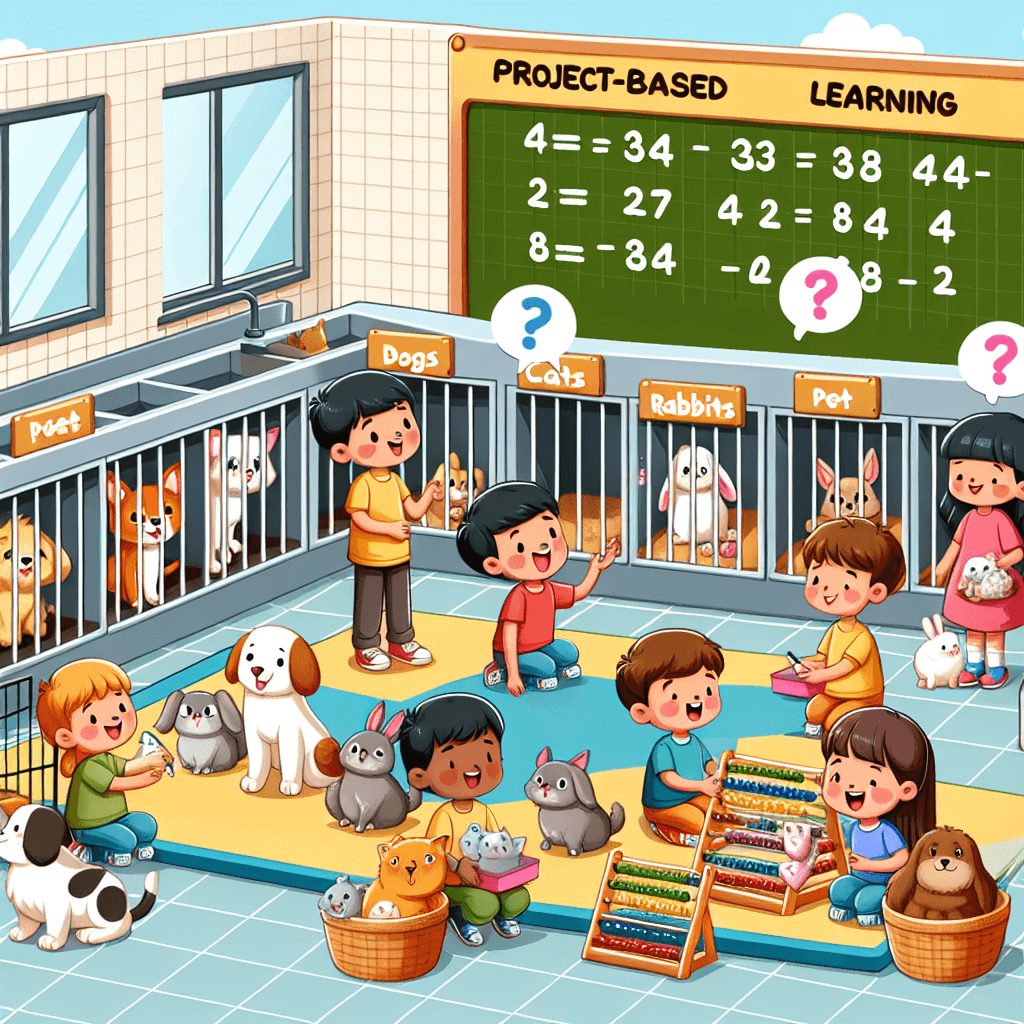
Pet Shelter Multiplication Mission
Inquiry Framework
Question Framework
Driving Question
The overarching question that guides the entire project.How can we, as mathematicians, use our understanding of multiplication and place value to determine the needs of a local animal shelter and effectively communicate those needs to the community?Essential Questions
Supporting questions that break down major concepts.- How can we use multiplication to determine the amount of food needed for all the animals in the shelter?
- How does understanding place value help us multiply large numbers efficiently?
- In what ways can we organize and present our calculations to effectively communicate the shelter's needs?
- How can we use multiplication to calculate the cost of supplies for the animal shelter?
Standards & Learning Goals
Learning Goals
By the end of this project, students will be able to:- Students will be able to fluently multiply multi-digit whole numbers using partial products.
- Students will be able to apply multiplication skills to solve real-world problems related to animal shelter needs.
- Students will be able to effectively communicate the needs of the animal shelter using mathematical calculations.
- Students will understand and apply place value concepts to multiply large numbers.
Common Core Standards
Entry Events
Events that will be used to introduce the project to studentsPet Shelter SOS: Urgent Appeal
A local animal shelter sends an 'urgent appeal' video showcasing overcrowded conditions and dwindling supplies. Students must analyze the video to identify the problem and brainstorm initial solutions to help the shelter care for its animals.Portfolio Activities
Portfolio Activities
These activities progressively build towards your learning goals, with each submission contributing to the student's final portfolio.Estimating the Animal Population
Students will begin by estimating the number of animals in the shelter. This activity sets the stage for subsequent calculations by providing a reasonable range for the number of animals.Steps
Here is some basic scaffolding to help students complete the activity.Final Product
What students will submit as the final product of the activityA class-generated list of estimated animal populations (dogs, cats, other) with a rationale for each estimate.Alignment
How this activity aligns with the learning objectives & standardsLays the groundwork for applying multiplication skills to solve real-world problems related to animal shelter needs.Daily Food Consumption Calculation
In this activity, students calculate the daily food consumption for different types of animals based on provided data. They will use multiplication to find the total amount of food needed.Steps
Here is some basic scaffolding to help students complete the activity.Final Product
What students will submit as the final product of the activityA detailed calculation of the total daily food consumption for each type of animal and the shelter as a whole, using multiplication with multi-digit whole numbers.Alignment
How this activity aligns with the learning objectives & standardsCovers M.5.NBT.B.5 (Fluently multiply multi-digit whole numbers using partial products) and applies multiplication skills to solve real-world problems.Weekly and Monthly Supply Needs
Building on the daily consumption calculations, students will extend their calculations to determine weekly and monthly supply needs, reinforcing their multiplication skills and understanding of time periods.Steps
Here is some basic scaffolding to help students complete the activity.Final Product
What students will submit as the final product of the activityA comprehensive table detailing the weekly and monthly food consumption and costs for the animal shelter.Alignment
How this activity aligns with the learning objectives & standardsReinforces M.5.NBT.B.5 and enhances the application of multiplication in real-world scenarios, focusing on efficiency and organization.Creating a Supply Donation List
Students will create a donation list for the animal shelter, specifying the quantities of each item needed for a month, based on their calculations. This activity encourages practical application and communication of mathematical findings.Steps
Here is some basic scaffolding to help students complete the activity.Final Product
What students will submit as the final product of the activityA donation list with prioritized items and quantities, along with a rationale for each item's importance.Alignment
How this activity aligns with the learning objectives & standardsCombines mathematical skills with practical communication, meeting the learning goal of effectively communicating the needs of the animal shelter using mathematical calculations.Rubric & Reflection
Portfolio Rubric
Grading criteria for assessing the overall project portfolioPet Shelter Multiplication Project Rubric
Accuracy of Calculations
Assesses the correctness of multiplication calculations performed in determining food and supply needs.Daily Food Consumption
Accuracy in calculating the total daily food consumption for each type of animal.
Exemplary
4 PointsCalculations are completely accurate, demonstrating a sophisticated understanding of multiplication and its application to the context.
Proficient
3 PointsCalculations are mostly accurate with only minor errors that do not significantly impact the overall result. Shows a thorough understanding.
Developing
2 PointsCalculations contain some errors, but the student demonstrates a basic understanding of multiplication. Errors may affect the overall result.
Beginning
1 PointsCalculations contain significant errors, indicating a limited understanding of multiplication. The result is largely inaccurate.
Weekly and Monthly Needs
Accuracy in calculating weekly and monthly food consumption and costs.
Exemplary
4 PointsWeekly and monthly calculations are precise and demonstrate an innovative application of multiplication and understanding of time periods.
Proficient
3 PointsWeekly and monthly calculations are accurate with minimal errors. Shows effective application of multiplication.
Developing
2 PointsCalculations show emerging understanding but contain errors that affect the accuracy of weekly and monthly totals.
Beginning
1 PointsCalculations contain significant errors, leading to inaccurate weekly and monthly totals. Shows limited understanding.
Problem-Solving and Application
Assesses the ability to apply multiplication skills to solve real-world problems related to animal shelter needs.Application to Shelter Needs
Effectiveness in using multiplication to determine the quantity of food and supplies needed by the shelter.
Exemplary
4 PointsDemonstrates sophisticated problem-solving skills by innovatively applying multiplication to determine shelter needs and anticipates potential challenges.
Proficient
3 PointsEffectively applies multiplication to accurately determine the quantity of food and supplies needed.
Developing
2 PointsShows emerging ability to apply multiplication but struggles with accurately determining the required quantities.
Beginning
1 PointsStruggles to apply multiplication to determine shelter needs. The quantities calculated are unrealistic or inappropriate.
Reasoning and Justification
Providing clear and logical reasoning for the estimates and calculations made.
Exemplary
4 PointsProvides comprehensive and insightful justification for all estimates and calculations, demonstrating exceptional critical thinking.
Proficient
3 PointsProvides clear and logical reasoning for estimates and calculations, supporting choices with evidence.
Developing
2 PointsProvides some reasoning for estimates and calculations, but explanations may be unclear or lack sufficient support.
Beginning
1 PointsProvides minimal or no reasoning for estimates and calculations. Explanations are unclear or missing.
Communication and Presentation
Assesses how clearly and effectively the student communicates the shelter's needs using mathematical calculations and a donation list.Clarity of Presentation
How well the calculations and results are organized and presented for effective communication.
Exemplary
4 PointsPresents calculations and results in an exceptionally clear, organized, and visually appealing manner, enhancing understanding and engagement.
Proficient
3 PointsPresents calculations and results in a clear and organized manner, facilitating understanding.
Developing
2 PointsPresentation is somewhat organized, but clarity is lacking, making it difficult to follow the calculations and results.
Beginning
1 PointsPresentation is disorganized and unclear, making it very difficult to understand the calculations and results.
Effectiveness of Donation List
How well the donation list communicates the shelter's prioritized needs to the public.
Exemplary
4 PointsThe donation list is exceptionally clear, persuasive, and effectively communicates the shelter's prioritized needs, inspiring action.
Proficient
3 PointsThe donation list clearly communicates the shelter's prioritized needs and includes a rationale for each item.
Developing
2 PointsThe donation list identifies some of the shelter's needs, but prioritization and rationale are unclear.
Beginning
1 PointsThe donation list is incomplete, lacks prioritization, and does not effectively communicate the shelter's needs.
Organization and Completeness
Assesses the organization of work and the inclusion of all required components.Completeness of Calculations
Ensuring all steps of the calculations are shown and all required calculations are performed.
Exemplary
4 PointsAll steps of the calculations are shown in a detailed and comprehensive manner, demonstrating exceptional attention to detail.
Proficient
3 PointsAll required calculations are performed and the steps are clearly shown.
Developing
2 PointsSome calculations are missing or incomplete. Some steps may be unclear.
Beginning
1 PointsSignificant calculations are missing or incomplete. The steps are not shown.
Organization of Portfolio
How well the portfolio is organized, including labeling, sequencing, and presentation of artifacts.
Exemplary
4 PointsThe portfolio is exceptionally well-organized, with clear labeling, logical sequencing, and a professional presentation of artifacts.
Proficient
3 PointsThe portfolio is well-organized with clear labeling and logical sequencing of artifacts.
Developing
2 PointsThe portfolio shows some organization, but labeling and sequencing could be improved.
Beginning
1 PointsThe portfolio is disorganized, lacking clear labeling and logical sequencing.