
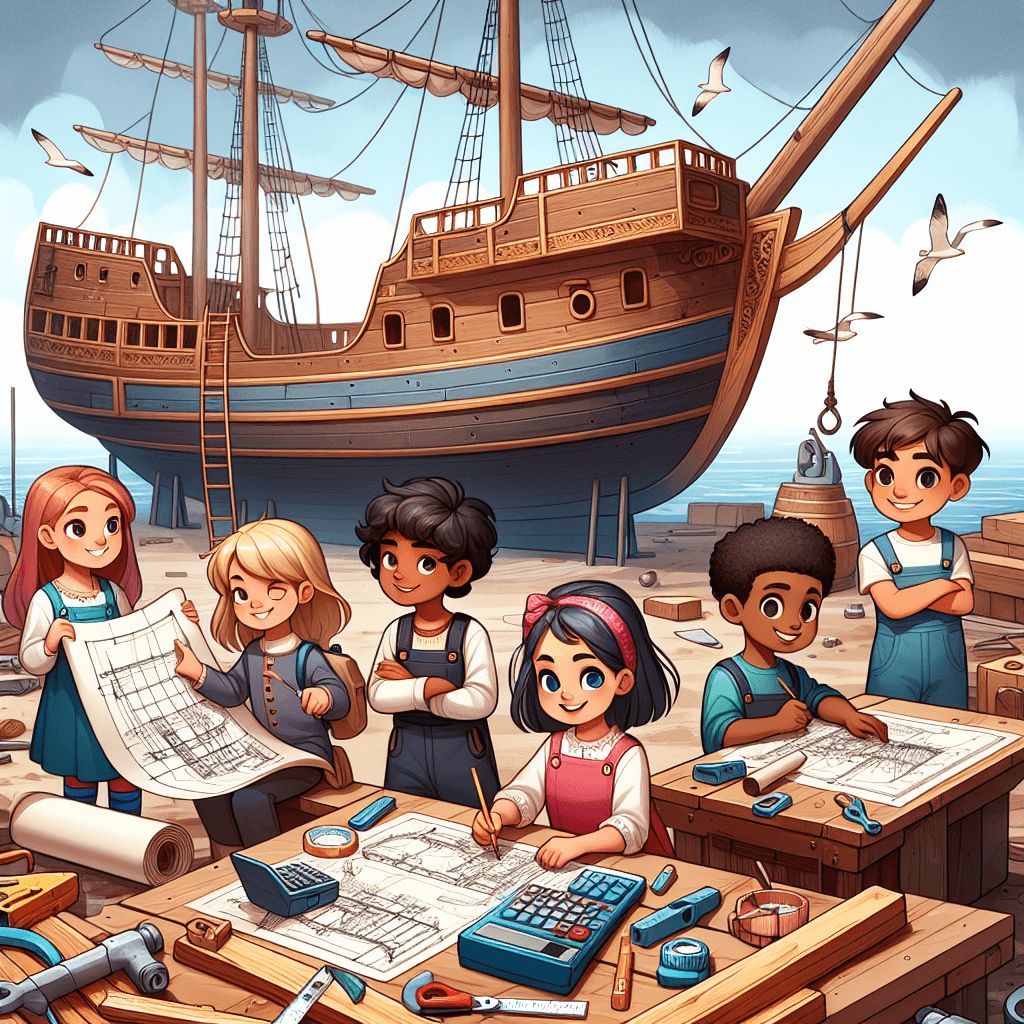
Pirate Ship Restoration: Math Measurements in Action
Inquiry Framework
Question Framework
Driving Question
The overarching question that guides the entire project.In what ways can understanding and applying measurements transform the process of restoring a historical pirate ship, ensuring accuracy and respect for its original design?Essential Questions
Supporting questions that break down major concepts.- How can understanding measurements help restore a historical pirate ship?
- What are the different units of measurement, and how do they apply to real-world projects like ship restoration?
- How can measuring length, volume, and weight contribute to the accuracy and success of restoring an old ship?
- Why is it important to be precise in measurements during restoration projects?
- What techniques can be used to convert measurements from one unit to another in the context of restoring a pirate ship?
Standards & Learning Goals
Learning Goals
By the end of this project, students will be able to:- Students will be able to identify and apply various units of measurement relevant to ship restoration, including length, volume, and weight.
- Students will develop proficiency in converting measurement units within the same system to support precision in restoration projects.
- Students will employ problem-solving skills to address multi-step measurement tasks involved in restoring a historical pirate ship.
- Students will understand the importance of precision in measurements to ensure historical accuracy and structural integrity in restoration projects.
- Students will engage in collaborative problem-solving to determine the best approaches to accurately measure and restore different parts of a pirate ship.
Common Core State Standards for Mathematics
Entry Events
Events that will be used to introduce the project to studentsMystery of the Missing Mast
Students receive a mysterious letter from a fictitious historical society asking for their help to solve the mystery of a missing mast from a recently discovered pirate ship. The letter includes clues requiring measurement and calculation to find the right dimensions for the mast.The Captain's Challenge
Students receive a recorded video message from a 'pirate captain' challenging them to restore his ship using precise measurements. The challenge involves solving a series of measurement tasks to ensure the ship is seaworthy.Portfolio Activities
Portfolio Activities
These activities progressively build towards your learning goals, with each submission contributing to the student's final portfolio.Measurement Mastery Quest
Students embark on a quest to gather and understand different measurement units crucial for the restoration of the pirate ship. This activity sets the foundation for knowing how to measure different elements like length, volume, and weight.Steps
Here is some basic scaffolding to help students complete the activity.Final Product
What students will submit as the final product of the activityA custom reference chart showing various measurement conversions and their applications to ship restoration.Alignment
How this activity aligns with the learning objectives & standardsAligns with 5.MD.A.1, as students learn to convert among different-sized standard measurement units.Restoration Blueprint Designers
In this activity, students become blueprint designers, using their knowledge of measurements to create a scale blueprint of the pirate ship's components, such as the mast, hull, and deck.Steps
Here is some basic scaffolding to help students complete the activity.Final Product
What students will submit as the final product of the activityA complete set of scale blueprints for the ship, demonstrating understanding of measurement and unit conversion.Alignment
How this activity aligns with the learning objectives & standardsMeets 5.MD.A.1 by applying measurement conversion to real-world problem-solving, enhancing understanding of scale and precision.Mast Model Makers
Here, students focus on creating a 3D model of the pirate ship's mast. They will apply their conversion and scale knowledge to build an accurate replica using materials such as cardboard or wood.Steps
Here is some basic scaffolding to help students complete the activity.Final Product
What students will submit as the final product of the activityA 3D model of the pirate ship's mast, showcasing detailed measurement and accurate scaling from blueprint to model.Alignment
How this activity aligns with the learning objectives & standardsFulfills 5.MD.A.1 by engaging students in hands-on conversion tasks and applying knowledge to a tangible creation.Historical Accuracy Advocates
In this final activity, students reflect on the importance of precision in restoration. They research historical masts to compare with their models and write a persuasive piece on the role of measurements in preserving history.Steps
Here is some basic scaffolding to help students complete the activity.Final Product
What students will submit as the final product of the activityA well-researched persuasive paper on the significance of measurement precision in historical restorations.Alignment
How this activity aligns with the learning objectives & standardsAligns with 5.MD.A.1 by emphasizing real-world applications of unit conversion and advocating for historically accurate restorations.Rubric & Reflection
Portfolio Rubric
Grading criteria for assessing the overall project portfolioPirate Ship Restoration Project Rubric
Measurement Application
This category assesses the student's understanding and application of measurement concepts.Understanding of Measurement
Demonstrates understanding of different measurement units and their application in ship restoration.
Exemplary
4 PointsShows exceptional understanding of various measurement units and their specific applications to different aspects of ship restoration, demonstrating advanced knowledge.
Proficient
3 PointsDemonstrates a solid understanding of measurement units and applies them correctly to ship restoration tasks, showing proficiency.
Developing
2 PointsShows a basic understanding of measurement units but may have some difficulty applying them consistently to ship restoration contexts.
Beginning
1 PointsStruggles to understand and apply measurement units in the context of ship restoration, requiring significant support.
Accuracy and Precision
Accuracy and precision in measurement conversions and calculations.
Exemplary
4 PointsConsistently performs accurate and precise measurement conversions and calculations, demonstrating mastery of the skill.
Proficient
3 PointsPerforms accurate measurement conversions and calculations with occasional minor errors, demonstrating proficiency.
Developing
2 PointsShows some accuracy in measurement conversions and calculations but makes frequent errors that impact the overall results.
Beginning
1 PointsStruggles with accurate measurement conversions and calculations, making significant errors that hinder project completion.
Project Execution
This category evaluates the quality and completeness of the student's project deliverables.Product Quality
Quality and completeness of the final products (reference chart, blueprints, 3D model, persuasive paper).
Exemplary
4 PointsProduces outstanding quality final products that exceed expectations, demonstrating exceptional creativity and attention to detail.
Proficient
3 PointsProduces high-quality final products that meet all requirements, demonstrating strong effort and attention to detail.
Developing
2 PointsProduces final products that meet most requirements but may lack some detail or refinement, showing developing skills.
Beginning
1 PointsProduces incomplete or low-quality final products that do not meet the requirements, requiring significant improvement.