
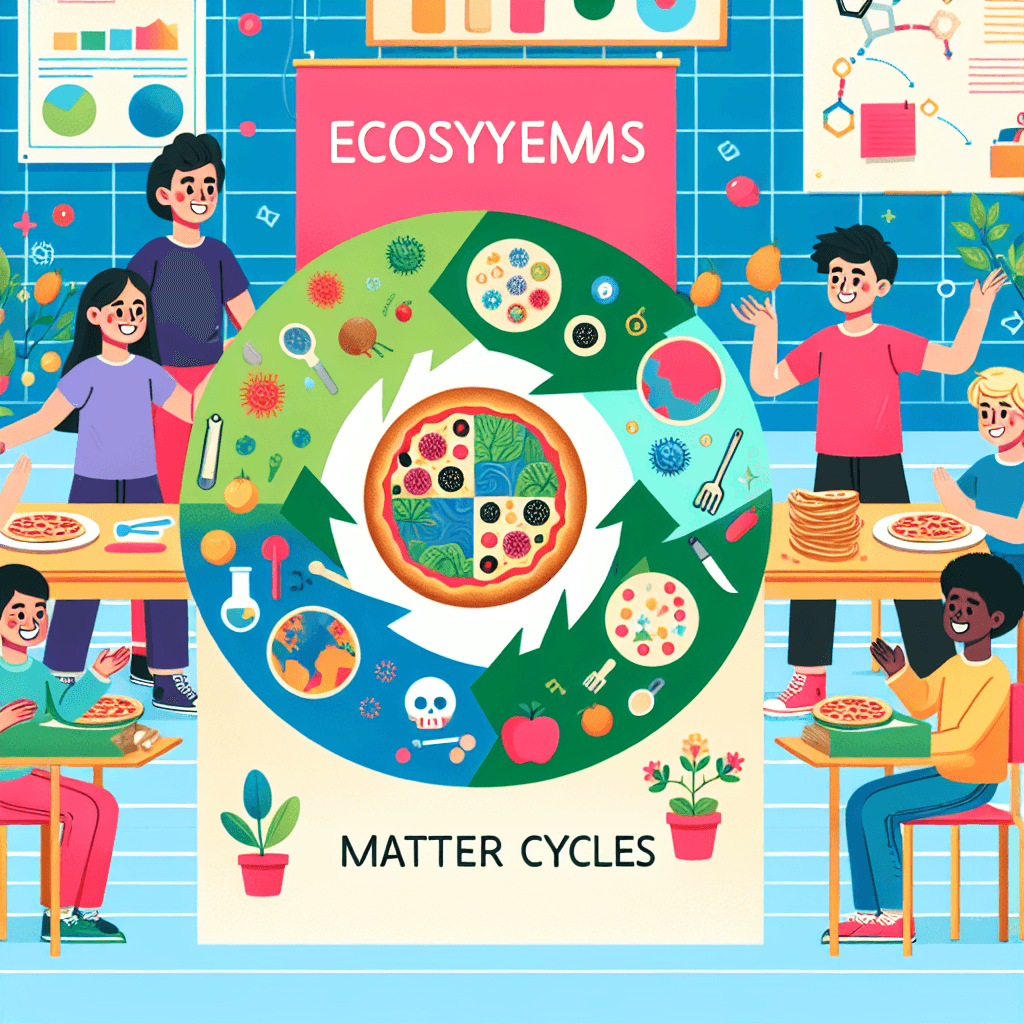
Inquiry Framework
Question Framework
Driving Question
The overarching question that guides the entire project.How can we create a pizza-selling project that not only raises money for charity but also educates our community about ecosystems, the role of plants in the food web, and the importance of sustainability?Essential Questions
Supporting questions that break down major concepts.- How can selling pizza facilitate an understanding of ecosystems and interdependence among living things?
- What role do plants play in the food web, and how does this relate to making and selling pizza?
- In what ways does the sale of pizza reflect the cycles of matter and energy transfer within an ecosystem?
- How can we communicate the importance of healthy ecosystems when promoting our pizza for charity?
- What strategies can we use to ensure that our pizza sales are environmentally sustainable and support local ecosystems?
Standards & Learning Goals
Learning Goals
By the end of this project, students will be able to:- Students will understand the role of plants in the food web and how it relates to the ingredients used in pizza.
- Students will devise a plan to sell pizza that incorporates sustainable practices to support local ecosystems.
- Students will create educational materials that communicate the principles of ecosystems, interdependence, and sustainability to the community.
- Students will demonstrate the ability to analyze and communicate how matter and energy cycles relate to their pizza project.
Next Generation Science Standards
Entry Events
Events that will be used to introduce the project to studentsPizza Pulse: Understanding Ecosystems Through Charitable Sales
Students receive an unexpected delivery of various pizza ingredients and a donated pizza oven. Their task? To create a pizza-selling business model, but each ingredient represents a different aspect of an ecosystem, showcasing how matter and energy flow within it. They must work together to create a delicious pizza and present their ecosystem model alongside their sales plan for charity.Mystery Ingredient Challenge: The Ecology of Pizza
Students are presented with a mystery box containing various pizza toppings and must research the ecological impact of each ingredient, learning where it comes from, how it interacts within its ecosystem, and its energy flow. They will create a public service announcement to raise awareness while planning their charity pizza event using these ingredients.Portfolio Activities
Portfolio Activities
These activities progressively build towards your learning goals, with each submission contributing to the student's final portfolio.Opinion Clouds: Why Pizza Matters
Students will create opinion pieces discussing the significance of pizza not just as food, but as a connection to community and charity. They will express their views on how contributing to charitable causes can be enhanced through local food sales.Steps
Here is some basic scaffolding to help students complete the activity.Final Product
What students will submit as the final product of the activityAn opinion piece articulating their viewpoint on the role of pizza in charitable initiatives and community life.Alignment
How this activity aligns with the learning objectives & standardsAligns with CCSS.ELA-Literacy.W.5.1, particularly W.5.1.a for introducing a topic and stating an opinion, and W.5.1.b for providing reasons supported by facts.From Dough to Dollars: Marketing and Sales Strategy
In this activity, students create a marketing plan to promote their pizza sale. They will learn about the role of marketing in business and how it connects to community involvement and environmental sustainability.Steps
Here is some basic scaffolding to help students complete the activity.Final Product
What students will submit as the final product of the activityA complete marketing plan and promotional materials ready for presenting to the class or executing within the community.Alignment
How this activity aligns with the learning objectives & standardsLinks with 5-LS2-1 by demonstrating how food (pizza) and its components support community and ecosystem principles.Eco-culinary Journey: Making Pizza and Understanding Waste
Students will participate in pizza making, focusing on the role of ingredients, food waste, and recycling materials used in the sale. Through hands-on experience, they will learn about sustainability practices in food preparation and disposal.Steps
Here is some basic scaffolding to help students complete the activity.Final Product
What students will submit as the final product of the activityA pizza made collaboratively with a waste tracking report that outlines what was learned about food production and waste management.Alignment
How this activity aligns with the learning objectives & standardsMeets standards of LS2.B regarding cycles of matter and energy in ecosystems, emphasizing food waste management.Pizza Physics & Functions
In this activity, students delve into the science behind the ingredients of pizza, linking it to ecosystems and the movement of matter. They will research where key pizza ingredients come from, particularly focusing on plants, and how these ingredients nourish both people and the environment.Steps
Here is some basic scaffolding to help students complete the activity.Final Product
What students will submit as the final product of the activityA group presentation or poster that showcases the chosen ingredient, its ecological importance, and connections to the pizza.Alignment
How this activity aligns with the learning objectives & standardsAligns with standard 5-LS2-1 as students develop a model (visual representation) to describe the movement of matter (ingredients) through ecosystems.Rubric & Reflection
Portfolio Rubric
Grading criteria for assessing the overall project portfolioPizza for Charity: Ecosystem and Sustainability Exploration
Understanding Ecosystems and Sustainability
Evaluates student understanding of ecosystems, sustainability, and how these concepts are integral to the project.Ecosystem Relationships
Assess how well students describe the relationships within ecosystems and the role of plants in the food web.
Exemplary
4 PointsProvides a thorough and accurate explanation of ecosystem relationships, including detailed roles of various organisms and the significance of plants in the food web.
Proficient
3 PointsDescribes key ecosystem relationships accurately, with a clear understanding of the roles of some organisms, and outlines the importance of plants in the food web.
Developing
2 PointsIdentifies some ecosystem relationships and mentions the role of plants but lacks depth in explanation or accuracy.
Beginning
1 PointsShows minimal recognition of ecosystem relationships, with unclear or incorrect identification of plant roles.
Sustainability Practices
Measures how effectively students consider and incorporate sustainable practices in their project planning and execution.
Exemplary
4 PointsInnovative sustainability strategies are thoroughly integrated into all aspects of the project, demonstrating leadership in environmental awareness.
Proficient
3 PointsConsistently applies sustainability practices in project planning and execution, with clear examples and intentions.
Developing
2 PointsShows awareness of sustainability but inconsistent application in project elements.
Beginning
1 PointsLimited consideration of sustainability, with little to no practical application in the project.
Communication and Persuasion in Writing
Assesses students' ability to articulate ideas clearly and persuasively, specifically in the context of their opinion pieces.Opinion Clarity and Support
Evaluates the clarity of students' opinion statements and the strength of their supporting arguments in written pieces.
Exemplary
4 PointsOpinion is clearly articulated with well-supported, compelling arguments enhanced by factual evidence, demonstrating higher-order thinking.
Proficient
3 PointsOpinion is clearly stated with logical support, including relevant facts and details.
Developing
2 PointsOpinion lacks full clarity, with partial support and unclear details.
Beginning
1 PointsOpinion is vague or unsupported, lacking clear reasoning and factual backing.
Revisions and Peer Feedback Integration
Measures the effectiveness of incorporating peer and self-feedback into written work revision.
Exemplary
4 PointsSeamlessly integrates feedback into revisions, markedly improving the coherence and impact of the writing.
Proficient
3 PointsEffectively incorporates feedback to enhance writing clarity and persuasive impact.
Developing
2 PointsPartially utilizes feedback, with limited improvement evident in revisions.
Beginning
1 PointsMinimal or ineffective use of feedback, little change in writing quality.
Marketing and Presentation Skills
Assesses the students' ability to create and present effective marketing strategies for their pizza project.Marketing Plan Development
Evaluates the comprehensiveness and creativity of the marketing plan, as well as alignment with project goals.
Exemplary
4 PointsDevelops a creative, comprehensive marketing plan that aligns perfectly with the project's educational and charitable goals.
Proficient
3 PointsCreates a clear marketing plan with logical alignment to project objectives.
Developing
2 PointsMarketing plan shows basic ideas but lacks depth and clear alignment.
Beginning
1 PointsMarketing plan is unclear or lacks important elements needed for effectiveness.
Presentation Delivery and Impact
Assesses the effectiveness of presentation delivery and the ability to engage the audience.
Exemplary
4 PointsDelivers a highly engaging and persuasive presentation with clear, impactful communication and visuals.
Proficient
3 PointsPresents information effectively with clear communication and supportive visuals.
Developing
2 PointsPresents basic information with some attempts at clarity and engagement.
Beginning
1 PointsPresentation lacks clarity and engagement. Minimal use of visuals or persuasive techniques.
Collaboration and Reflection
Measures the ability to collaborate effectively with peers and reflect on the learning process.Collaborative Contribution
Evaluates the level of meaningful contribution and communication within group tasks.
Exemplary
4 PointsExceeds in contributing to group tasks, showing leadership and encouraging participation from all members.
Proficient
3 PointsContributes actively and respectfully in group tasks, facilitating group progress.
Developing
2 PointsParticipates in group tasks with occasional contributions, needs encouragement to engage fully.
Beginning
1 PointsMinimal contribution to group tasks, often requiring prompts or support to participate.
Reflective Practice
Assesses the student's ability to reflect on learning experiences and articulate growth areas.
Exemplary
4 PointsConsistently reflects on learning with insight, detailing personal growth and future improvement areas.
Proficient
3 PointsReflects on learning experiences thoughtfully, identifying growth and areas for enhancement.
Developing
2 PointsReflects superficially on learning with limited insights into growth areas.
Beginning
1 PointsReflects minimally on learning experiences, with vague insights.