
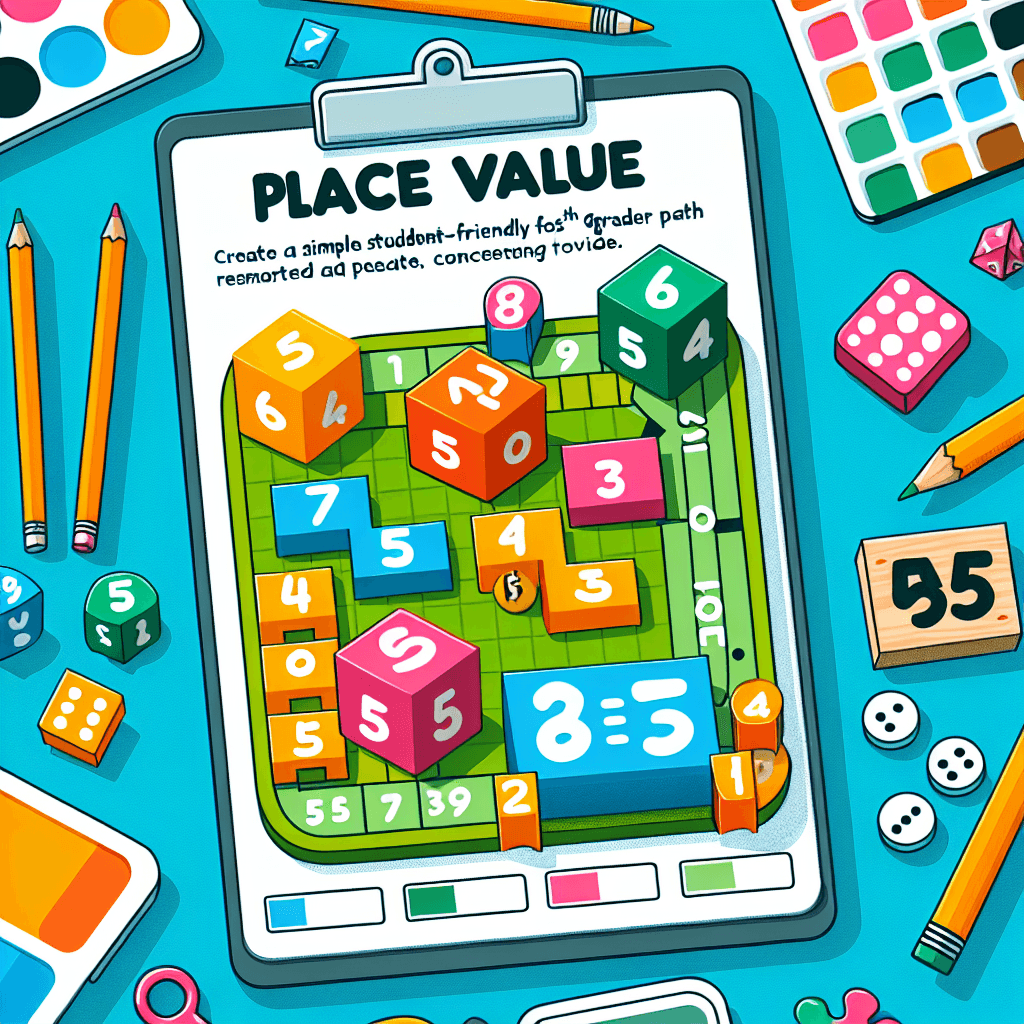
Place Value Game Design: A 5th Grade Math Project
Inquiry Framework
Question Framework
Driving Question
The overarching question that guides the entire project.How can we design a place value board game that helps players understand the relationship between a digit's position, its value, different number representations, the use of exponents, and strategies for comparing large numbers in a fun and engaging way?Essential Questions
Supporting questions that break down major concepts.- How does the position of a digit affect its value?
- How can we represent numbers in different ways?
- How can understanding place value help us in everyday life?
- How can exponents be used to represent place value?
- What strategies can we use to compare and order large numbers?
Standards & Learning Goals
Learning Goals
By the end of this project, students will be able to:- Understand the relationship between place value positions
- Write multi-digit numbers in different forms and compare the values of digits
- Write numbers using exponents
- Design a place value board game that helps players understand the relationship between a digit's position, its value, different number representations, the use of exponents, and strategies for comparing large numbers in a fun and engaging way
Entry Events
Events that will be used to introduce the project to studentsToy Company SOS
Students receive a letter from a toy company explaining that their new place value game is losing sales because kids don't understand how to play. The toy company asks the students to redesign the game, explain the math, and show why understanding place value makes the game fun and strategic. This creates a real-world problem that directly relates to student experiences and interests.Portfolio Activities
Portfolio Activities
These activities progressively build towards your learning goals, with each submission contributing to the student's final portfolio.Place Value Explorers
Students will explore the concept of place value by creating a place value chart and representing numbers in different forms (standard, expanded, and word form).Steps
Here is some basic scaffolding to help students complete the activity.Final Product
What students will submit as the final product of the activityA completed place value chart with examples of numbers written in standard, expanded, and word form.Alignment
How this activity aligns with the learning objectives & standardsUnderstand the relationship between place value positions. Write multi-digit numbers in different forms.Exponent Experts
Students will learn about exponents and how they relate to place value, specifically powers of 10. They will practice writing numbers using exponents to represent place value positions.Steps
Here is some basic scaffolding to help students complete the activity.Final Product
What students will submit as the final product of the activityA table showing place values as powers of 10, with examples of numbers written using exponents.Alignment
How this activity aligns with the learning objectives & standardsWrite numbers using exponents.Number Comparison Strategists
Students will develop strategies for comparing large numbers and understanding the relative value of digits in different place value positions.Steps
Here is some basic scaffolding to help students complete the activity.Final Product
What students will submit as the final product of the activityA set of comparison cards with pairs of numbers, along with explanations of how the numbers were compared using place value strategies.Alignment
How this activity aligns with the learning objectives & standardsCompare the values of digits.Game Design Masters
Students will apply their understanding of place value to design a board game. This activity integrates all the concepts learned in the previous activities.Steps
Here is some basic scaffolding to help students complete the activity.Final Product
What students will submit as the final product of the activityA fully designed and playable place value board game, including rules, game board, and playing pieces.Alignment
How this activity aligns with the learning objectives & standardsDesign a place value board game that helps players understand the relationship between a digit's position, its value, different number representations, the use of exponents, and strategies for comparing large numbers in a fun and engaging way.Rubric & Reflection
Portfolio Rubric
Grading criteria for assessing the overall project portfolioPlace Value Game Design Rubric
Place Value Understanding
Assesses the student's understanding and application of place value concepts and number representation.Accuracy and Representation
Accuracy of place value chart and representation of numbers in standard, expanded, and word forms.
Beginning
1 PointsPlace value chart is incomplete or contains inaccuracies. Struggles to represent numbers in different forms.
Developing
2 PointsPlace value chart has some errors. Can represent numbers in different forms with some mistakes.
Proficient
3 PointsPlace value chart is mostly accurate. Can represent numbers in different forms correctly.
Exemplary
4 PointsPlace value chart is completely accurate and detailed. Numbers are flawlessly represented in standard, expanded, and word forms, demonstrating deep understanding.
Understanding of Place Value Relationships
Demonstrates understanding of the relationship between place value positions.
Beginning
1 PointsShows little to no understanding of place value relationships.
Developing
2 PointsShows some understanding of place value relationships but struggles to explain them.
Proficient
3 PointsUnderstands and can explain the relationship between place value positions.
Exemplary
4 PointsDemonstrates a sophisticated understanding of place value relationships, including the ability to apply this knowledge to complex problems.
Exponents and Place Value
Assesses the student's understanding and application of exponents in relation to place value.Accuracy and Exponential Representation
Accuracy of the table showing place values as powers of 10. Correct representation of numbers using exponents.
Beginning
1 PointsTable is incomplete or contains inaccuracies. Struggles to represent numbers using exponents.
Developing
2 PointsTable has some errors. Can represent numbers using exponents with some mistakes.
Proficient
3 PointsTable is mostly accurate. Can represent numbers using exponents correctly.
Exemplary
4 PointsTable is completely accurate and detailed, demonstrating a deep understanding of exponents and their relationship to place value. Numbers are flawlessly represented using exponents.
Understanding of Exponents
Demonstrates understanding of exponents and their relationship to place value.
Beginning
1 PointsShows little to no understanding of exponents and their relationship to place value.
Developing
2 PointsShows some understanding of exponents but struggles to explain their connection to place value.
Proficient
3 PointsUnderstands and can explain the relationship between exponents and place value.
Exemplary
4 PointsDemonstrates a sophisticated understanding of exponents and their connection to place value, applying this knowledge to explain complex numerical relationships.
Number Comparison Strategies
Assesses the student's ability to compare large numbers and explain their reasoning using place value concepts.Clarity and Accuracy of Explanations
Clarity and accuracy of explanations for comparing pairs of multi-digit numbers. Effective use of place value reasoning.
Beginning
1 PointsExplanations are unclear or inaccurate. Shows little to no understanding of place value reasoning.
Developing
2 PointsExplanations are somewhat unclear and contain some inaccuracies. Demonstrates a basic understanding of place value reasoning.
Proficient
3 PointsExplanations are clear and accurate. Effectively uses place value reasoning to compare numbers.
Exemplary
4 PointsExplanations are exceptionally clear, accurate, and insightful. Demonstrates a sophisticated understanding of place value reasoning, providing nuanced comparisons and justifications.
Comparison Strategies
Demonstrates effective strategies for comparing large numbers.
Beginning
1 PointsStruggles to compare large numbers and lacks effective strategies.
Developing
2 PointsUses inefficient or incorrect strategies for comparing large numbers.
Proficient
3 PointsUses effective strategies for comparing large numbers.
Exemplary
4 PointsDemonstrates and articulates a variety of efficient and sophisticated strategies for comparing large numbers, adapting their approach based on the specific numbers being compared.
Game Design and Application
Assesses the student's ability to apply their understanding of place value to design a fun and educational board game.Integration of Place Value Concepts
Incorporation of place value concepts, different number representations, exponents, and number comparison strategies into the game design.
Beginning
1 PointsGame design shows little to no incorporation of place value concepts.
Developing
2 PointsGame design incorporates some place value concepts, but implementation is weak.
Proficient
3 PointsGame design effectively incorporates place value concepts.
Exemplary
4 PointsGame design seamlessly and creatively integrates place value concepts, different number representations, exponents, and number comparison strategies, enhancing the game's educational value and engagement.
Game Rules and Playability
Clarity and completeness of game rules. Playability and engagement of the game.
Beginning
1 PointsGame rules are unclear or incomplete. Game is not playable or engaging.
Developing
2 PointsGame rules are somewhat clear but have gaps. Game is playable but not very engaging.
Proficient
3 PointsGame rules are clear and complete. Game is playable and engaging.
Exemplary
4 PointsGame rules are exceptionally clear, concise, and well-organized. The game is highly playable, engaging, and demonstrates a deep understanding of game design principles.
Creativity and Originality
Creativity and originality of the game design.
Beginning
1 PointsGame design lacks creativity and originality.
Developing
2 PointsGame design shows some creativity but is not very original.
Proficient
3 PointsGame design is creative and original.
Exemplary
4 PointsGame design is exceptionally creative, innovative, and original, demonstrating a unique approach to teaching and reinforcing place value concepts.