
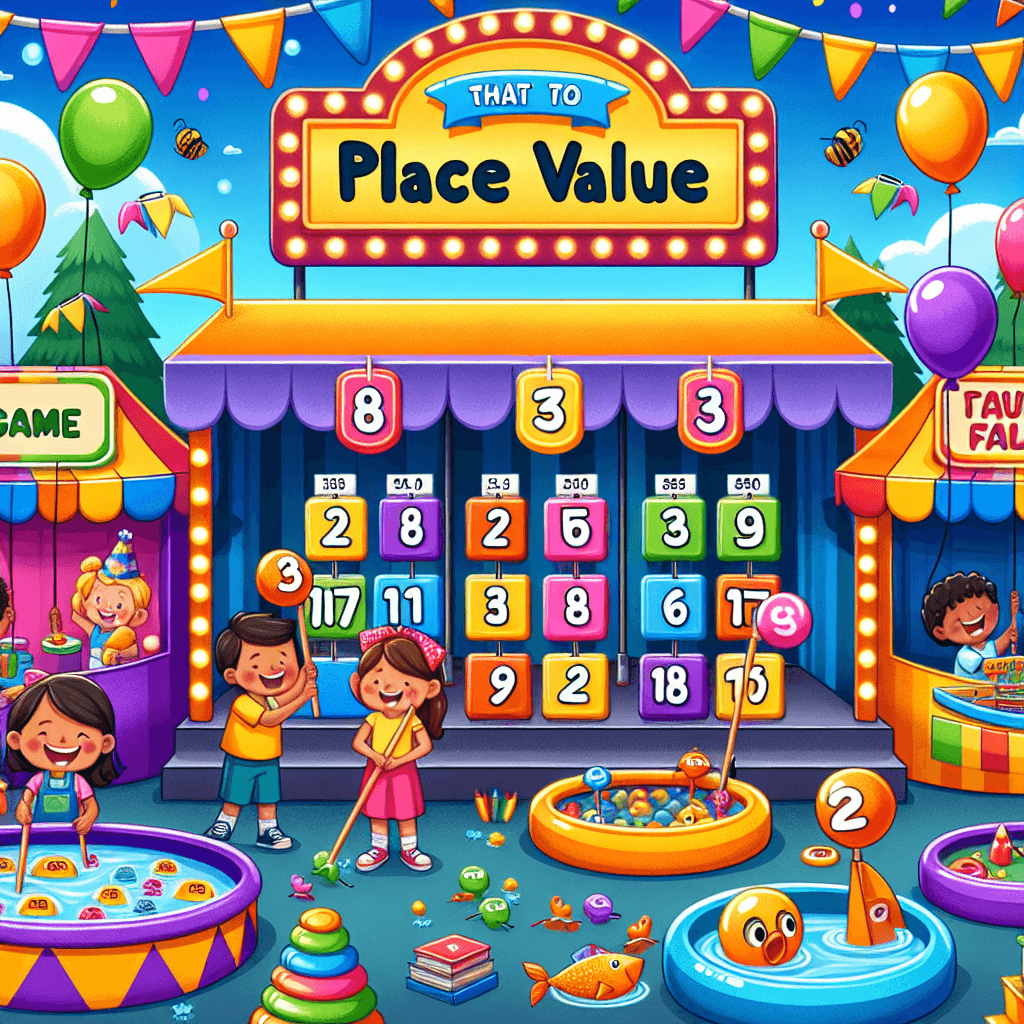
Place Value Math Carnival: Fun Games for Grades 3
Inquiry Framework
Question Framework
Driving Question
The overarching question that guides the entire project.How can we design engaging and educational carnival games to teach others about place value, enabling them to compose, decompose, and compare numbers using the base-10 system?Essential Questions
Supporting questions that break down major concepts.- How can numbers be composed and decomposed using the base-10 system?
- What are the different ways to represent numbers up to 100,000 using objects and models?
- How do place values help us compare and order large numbers?
- In what ways can expanded notation help us understand large numbers?
- How can we use a number line to understand the size and order of numbers?
- What strategies can we use to round numbers effectively?
Standards & Learning Goals
Learning Goals
By the end of this project, students will be able to:- Design and develop engaging carnival games that help players understand and practice place value concepts in the base-10 system.
- Use mathematical models, objects, and expanded notation to explore numbers up to 100,000.
- Enhance number sense by composing, decomposing, and comparing large whole numbers through interactive activities.
- Apply knowledge of place value to create educational game mechanics that facilitate learning.
- Utilize number lines in game design to help players visualize the relative size and order of numbers.
Number and Operations
Entry Events
Events that will be used to introduce the project to studentsBalloon Pop Math Challenge
Set up a carnival-style booth where each balloon contains a number component (hundreds, tens, or ones). As balloons pop, students must quickly compose or decompose the final number, linking it to its place value. This creates an exciting atmosphere while reinforcing rapid mental math skills.Interactive Place Value Story
Kick off with an interactive storytime where characters face challenges solved through place value knowledge. As the plot unfolds, students intervene to solve puzzles, each involving place value configurations. The narrative-driven approach concretizes abstract concepts and caters to students with varied learning preferences.Mystery Number Auction
Host a 'mystery number' auction where students start with a limited amount of play money to bid on mystery boxes containing numbers. The goal is to win the highest value numbers based on their place values. This auction immediately hooks students' interests and connects directly to understanding the importance of each digit in determining a number's value.Portfolio Activities
Portfolio Activities
These activities progressively build towards your learning goals, with each submission contributing to the student's final portfolio.Balloon Pop Number Crafter
In this activity, students will create a carnival booth game where they will use balloons to represent different number components (hundreds, tens, or ones). As each balloon is popped, students will be required to quickly compose or decompose a number, reinforcing mental math skills related to place value.Steps
Here is some basic scaffolding to help students complete the activity.Final Product
What students will submit as the final product of the activityA composed or decomposed number on a whiteboard that demonstrates understanding of place value.Alignment
How this activity aligns with the learning objectives & standardsAligns with standard 2.A (Compose and decompose numbers using objects).Place Value Adventure Story
Students will participate in and contribute to an interactive story where the characters solve various challenges using their place value knowledge. The engagements will require students to apply their understanding of number models to aid in the story progression.Steps
Here is some basic scaffolding to help students complete the activity.Final Product
What students will submit as the final product of the activityA completed interactive story chart showing the role of place value in each challenge faced by the characters.Alignment
How this activity aligns with the learning objectives & standardsAligns with standard 2.B (Describe mathematical relationships in the base-10 system).Number Line Quest
In this activity, students will design a game where they place numbers on a number line, helping them visually understand the scale and order of numbers. Students will compete to accurately position their numbers between two consecutive multiples such as 10, 100, or 1,000.Steps
Here is some basic scaffolding to help students complete the activity.Final Product
What students will submit as the final product of the activityA number line displaying numbers accurately placed relative to multiples, demonstrating comprehension of number scale.Alignment
How this activity aligns with the learning objectives & standardsAligns with standard 2.C (Represent a number on a number line).Rubric & Reflection
Portfolio Rubric
Grading criteria for assessing the overall project portfolioPlace Value Carnival Games Rubric
Understanding of Place Value
Measures the student's depth of understanding regarding the base-10 system and place value relationships when composing and decomposing numbers.Place Value Concepts
Assesses the ability to accurately compose and decompose numbers up to 100,000 using objects and models.
Exemplary
4 PointsDemonstrates sophisticated understanding by accurately composing and decomposing numbers in a variety of ways using multiple representations.
Proficient
3 PointsAccurately composes and decomposes numbers using standard models and representations.
Developing
2 PointsComposes and decomposes numbers with some errors and often relies on a single model approach.
Beginning
1 PointsRarely or inaccurately composes and decomposes numbers, needing frequent assistance.
Application of Base-10 System
Evaluates the ability to apply knowledge of base-10 relationships in designing game mechanics.
Exemplary
4 PointsIntegrates advanced understanding of base-10 relationships to create innovative and educational game mechanics.
Proficient
3 PointsApplies base-10 knowledge effectively to develop sound and understandable game mechanics.
Developing
2 PointsApplies basic base-10 concepts but with limited depth or innovation in game design.
Beginning
1 PointsStruggles to apply base-10 principles in the context of game design.
Use of Number Lines
Assesses students’ ability to use number lines to represent and compare numbers effectively as part of their game design.Number Placement and Strategy
Evaluates how well students use a number line to place numbers accurately and strategies used for estimation and comparison.
Exemplary
4 PointsUses number lines strategically and accurately to represent and compare numbers, demonstrating clear and effective strategies.
Proficient
3 PointsAccurately places numbers on the number line, demonstrating good strategies for comparison and estimation.
Developing
2 PointsPlaces numbers with some accuracy and limited strategic depth, often needing guidance.
Beginning
1 PointsShows difficulty in placing numbers accurately or using strategies effectively, requiring considerable help.
Collaboration and Problem Solving
Examines the student's ability to work with others in solving problems related to game design and place value challenges.Teamwork and Initiative
Assesses how effectively the student collaborates with peers to solve place value challenges.
Exemplary
4 PointsLeads and collaborates effectively, often taking initiative to incorporate complex ideas and resolve conflicts constructively.
Proficient
3 PointsWorks well with peers, actively contributing ideas and helping resolve challenges.
Developing
2 PointsParticipates in group work but hesitates to take initiative or resolve differences.
Beginning
1 PointsStruggles to collaborate, contributing minimally or requiring significant assistance to engage.
Creativity and Innovation
Evaluates the originality and engagement level of the carnival games designed by students, focusing on creativity in applying place value concepts.Game Design Creativity
Assesses the creativity and educational value of the place value games designed.
Exemplary
4 PointsDesigns highly creative and engaging games that innovatively teach place value concepts.
Proficient
3 PointsCreates engaging and educational games that clearly teach place value concepts.
Developing
2 PointsDesigns games with basic educational value and engagement, often with limited creative elements.
Beginning
1 PointsStruggles with creativity, designing games that lack clear educational goals or engagement.