
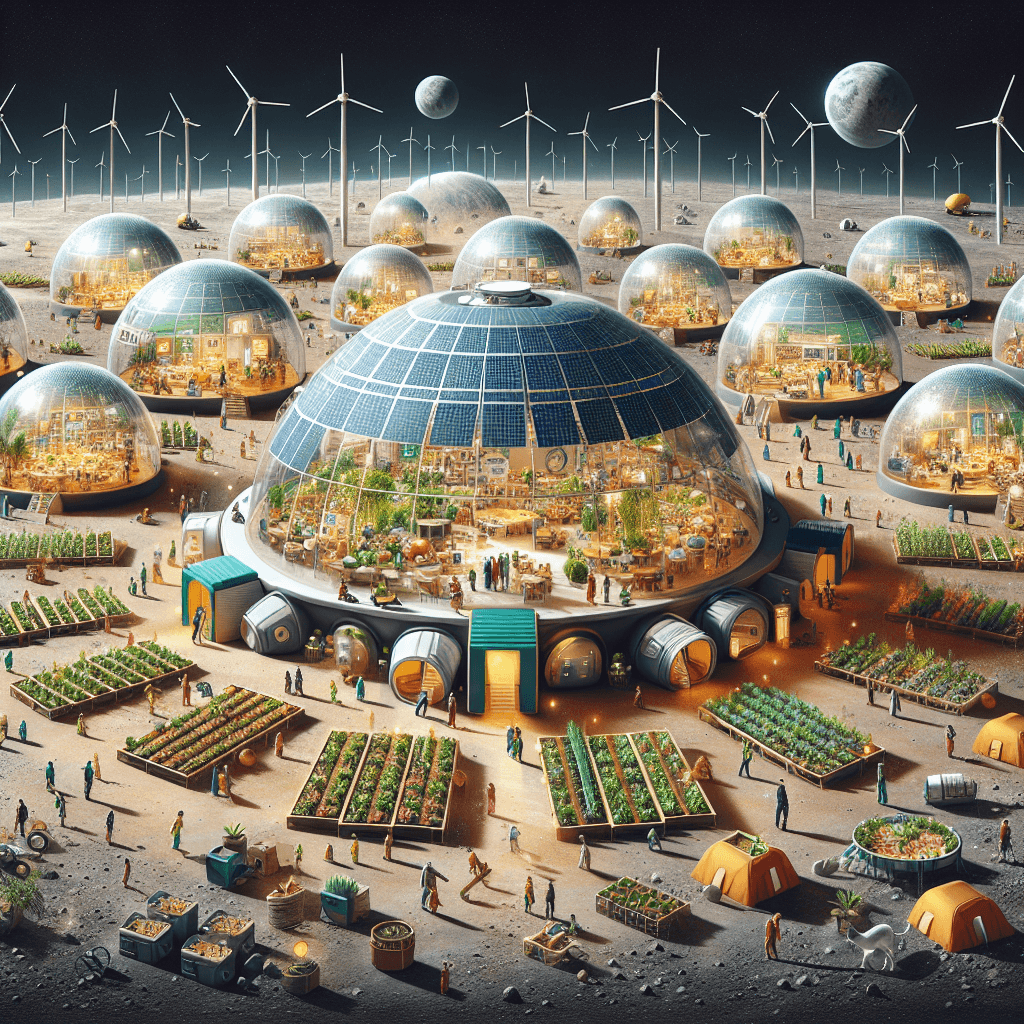
Planetary Pioneers: Designing a Sustainable Colony
Inquiry Framework
Question Framework
Driving Question
The overarching question that guides the entire project.How can we design a thriving and sustainable extraterrestrial colony, learning from past colonization efforts and applying scientific and mathematical principles to overcome the unique challenges of a chosen planet or moon, while effectively communicating our vision?Essential Questions
Supporting questions that break down major concepts.- What are the most significant challenges to human survival on other planets or moons, and how can we overcome them?
- How can we create a sustainable colony that meets the needs of its inhabitants without harming the environment?
- In what ways can historical examples of colonization inform our approach to establishing a successful and ethical extraterrestrial settlement?
- How do the unique characteristics of our chosen planet or moon impact the design and function of our colony?
- What mathematical and scientific principles are essential for planning and constructing a self-sufficient colony?
- How can we effectively communicate our colony design and justify our decisions using persuasive writing and visual representations?
Standards & Learning Goals
Learning Goals
By the end of this project, students will be able to:- Apply mathematical and scientific principles to design a sustainable extraterrestrial colony.
- Evaluate historical colonization efforts to inform ethical and practical approaches to extraterrestrial settlement.
- Communicate colony design and justify decisions through persuasive writing and visual representations.
- Identify and address the unique challenges of human survival on a chosen planet or moon.
- Create a sustainable colony that meets the needs of its inhabitants without harming the environment.
- Represent the characteristics of the selected planet or moon in the colony design, showing understanding of their impact on the project's viability.
- Demonstrate an understanding of matter and its conservation through practical applications in colony design (e.g., resource management, waste recycling).
- Apply geometric principles to colony design, considering spatial relationships and efficient use of space.
- Utilize fractions, multiplication, and division to solve real-world problems related to resource allocation, construction, and other colony needs.
- Model the interactions between the geosphere, biosphere, hydrosphere, and/or atmosphere in the context of their colony's environment and operations.
- Show how gravity and the relative brightness of stars influence the design and function of the colony.
- Use graphs and data displays to show patterns related to the colony's environment, such as changes in shadows, day and night, and seasonal effects on the chosen planet or moon.
- Integrate technology to create models and communicate design ideas effectively, adhering to established scientific and mathematical concepts.
- Develop arguments that introduce a topic clearly, express distinct opinions supported with adequate facts, ideas, and reasons that are logically grouped, and provide a concluding section.
- Draw evidence from grade-level texts to explain explicit content and inferences, including quoting from texts accurately.
- Demonstrate fluency for multiplication of multi-digit whole numbers using the standard algorithm.
- Solve word problems involving addition and subtraction of fractions referring to the same whole, including cases of unlike denominators.
- Solve real-world problems involving multiplication of fractions and mixed numbers using visual fraction models and/or equations to represent the problem.
- Solve real-world problems involving division of unit fractions by nonzero whole numbers and division of whole numbers by unit fractions using visual fraction models and/or equations to represent the problem.
- Use concrete and/or visual models to measure the volume of rectangular prisms in cubic units.
- Graph points on the coordinate plane to solve real-world and mathematical problems.
Teacher Specified
Entry Events
Events that will be used to introduce the project to studentsSpace Race: Colony Design Competition
The class is divided into competing 'space agencies,' each tasked with presenting a proposal for colonizing a different celestial body. They must research the environmental challenges, create a budget, and design a sustainable habitat. A panel of judges (teachers, community members) will evaluate the proposals based on feasibility and creativity.The Colonist's Dilemma: Ethical Challenges in Space
Present the class with a series of ethical dilemmas faced by early space colonists (e.g., resource allocation, social structure, contact with potential alien life). Students debate these issues from different perspectives, considering the long-term consequences of their decisions on the colony's sustainability and social harmony.Portfolio Activities
Portfolio Activities
These activities progressively build towards your learning goals, with each submission contributing to the student's final portfolio.Planet/Moon Selection & Initial Justification
Students will research different planets or moons and choose one for their colony. They will then write an introduction that clearly states their choice and provides initial reasons for why this celestial body is the best option.Steps
Here is some basic scaffolding to help students complete the activity.Final Product
What students will submit as the final product of the activityA one-page document introducing their chosen planet/moon and stating their initial reasons for colonization, supported by preliminary research.Alignment
How this activity aligns with the learning objectives & standardsAddresses 5.W.RW.2 (Introduce a topic and state an opinion) and 5.RC.TE.3 (Draw evidence from grade-level texts).Habitat Volume & Resource Calculation
Students will calculate the volume of potential habitat structures, considering the number of colonists and their needs. They will use multi-digit multiplication to determine the resources required to construct these habitats.Steps
Here is some basic scaffolding to help students complete the activity.Final Product
What students will submit as the final product of the activityA detailed plan of the colony's habitat structures, including volume calculations and resource estimations, demonstrating the application of multi-digit multiplication.Alignment
How this activity aligns with the learning objectives & standardsAddresses 5.NBT.B.5 (Demonstrate fluency for multiplication of multi-digit whole numbers) and 5.MD.C.4 (Measure the volume of rectangular prisms).Fraction-Based Resource Management
Students will solve word problems related to resource allocation, food production, and energy distribution in the colony, using fractions to represent portions of resources and needs.Steps
Here is some basic scaffolding to help students complete the activity.Final Product
What students will submit as the final product of the activityA series of solved word problems demonstrating their understanding of fraction operations in the context of the colony's resource management.Alignment
How this activity aligns with the learning objectives & standardsAddresses 5.NF.A.2 (Solve word problems involving addition and subtraction of fractions), 5.NF.B.6 (Solve real-world problems involving multiplication of fractions), and 5.NF.B.7c (Solve real-world problems involving division of unit fractions).Matter Management in the Colony
Students will investigate how matter and its properties affect the colony. They will create a model describing that matter is made of unseen particles and investigate the changes in matter when mixing substances to create new resources. They will create graphs using measurements of quantities to display the conservation of weight.Steps
Here is some basic scaffolding to help students complete the activity.Final Product
What students will submit as the final product of the activityA presentation which contains a model of matter, graphs of change in matter from conducting investigations, and descriptions of how matter will need to be changed or conserved to best use it for the colony.Alignment
How this activity aligns with the learning objectives & standardsAddresses 5-PS-1.1 (Model that matter is made of particles), 5-PS-1.2 (Measure and graph quantities to show weight conservation), and 5-PS-1.4 (Investigate mixing substances).Earth Systems and Water Distribution
Students will develop a model showing the interactions between the different earth systems in their colony. They will graph the distribution of fresh and salt water on their planet to demonstrate how access to water will influence their colony.Steps
Here is some basic scaffolding to help students complete the activity.Final Product
What students will submit as the final product of the activityA presentation and model showing the interactions between the earth systems and the graph of fresh and salt water distribution on the chosen planet or moon.Alignment
How this activity aligns with the learning objectives & standardsAddresses 5-ESS-2.1 (Develop a model to describe interactions between Earth's systems) and 5-ESS-2.2 (Describe and graph fresh and salt water distribution).Rubric & Reflection
Portfolio Rubric
Grading criteria for assessing the overall project portfolioExtraterrestrial Colony Design Rubric
Planet/Moon Selection & Justification
Assessment of the rationale and support for the chosen planet or moon, evaluating the clarity of the choice, the quality of supporting research, and the accuracy of source citations.Clarity of Choice
Clarity of the planet/moon choice statement and the initial reasons provided.
Exemplary
4 PointsThe statement of choice is exceptionally clear, concise, and compelling, demonstrating a deep understanding of the planet/moon's potential for colonization. Reasons are exceptionally well-articulated, insightful, and directly linked to the planet/moon's unique characteristics.
Proficient
3 PointsThe statement of choice is clear and concise, demonstrating a good understanding of the planet/moon's potential for colonization. Reasons are well-articulated and generally linked to the planet/moon's characteristics.
Developing
2 PointsThe statement of choice is somewhat unclear or lacks detail, demonstrating a basic understanding of the planet/moon's potential for colonization. Reasons are vaguely articulated or weakly linked to the planet/moon's characteristics.
Beginning
1 PointsThe statement of choice is unclear, missing, or demonstrates little to no understanding of the planet/moon's potential for colonization. Reasons are poorly articulated and not linked to the planet/moon's characteristics.
Quality of Research
Quality and relevance of preliminary research supporting the reasons for the planet/moon selection.
Exemplary
4 PointsResearch is exceptionally thorough, relevant, and demonstrates an advanced understanding of the planet/moon's environment and resources. Sources are expertly integrated and contribute significantly to the justification of the choice.
Proficient
3 PointsResearch is thorough, relevant, and demonstrates a good understanding of the planet/moon's environment and resources. Sources are well-integrated and support the justification of the choice.
Developing
2 PointsResearch is limited, somewhat relevant, and demonstrates a basic understanding of the planet/moon's environment and resources. Sources are included but may not be well-integrated or fully support the justification of the choice.
Beginning
1 PointsResearch is minimal, irrelevant, or demonstrates little to no understanding of the planet/moon's environment and resources. Sources are missing, poorly integrated, or do not support the justification of the choice.
Citation Accuracy
Proper citation of sources following a consistent citation style.
Exemplary
4 PointsAll sources are flawlessly cited following a consistent and appropriate citation style. The citations enhance the credibility and authority of the work.
Proficient
3 PointsAll sources are properly cited following a consistent and appropriate citation style.
Developing
2 PointsMost sources are cited, but there are some inconsistencies in the citation style or minor errors.
Beginning
1 PointsSources are missing or improperly cited, demonstrating a lack of understanding of citation conventions.
Habitat Planning & Resource Use
Assessment of the mathematical calculations and design considerations involved in planning and constructing habitats for the extraterrestrial colony.Volume Calculation Accuracy
Accuracy of volume calculations for habitat structures, demonstrating fluency in multi-digit multiplication.
Exemplary
4 PointsAll volume calculations are flawlessly accurate, demonstrating an exceptional command of multi-digit multiplication and units. The habitat plan is optimized for space and resource efficiency.
Proficient
3 PointsAll volume calculations are accurate, demonstrating fluency in multi-digit multiplication and units. The habitat plan is well-organized and efficient.
Developing
2 PointsMost volume calculations are accurate, but there are some minor errors in multi-digit multiplication or unit conversions. The habitat plan is somewhat disorganized or inefficient.
Beginning
1 PointsVolume calculations are inaccurate or missing, demonstrating a lack of understanding of multi-digit multiplication and units. The habitat plan is disorganized and inefficient.
Habitat Plan Clarity
Clarity and detail of the habitat plan, including dimensions and layout of essential facilities.
Exemplary
4 PointsThe habitat plan is exceptionally clear, detailed, and visually appealing, showcasing an innovative and well-thought-out design that maximizes functionality and comfort for the colonists.
Proficient
3 PointsThe habitat plan is clear, detailed, and well-organized, showcasing a functional and comfortable design for the colonists.
Developing
2 PointsThe habitat plan is somewhat unclear, lacking detail, or disorganized, making it difficult to visualize the colony's layout and functionality.
Beginning
1 PointsThe habitat plan is unclear, missing, or poorly organized, failing to convey the colony's layout and functionality.
Resource Estimation
Reasonableness and justification of resource estimations for habitat construction.
Exemplary
4 PointsResource estimations are exceptionally reasonable, thoroughly justified, and demonstrate an advanced understanding of the materials and processes required for habitat construction. Consideration is given to resource availability and sustainability.
Proficient
3 PointsResource estimations are reasonable, well-justified, and demonstrate a good understanding of the materials and processes required for habitat construction.
Developing
2 PointsResource estimations are somewhat unreasonable, poorly justified, or demonstrate a basic understanding of the materials and processes required for habitat construction.
Beginning
1 PointsResource estimations are unreasonable, missing, or demonstrate a lack of understanding of the materials and processes required for habitat construction.
Fraction Resource Problems
Assessment of the ability to apply fraction operations to solve real-world problems related to resource allocation and management within the colony.Problem Solving Accuracy
Accuracy of solutions to word problems involving fraction operations.
Exemplary
4 PointsAll word problems are solved with flawless accuracy, demonstrating an exceptional command of fraction operations and their application to real-world scenarios.
Proficient
3 PointsAll word problems are solved accurately, demonstrating a good understanding of fraction operations and their application to real-world scenarios.
Developing
2 PointsMost word problems are solved accurately, but there are some minor errors in fraction operations or problem-solving strategies.
Beginning
1 PointsWord problems are solved inaccurately or missing, demonstrating a lack of understanding of fraction operations and their application to real-world scenarios.
Model Clarity
Clarity and effectiveness of visual fraction models and/or equations used to represent the problems and solutions.
Exemplary
4 PointsVisual fraction models and/or equations are exceptionally clear, effective, and insightful, providing a deep understanding of the problem-solving process and the relationships between quantities.
Proficient
3 PointsVisual fraction models and/or equations are clear and effective, providing a good understanding of the problem-solving process and the relationships between quantities.
Developing
2 PointsVisual fraction models and/or equations are somewhat unclear or ineffective, making it difficult to understand the problem-solving process and the relationships between quantities.
Beginning
1 PointsVisual fraction models and/or equations are unclear, missing, or ineffective, failing to convey the problem-solving process and the relationships between quantities.
Solution Reasoning
Reasoning and explanation of solutions, demonstrating an understanding of the context and implications of resource management.
Exemplary
4 PointsReasoning and explanations are exceptionally clear, concise, and insightful, demonstrating a deep understanding of the context and implications of resource management in the colony.
Proficient
3 PointsReasoning and explanations are clear and concise, demonstrating a good understanding of the context and implications of resource management in the colony.
Developing
2 PointsReasoning and explanations are somewhat unclear or incomplete, demonstrating a basic understanding of the context and implications of resource management in the colony.
Beginning
1 PointsReasoning and explanations are unclear, missing, or demonstrate a lack of understanding of the context and implications of resource management in the colony.
Matter Management
Assessment of the use of matter to benefit the colony including research, models and visual data.Research Accuracy
Accuracy of Research on planet composition.
Exemplary
4 PointsDemonstrates comprehensive and accurate research on the composition of the planet's surface and atmosphere, displaying an advanced understanding of the matter.
Proficient
3 PointsDemonstrates accurate research on the composition of the planet's surface and atmosphere.
Developing
2 PointsDemonstrates basic research with some inaccuracies on the composition of the planet's surface and atmosphere.
Beginning
1 PointsDemonstrates little to no research on the composition of the planet's surface and atmosphere, with inaccuracies.
Model Quality
Quality of matter model.
Exemplary
4 PointsThe model of matter is exceptionally clear, creatively designed, and accurately represents the particles of matter on the chosen planet or moon.
Proficient
3 PointsThe model of matter is clear, well-designed, and accurately represents the particles of matter on the chosen planet or moon.
Developing
2 PointsThe model of matter is somewhat unclear or lacks detail, with some inaccuracies.
Beginning
1 PointsThe model of matter is unclear, missing, or inaccurate.
Graph Effectiveness
Effectiveness of conservation of weight graphs.
Exemplary
4 PointsThe graphs showing the conservation of weight are exceptionally well-organized, and easy to read and thoroughly prove the conservation of mass.
Proficient
3 PointsThe graphs showing the conservation of weight are well-organized and easy to read.
Developing
2 PointsThe graphs showing the conservation of weight are somewhat disorganized or difficult to read.
Beginning
1 PointsThe graphs showing the conservation of weight are disorganized, missing or too difficult to read.
Earth Systems and Water
Assessment of the understanding of the earth systems and water distribution in the planning of the colony.Research Accuracy
Accuracy of research on the earth systems.
Exemplary
4 PointsDemonstrates accurate and in-depth research on the earth systems of the chosen planet or moon.
Proficient
3 PointsDemonstrates accurate research on the earth systems of the chosen planet or moon.
Developing
2 PointsDemonstrates basic research with inaccuracies on the earth systems of the chosen planet or moon.
Beginning
1 PointsDemonstrates little to no research on the earth systems of the chosen planet or moon.
Model Effectiveness
Effectiveness of earth system model.
Exemplary
4 PointsThe earth system model is exceptionally clear, accurately represents the interactions between systems, and shows in-depth knowledge of the systems.
Proficient
3 PointsThe earth system model is clear, accurately represents the interactions between systems, and shows knowledge of the systems.
Developing
2 PointsThe earth system model is unclear or contains inaccuracies.
Beginning
1 PointsThe earth system model is missing, unclear, or inaccurate.
Water Distribution Graph
Graph and explanation of water distribution.
Exemplary
4 PointsThe graph of fresh and salt water distribution is exceptionally clear, accurate, and insightful. The explanation thoroughly shows how water distribution influenced the placement of the colony.
Proficient
3 PointsThe graph of fresh and salt water distribution is clear and accurate. The explanation shows how water distribution influenced the placement of the colony.
Developing
2 PointsThe graph of fresh and salt water distribution is somewhat unclear or contains inaccuracies. The explanation is not thorough.
Beginning
1 PointsThe graph of fresh and salt water distribution is missing, unclear, or inaccurate. The explanation is missing or does not show how water distribution influenced the placement of the colony.