
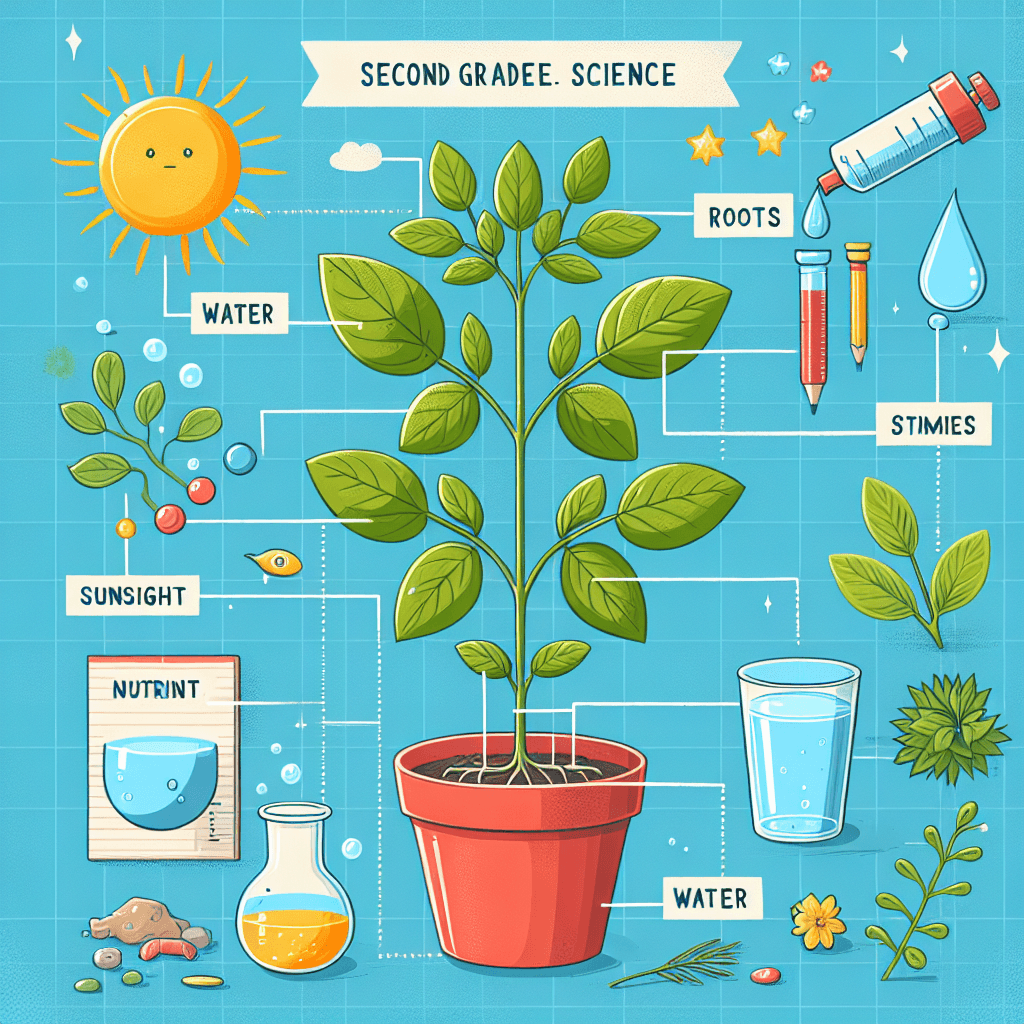
Plant Needs Investigation: A 2nd Grade Science Project
Inquiry Framework
Question Framework
Driving Question
The overarching question that guides the entire project.How can we design a self-sustaining ecosystem that meets the diverse needs of various plants and the living things around them?Essential Questions
Supporting questions that break down major concepts.- What are the basic needs of a plant?
- How do plants get what they need from their environment?
- What happens to a plant if it doesn't get enough of what it needs?
- How do different plants have different needs?
- How do plants depend on their environment and other living things?
Standards & Learning Goals
Learning Goals
By the end of this project, students will be able to:- Identify the basic needs of plants (sunlight, water, nutrients).
- Explain how plants obtain resources from their environment.
- Describe the effects of limited resources on plant growth.
- Compare the needs of different types of plants.
- Illustrate the interdependence of plants, other living things, and the environment.
- Design a self-sustaining ecosystem.
NGSS
Entry Events
Events that will be used to introduce the project to studentsThe Mysterious Case of the Wilting Wonder
A healthy plant is found dramatically wilted overnight! Students become botanical detectives, analyzing clues (soil samples, light exposure, water levels) to diagnose the problem and revive the plant. This sparks curiosity about plant needs and sets the stage for experimentation.Portfolio Activities
Portfolio Activities
These activities progressively build towards your learning goals, with each submission contributing to the student's final portfolio.Plant Needs Investigator
Students conduct preliminary research on the basic needs of plants (sunlight, water, air, nutrients) and document their findings using a KWL chart. This activity sets the foundation for understanding what a plant needs to survive and thrive.Steps
Here is some basic scaffolding to help students complete the activity.Final Product
What students will submit as the final product of the activityCompleted KWL chart documenting prior knowledge, learning goals, and research findings on plant needs.Alignment
How this activity aligns with the learning objectives & standardsAddresses learning goals: Identify the basic needs of plants (sunlight, water, nutrients); Explain how plants obtain resources from their environment. Prepares for NGSS2-LS2-1 by establishing the foundational knowledge of plant needs.Sunlight vs. Shadow Experiment
Students design and conduct a simple experiment to test the effect of sunlight on plant growth. They will grow two identical plants, one in sunlight and one in shade, observing and recording differences in growth over a set period.Steps
Here is some basic scaffolding to help students complete the activity.Final Product
What students will submit as the final product of the activityA detailed experiment report with observations, drawings, and a conclusion about the effect of sunlight on plant growth.Alignment
How this activity aligns with the learning objectives & standardsDirectly addresses NGSS2-LS2-1: Plan and conduct an investigation to determine if plants need sunlight and water to grow. Addresses learning goals: Explain how plants obtain resources from their environment; Describe the effects of limited resources on plant growth.Water Works: A Hydration Investigation
Students conduct an experiment to determine the effect of different watering levels on plant growth. They grow three identical plants, watering one regularly, one sparingly, and one excessively, observing and recording the effects.Steps
Here is some basic scaffolding to help students complete the activity.Final Product
What students will submit as the final product of the activityA comprehensive experiment report detailing watering levels, observations, drawings, and conclusions about the effect of water on plant growth.Alignment
How this activity aligns with the learning objectives & standardsDirectly addresses NGSS2-LS2-1: Plan and conduct an investigation to determine if plants need sunlight and water to grow. Addresses learning goals: Explain how plants obtain resources from their environment; Describe the effects of limited resources on plant growth.Seed Dispersal Model
Students create a model of an animal dispersing seeds or pollinating plants. This can be a physical model, a drawing, or a digital representation. They will explain how their model mimics the function of the animal in helping plants reproduce.Steps
Here is some basic scaffolding to help students complete the activity.Final Product
What students will submit as the final product of the activityA model (physical, drawn, or digital) of an animal dispersing seeds or pollinating plants, accompanied by a written explanation.Alignment
How this activity aligns with the learning objectives & standardsAddresses NGSS2-LS2-2: Develop a simple model that mimics the function of an animal in dispersing seeds or pollinating plants. Addresses learning goals: Illustrate the interdependence of plants, other living things, and the environment.Ecosystem Architect
Students design a self-sustaining ecosystem incorporating a variety of plants and considering their needs for sunlight, water, and interactions with other living things (animals, insects). They create a detailed diagram or diorama of their ecosystem, labeling the components and explaining how it meets the needs of all the plants.Steps
Here is some basic scaffolding to help students complete the activity.Final Product
What students will submit as the final product of the activityA detailed diagram or diorama of a self-sustaining ecosystem, labeled with all components and accompanied by a written explanation of how the ecosystem functions.Alignment
How this activity aligns with the learning objectives & standardsAddresses learning goals: Compare the needs of different types of plants; Illustrate the interdependence of plants, other living things, and the environment; Design a self-sustaining ecosystem. Integrates knowledge from NGSS2-LS2-1 and NGSS2-LS2-2.Rubric & Reflection
Portfolio Rubric
Grading criteria for assessing the overall project portfolioPlant Life Cycle Portfolio Rubric
Understanding Plant Needs (KWL Chart)
Demonstrates comprehension of plants' basic requirements for survival.Prior Knowledge
Accuracy and depth of initial understanding about plant needs before research.
Exemplary
4 PointsDemonstrates a sophisticated understanding of plant needs, including accurate prior knowledge and insightful questions.
Proficient
3 PointsDemonstrates a thorough understanding of plant needs, including accurate prior knowledge and relevant questions.
Developing
2 PointsShows an emerging understanding of plant needs, with some inaccuracies in prior knowledge and vague questions.
Beginning
1 PointsShows a limited understanding of plant needs, with significant gaps in prior knowledge and irrelevant questions.
Research Findings
Thoroughness and accuracy of information gathered about plant needs.
Exemplary
4 PointsPresents comprehensive and accurate research findings that demonstrate a deep understanding of plant needs and their sources.
Proficient
3 PointsPresents thorough and accurate research findings that demonstrate a clear understanding of plant needs.
Developing
2 PointsPresents some research findings, but with gaps in information or minor inaccuracies.
Beginning
1 PointsPresents limited and/or inaccurate research findings, demonstrating a minimal understanding of plant needs.
Experimental Design & Observation (Sunlight & Water)
Effectively applies the scientific method to investigate the impact of sunlight and water on plant growth.Experimental Setup
Clarity and control of variables in the sunlight and water experiments.
Exemplary
4 PointsDemonstrates a well-designed experiment with clear controls and variables, meticulously documented.
Proficient
3 PointsDemonstrates a sound experiment with appropriate controls and variables, clearly documented.
Developing
2 PointsShows an attempt at experimental design, but with some inconsistencies in controls or unclear variables.
Beginning
1 PointsShows a poorly designed experiment with little or no control of variables.
Observations & Data Recording
Accuracy, detail, and consistency of recorded observations in both experiments.
Exemplary
4 PointsProvides detailed, accurate, and consistent observations with insightful analysis of plant growth differences.
Proficient
3 PointsProvides clear, accurate, and consistent observations of plant growth differences.
Developing
2 PointsProvides some observations, but with gaps in detail or inconsistencies in accuracy.
Beginning
1 PointsProvides limited or inaccurate observations with no clear patterns identified.
Conclusion
Appropriateness of the conclusion based on experimental evidence.
Exemplary
4 PointsDraws a well-supported conclusion that clearly explains the relationship between sunlight/water and plant growth, referencing specific evidence from the experiment.
Proficient
3 PointsDraws a logical conclusion that explains the relationship between sunlight/water and plant growth, using evidence from the experiment.
Developing
2 PointsDraws a conclusion, but with limited evidence or a weak connection to the experimental results.
Beginning
1 PointsDraws an unsupported or inaccurate conclusion with no connection to the experimental results.
Modeling Interdependence (Seed Dispersal)
Demonstrates understanding of plant and animal interdependence through an accurate and functional model.Model Design & Function
Creativity, accuracy, and functionality of the seed dispersal model.
Exemplary
4 PointsCreates an innovative and highly functional model that accurately mimics the animal's role in seed dispersal, demonstrating a deep understanding of the process.
Proficient
3 PointsCreates a functional model that accurately mimics the animal's role in seed dispersal.
Developing
2 PointsCreates a model that partially mimics the animal's role in seed dispersal, but with some inaccuracies or functional limitations.
Beginning
1 PointsCreates a model that does not accurately represent the animal's role in seed dispersal or lacks functionality.
Explanation of Model
Clarity and accuracy of the written explanation of how the model works.
Exemplary
4 PointsProvides a clear, concise, and insightful explanation of how the model works and its relationship to the animal's role in seed dispersal.
Proficient
3 PointsProvides a clear and accurate explanation of how the model works and its relationship to the animal's role in seed dispersal.
Developing
2 PointsProvides an explanation of the model, but with some unclear or inaccurate information.
Beginning
1 PointsProvides a limited or confusing explanation of the model with little connection to seed dispersal.
Ecosystem Design
Creation of a balanced and self-sustaining ecosystem model incorporating diverse plant and animal needs.Ecosystem Components & Balance
Diversity and appropriateness of plants and animals included in the ecosystem design.
Exemplary
4 PointsDesigns a highly diverse and well-balanced ecosystem with careful consideration of the needs of all plants and animals, demonstrating advanced understanding of ecological relationships.
Proficient
3 PointsDesigns a diverse and balanced ecosystem with consideration of the needs of the plants and animals.
Developing
2 PointsDesigns an ecosystem with limited diversity or imbalances in the relationships between plants and animals.
Beginning
1 PointsDesigns an incomplete or unbalanced ecosystem with little consideration for the needs of the plants and animals.
Diagram/Diorama & Explanation
Clarity, detail, and accuracy of the ecosystem representation and explanation.
Exemplary
4 PointsCreates a detailed and visually appealing diagram/diorama with a comprehensive explanation of how the ecosystem functions and meets the needs of all organisms.
Proficient
3 PointsCreates a clear and detailed diagram/diorama with a well-written explanation of how the ecosystem functions.
Developing
2 PointsCreates a diagram/diorama with some details and an explanation that may lack clarity or completeness.
Beginning
1 PointsCreates an incomplete or poorly labeled diagram/diorama with a limited explanation of the ecosystem.