
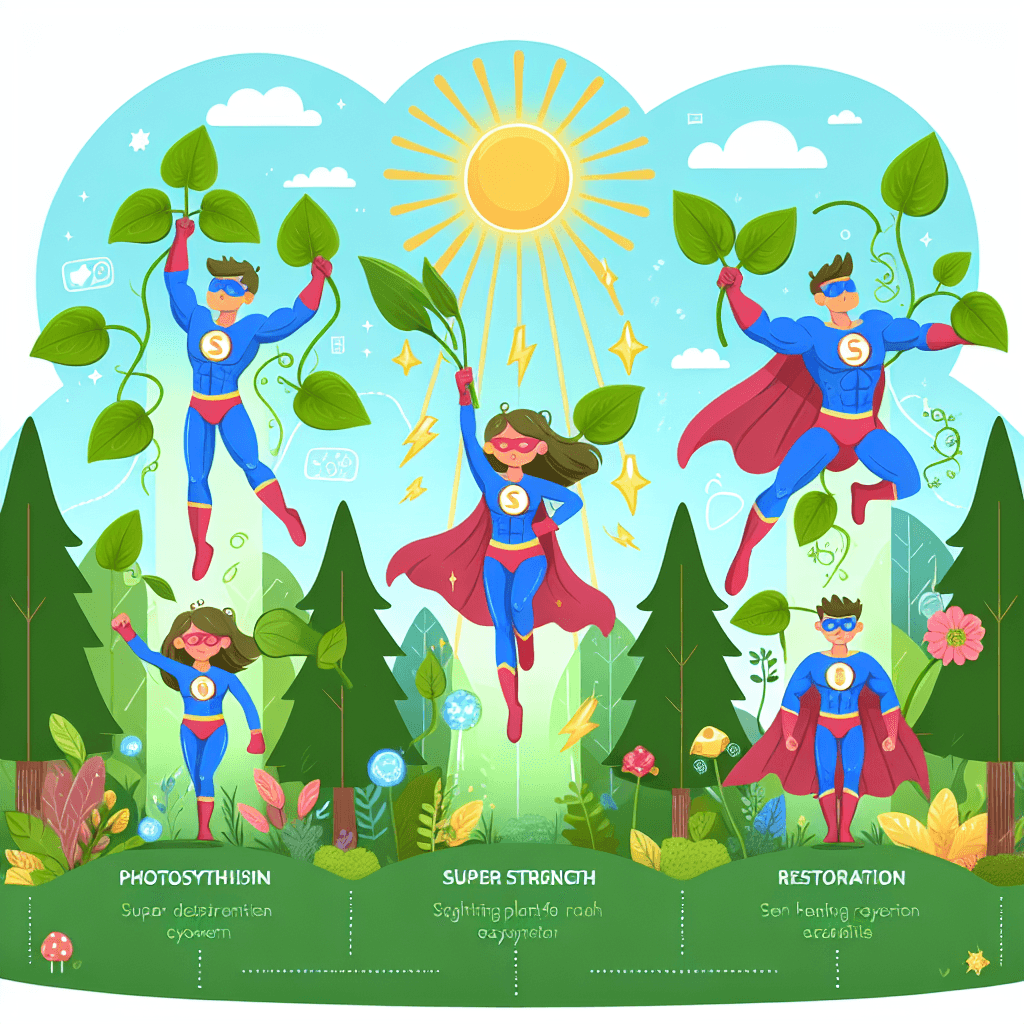
Plant Superheroes: Ecosystem Restoration
Inquiry Framework
Question Framework
Driving Question
The overarching question that guides the entire project.How can we identify and harness the superhero qualities of plants to restore and maintain a balanced ecosystem?Essential Questions
Supporting questions that break down major concepts.- What role do plants play in maintaining a balanced ecosystem?
- How do specific plants contribute to ecosystem restoration?
- What characteristics make a plant valuable for restoring ecosystems?
- Why are plants considered 'superheroes' in the context of ecosystems?
- How can we identify the most effective plants for different ecosystem restoration projects?
Standards & Learning Goals
Learning Goals
By the end of this project, students will be able to:- Understand the pivotal role of plants in ecosystem balance and restoration.
- Identify specific plants and their unique characteristics that aid in ecosystem restoration.
- Explain why certain plants are considered "superheroes" in restoring ecosystems.
- Develop research and inquiry skills to investigate ecosystem restoration.
- Combine multiple information sources to conclude the effectiveness of selected plants in different contexts.
Next Generation Science Standards (NGSS)
Common Core Standards (CCSS)
Entry Events
Events that will be used to introduce the project to studentsPlant Detective Mystery
Upon arrival, students are handed a mysterious case file detailing an ecosystem in distress. Their mission? To identify which superhero plants can save the day! Using clues and expert interviews, they must conduct research to solve the mystery, sparking curiosity about the roles of plants in environmental health.Portfolio Activities
Portfolio Activities
These activities progressively build towards your learning goals, with each submission contributing to the student's final portfolio.Superhero Plant Profile
Students create a profile for a specific 'superhero' plant that plays a vital role in ecosystem restoration. The profile will include the plant's characteristics, habitat, and its contributions to the ecosystem.Steps
Here is some basic scaffolding to help students complete the activity.Final Product
What students will submit as the final product of the activityA detailed visual and written profile of a 'superhero' plant, explaining its characteristics and role in ecosystem restoration.Alignment
How this activity aligns with the learning objectives & standardsAligned with NGSS 5-LS2-1 by exploring how specific plants move matter and contribute to ecosystem health. Also supports CCSS.ELA-LITERACY.W.5.7 by requiring students to conduct research and synthesize information from multiple sources.Ecosystem Hero Workshops
Students design and conduct workshops to teach their peers about how plants can be utilized in ecosystem restoration, emphasizing the importance of each plant's superhero qualities.Steps
Here is some basic scaffolding to help students complete the activity.Final Product
What students will submit as the final product of the activityAn interactive workshop where students teach about the plants' ecosystem superheroes role, complete with activities and presentations.Alignment
How this activity aligns with the learning objectives & standardsSupports NGSS 5-ESS3-1 by exploring scientific ways to restore ecosystems, and CCSS.ELA-LITERACY.W.5.7 by synthesizing and presenting researched information.Dynamic Plant Dialogue Enhancement
In this enhanced activity, students engage in a Socratic Seminar, focusing on the superhero qualities of plants and their role in ecosystem restoration. The activity emphasizes collaborative dialogue and critical thinking, guiding students to develop informed viewpoints.Steps
Here is some basic scaffolding to help students complete the activity.Final Product
What students will submit as the final product of the activityAn expanded reflective journal capturing personal insights, diverse opinions, and new understandings about the plants' roles in ecosystems.Alignment
How this activity aligns with the learning objectives & standardsAligned with NGSS 5-ESS3-1 by evaluating scientific discourse, and CCSS.ELA-LITERACY.W.5.7 by enhancing research, critical thinking, and synthesis skills.Ecosystem Restoration Simulation
Conduct a simulation where students assess an ecosystem in distress and devise a plant-based restoration plan, applying their understanding of plant roles and ecosystem dynamics.Steps
Here is some basic scaffolding to help students complete the activity.Final Product
What students will submit as the final product of the activityA comprehensive ecosystem restoration plan, detailing the selection and role of plants in recovering ecosystem balance.Alignment
How this activity aligns with the learning objectives & standardsAligned with NGSS 5-LS2-1 and 5-ESS3-1 by applying understanding of matter movement and scientific restoration strategies in real-world contexts, also meeting CCSS.ELA-LITERACY.W.5.7 by combining information to construct the restoration plan.Community Action Proposal
Students develop a proposal for a community initiative to use plants in local ecosystem restoration projects, integrating all they have learned throughout the project.Steps
Here is some basic scaffolding to help students complete the activity.Final Product
What students will submit as the final product of the activityA formal proposal and presentation for a community action plan to employ plants in local ecosystem restoration efforts.Alignment
How this activity aligns with the learning objectives & standardsMeets NGSS 5-ESS3-1 by proposing science-based community action for environmental protection. Incorporates CCSS.ELA-LITERACY.W.5.7 through the integration and presentation of research findings in a real-world context.Rubric & Reflection
Portfolio Rubric
Grading criteria for assessing the overall project portfolioSuperhero Plants and Ecosystem Restoration Rubric
Research and Information Synthesis
Ability to conduct research using multiple sources to gather, evaluate and synthesize information regarding plant roles in ecosystems.Research Skills
Evaluates ability to effectively conduct research and gather relevant information.
Exemplary
4 PointsStudent uses a wide array of credible sources to gather comprehensive and detailed information, demonstrating advanced research skills.
Proficient
3 PointsStudent uses multiple credible sources to gather sufficient detail about the plant’s role in the ecosystem.
Developing
2 PointsStudent uses limited sources and gathers some relevant information but lacks depth.
Beginning
1 PointsStudent struggles to effectively research and gather relevant information, resulting in incomplete data collection.
Information Synthesis
Measures ability to synthesize information into coherent, comprehensive outputs.
Exemplary
4 PointsInformation is synthesized into an insightful and well-organized presentation, showcasing clear connections to ecosystem roles.
Proficient
3 PointsInformation is effectively synthesized to provide a clear overview of the plant’s ecosystem role.
Developing
2 PointsInformation synthesis is attempted with partial effectiveness, showing gaps in clarity and organization.
Beginning
1 PointsLittle to no synthesis of information is evident, with significant gaps in clarity and organization.
Creative Presentation and Engagement
Effectiveness of visual and oral communication to convey research findings and engage audience.Visual Design
Quality and creativity in the design of visual materials used in presentations.
Exemplary
4 PointsVisuals are highly creative, well-structured, and thoroughly elucidate the presented content.
Proficient
3 PointsVisuals are clear and structured, aiding in the understanding of the content.
Developing
2 PointsVisuals provide some information but lack creativity or clarity, affecting understanding.
Beginning
1 PointsVisuals are unclear or lacking essential information, hindering understanding.
Engagement and Delivery
Evaluates engagement strategies and the effectiveness of oral delivery in presentations.
Exemplary
4 PointsPresentation is highly engaging, stimulating audience interest and demonstrating leadership in delivery.
Proficient
3 PointsPresentation is clear and maintains audience interest with effective delivery techniques.
Developing
2 PointsPresentation captures some audience interest but lacks full clarity and dynamism.
Beginning
1 PointsPresentation lacks engagement and clarity, needing substantial support.
Collaborative Skills and Reflection
Ability to work collaboratively, participate in discussions, and reflect on learning experiences.Collaboration
Assesses participation and collaboration within group activities.
Exemplary
4 PointsTakes leadership roles in collaboration, contributing significantly and encouraging group dynamics.
Proficient
3 PointsContributes effectively to group work, engaging in constructive dialogue.
Developing
2 PointsParticipates in group work with limited input, contributing inconsistently.
Beginning
1 PointsMinimal participation in group work, requiring support and guidance.
Reflective Thought
Evaluates the depth of reflection upon learning experiences and insights gained.
Exemplary
4 PointsReflection shows deep insights and synthesis of personal learning and group discussions.
Proficient
3 PointsReflection provides clear insights into personal learning and group discussions.
Developing
2 PointsReflection provides limited insights with partial depth and synthesis.
Beginning
1 PointsReflection lacks depth and insight, with superficial synthesis.