
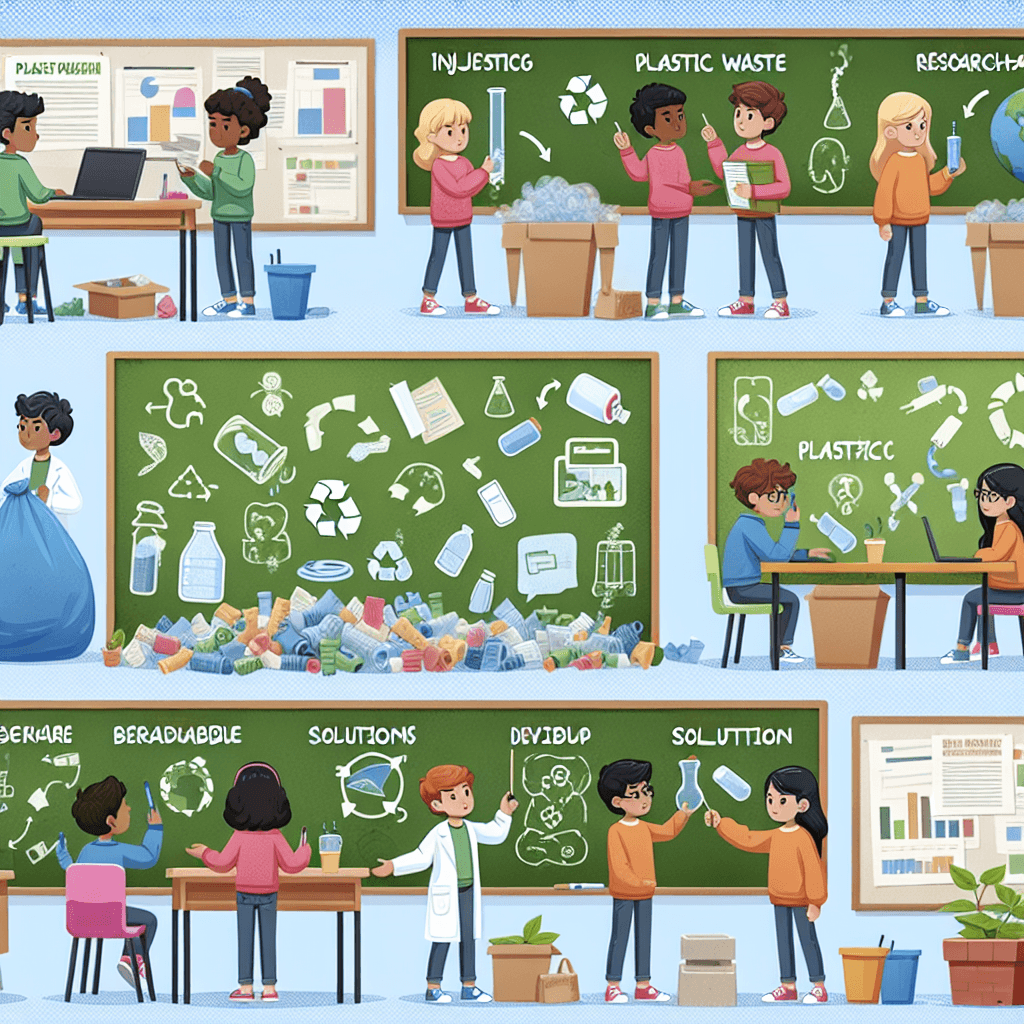
Plastic Impact Investigation: Solutions for Reduction
Inquiry Framework
Question Framework
Driving Question
The overarching question that guides the entire project.How can we understand and mitigate the impact of plastic on the environment and health while promoting sustainable practices to reduce its use and manage waste effectively?Essential Questions
Supporting questions that break down major concepts.- What is the current impact of plastic on the environment and wildlife?
- How does plastic affect human health?
- What are the different types of plastic and how are they used?
- Why is it important to reduce plastic use?
- What solutions currently exist to reduce plastic use and waste?
- How can individuals and communities contribute to reducing plastic pollution?
- How does recycling work and why is it important in managing plastic waste?
Standards & Learning Goals
Learning Goals
By the end of this project, students will be able to:- Investigate the impact of plastic on the environment and wildlife.
- Describe how plastic affects human health.
- Differentiate between various types of plastics and their uses.
- Explain the importance of reducing plastic use.
- Identify existing solutions to reduce plastic use and waste.
- Develop and propose new strategies for individuals and communities to reduce plastic pollution.
- Understand and explain how recycling works and its importance in managing plastic waste.
NGSS
Entry Events
Events that will be used to introduce the project to studentsOcean in the Classroom
Transform the classroom into a virtual ocean filled with images and artifacts showing plastic pollution. Begin with an emotionally-provoking short film showing the journey of a plastic bottle from a store shelf to the ocean aftermath, inviting students to explore how they can make a difference.The Plastic Detective
Invite students to become detectives by examining common household and classroom items to identify their plastic components. Present a mystery to solve: How can we live without these items? This scavenger hunt encourages students to consider alternatives and innovations.Portfolio Activities
Portfolio Activities
These activities progressively build towards your learning goals, with each submission contributing to the student's final portfolio.Plastic Impact Explorers
Students dive into the task of understanding the impact of plastic on the environment by researching real-world case studies, scientific articles, and documentaries. This sets a foundational context for the issues surrounding plastic pollution and introduces them to how it affects ecosystems and human health.Steps
Here is some basic scaffolding to help students complete the activity.Final Product
What students will submit as the final product of the activityA research journal detailing findings on how plastic impacts the environment, wildlife, and human health.Alignment
How this activity aligns with the learning objectives & standardsAligns with 5-ESS3-1 by combining information about how environmental resources are affected by plastic pollution.The Plastic Identifier Challenge
This activity encourages students to explore and classify different types of plastics based on their properties. By examining everyday items, students learn about diverse plastic materials, their uses, and begin to question their necessity, promoting critical thinking.Steps
Here is some basic scaffolding to help students complete the activity.Final Product
What students will submit as the final product of the activityA categorized chart of different plastics with their properties and uses, accompanied by reflective notes on their necessity.Alignment
How this activity aligns with the learning objectives & standardsSupports 5-PS1-3 by making observations and measurements to identify materials.Plastic Movement Model Makers
Students develop a model describing how plastic moves through and affects ecosystems. They create visual representations showing the journey of plastic matter through various environmental tissues and its interactions with living organisms.Steps
Here is some basic scaffolding to help students complete the activity.Final Product
What students will submit as the final product of the activityA comprehensive model (physical or digital) illustrating plastic's movement through ecosystems and its environmental impact.Alignment
How this activity aligns with the learning objectives & standardsAligns with 5-LS2-1 by developing a model to describe the movement of matter.Rubric & Reflection
Portfolio Rubric
Grading criteria for assessing the overall project portfolioImpact of Plastic Investigation Rubric
Research & Information Gathering
Evaluation of students' ability to research and gather information from multiple sources accurately and effectively.Quality of Research
Assesses the depth and reliability of the information collected from various sources such as articles, documentaries, and case studies.
Exemplary
4 PointsThe research is comprehensive, incorporating a wide range of reliable sources with critical analysis of data.
Proficient
3 PointsThe research includes relevant information from multiple reliable sources with some analysis.
Developing
2 PointsResearch is primarily based on a limited number of sources with basic analysis.
Beginning
1 PointsResearch lacks depth and relies on singular or unreliable sources with little or no analysis.
Note Organization
Measures the ability to organize and categorize research notes effectively.
Exemplary
4 PointsNotes are well-organized, creating clear categories for environmental effects, effects on wildlife, and human health concerns.
Proficient
3 PointsNotes are generally organized with relevant categories created.
Developing
2 PointsNotes show some organization but categories may be incomplete or unclear.
Beginning
1 PointsNotes are poorly organized with unclear or missing categories.
Critical Thinking & Analysis
Assessment of students' ability to analyze the implications of plastic use and impact on environment and health.Impact Analysis
Evaluates the analysis of plastic's impact on the environment, wildlife, and human health.
Exemplary
4 PointsDemonstrates a thorough understanding of the complex impact of plastics, supported by well-reasoned arguments.
Proficient
3 PointsShows a clear understanding of the impact of plastics with logical rationale.
Developing
2 PointsAnalysis is present but lacks depth or comprehensive understanding.
Beginning
1 PointsMinimal analysis provided, lacking coherent understanding of impacts.
Solution Development
Measures creativity and feasibility of proposed solutions to reduce plastic use and manage waste.
Exemplary
4 PointsProposes innovative, realistic solutions with a detailed plan for reduction and waste management.
Proficient
3 PointsSuggests feasible solutions for reducing plastic use with basic planning.
Developing
2 PointsSolutions are simplistic or lack feasibility in real-world application.
Beginning
1 PointsFew or unrealistic solutions provided, lacking clarity and detail.
Collaboration & Communication
Assessment of collaborative efforts and communication skills during group work and presentation of research findings.Contribution to Group Work
Evaluates the participation and leadership in collaborative tasks among peers.
Exemplary
4 PointsLeads group participation, fostering a productive and inclusive working environment.
Proficient
3 PointsContributes effectively to group tasks with active participation.
Developing
2 PointsParticipates in group work but contributions vary in significance.
Beginning
1 PointsLimited participation, requiring guidance to be involved in group activities.
Clarity of Presentation
Assesses the effectiveness of presenting research and solutions to peers and teachers.
Exemplary
4 PointsPresents findings with exceptional clarity, engaging visuals, and comprehensive detail.
Proficient
3 PointsClearly presents research with supporting visuals and information.
Developing
2 PointsPresentation is clear but lacks detailed explanation or engaging visuals.
Beginning
1 PointsPresentation lacks clarity and detail, with limited use of visuals.