
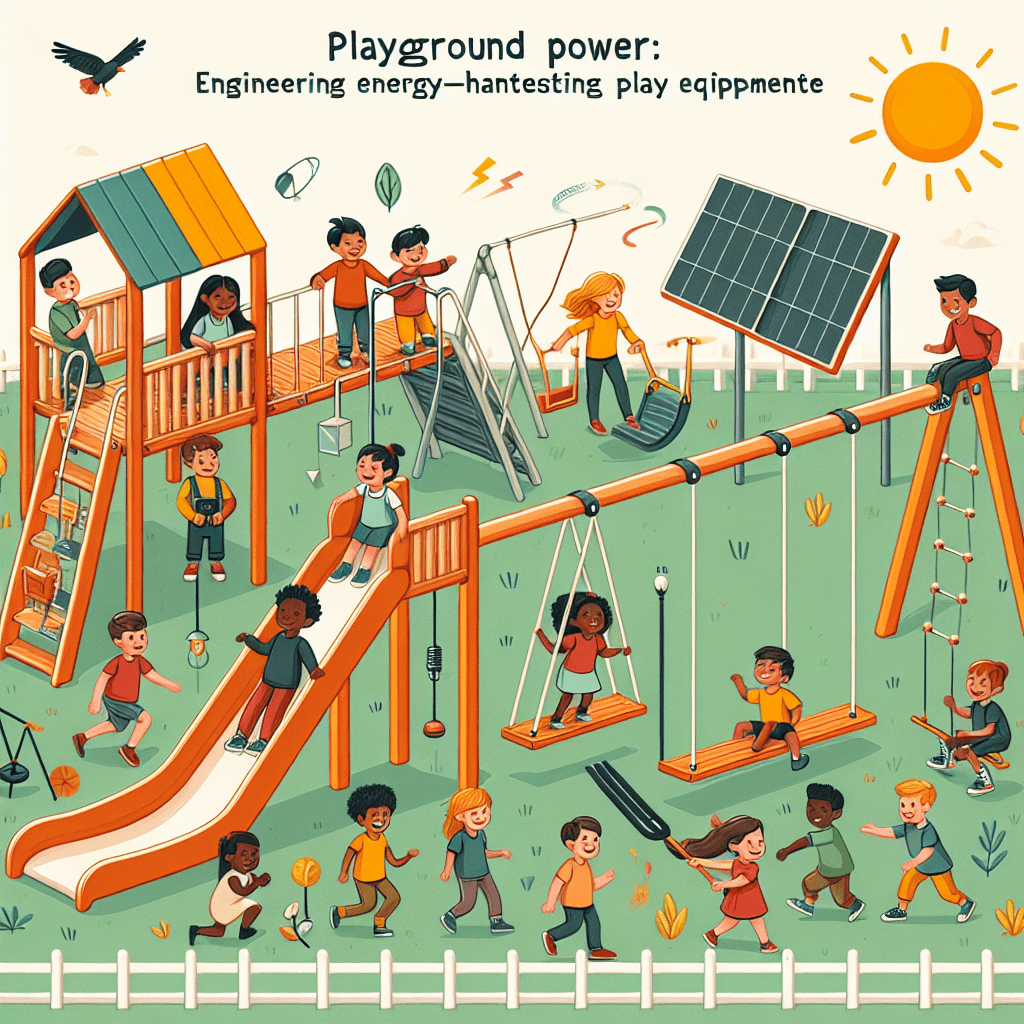
Playground Power: Engineering Energy-Harvesting Play Equipment
Inquiry Framework
Question Framework
Driving Question
The overarching question that guides the entire project.How can we design energy-harvesting playground equipment that is fun, safe, and efficient, and use scientific evidence to persuade city leaders that our "Kinetic Playground" will power a more sustainable community?Essential Questions
Supporting questions that break down major concepts.- How can kinetic energy from human movement be captured and transformed into usable electrical energy?
- What design features maximize the efficiency of energy-harvesting playground equipment without compromising fun or safety?
- How can we use mathematical data and physics principles to prove the feasibility of our playground designs?
- How do effective communicators translate complex scientific data into clear, persuasive arguments for a non-expert audience?
- In what ways can a 'Kinetic Playground' contribute to a city's sustainability goals and community well-being?
Standards & Learning Goals
Learning Goals
By the end of this project, students will be able to:- Analyze and explain the transformation of kinetic energy into electrical energy within a mechanical system.
- Design and iterate on a prototype of playground equipment that maximizes energy-harvesting efficiency while maintaining safety and playability.
- Collect, interpret, and present scientific data to support claims about the feasibility and sustainability of an engineering design.
- Construct and deliver a persuasive pitch that translates complex physics data into clear, actionable insights for a non-scientific audience (city board).
Common Core State Standards (ELA)
Next Generation Science Standards (NGSS)
Entry Events
Events that will be used to introduce the project to studentsThe 'Dark Park' Crisis Call
Students enter a darkened classroom to find a video message from the City Parks Commissioner. The city is facing a massive energy crisis and a skyrocketing utility bill; they are threatening to remove all park lighting and Wi-Fi unless the community can find a way to make the playground 'off-grid' and self-sustaining.Portfolio Activities
Portfolio Activities
These activities progressively build towards your learning goals, with each submission contributing to the student's final portfolio.Energy Alchemy: Mapping the Flow
Before building, students must understand the 'magic' behind their invention. In this activity, students investigate the physics of standard playground equipment (swings, slides, merry-go-rounds) to identify where potential energy is stored and how it transforms into kinetic energy. They will then research 'Energy Harvesting' (using electromagnetic induction or piezoelectrics) to determine how that motion can be 'tapped' to create electricity.Steps
Here is some basic scaffolding to help students complete the activity.Final Product
What students will submit as the final product of the activityAn 'Energy Flow Map' (an annotated infographic) that labels points of maximum potential energy, kinetic energy, and the specific location where energy-harvesting technology would be integrated.Alignment
How this activity aligns with the learning objectives & standardsThis activity aligns with MS-PS3-2 (Developing a model to describe potential energy) and MS-PS3-5 (Constructing arguments about kinetic energy transfer). It specifically targets the learning goal of analyzing and explaining the transformation of energy within a mechanical system.The Playground Blueprint: Safety & Specs
Engineers don't just build; they plan within limits. Students will act as Lead Designers to define the 'Rules of the Playground.' They must identify the 'Criteria' (what makes it fun and how much energy it must produce) and the 'Constraints' (safety regulations, cost of materials, and space). This ensures their final design is actually feasible for a city board to approve.Steps
Here is some basic scaffolding to help students complete the activity.Final Product
What students will submit as the final product of the activityA 'Design Manifest'—a formal document that lists all engineering constraints, safety requirements, and a technical sketch of the proposed equipment.Alignment
How this activity aligns with the learning objectives & standardsThis activity aligns with MS-ETS1-1 (Defining the criteria and constraints of a design problem). It requires students to balance the scientific need for energy efficiency with the human needs of safety and enjoyment.The Data Dynamo Lab
Now it's time to prove it works! Students build a small-scale prototype (using materials like cardboard, magnets, wire, or LEGO Technic) and conduct trials. They will measure the 'output'—this could be measured in volts using a multimeter or by the distance a weight is lifted—and record how changes in movement (speed/mass) affect the energy harvested.Steps
Here is some basic scaffolding to help students complete the activity.Final Product
What students will submit as the final product of the activityA 'Performance Data Dashboard' consisting of data tables, a line graph showing the relationship between movement and energy, and a summary of the 'Best-Case Scenario' for energy production.Alignment
How this activity aligns with the learning objectives & standardsThis activity aligns with MS-PS3-5 (Presenting arguments supported by claims that energy is transferred). It also meets the learning goal of collecting and interpreting scientific data to prove feasibility.The Boardroom Persuader: The Grand Pitch
The City Board is skeptical and busy. They don't need a lecture on physics; they need a persuasive argument for why your playground is the solution to the 'Dark Park' crisis. In this final activity, students synthesize their energy maps, design specs, and data into a professional pitch. They must focus on their delivery, eye contact, and the 'So What?'—why this project matters for the community's future.Steps
Here is some basic scaffolding to help students complete the activity.Final Product
What students will submit as the final product of the activityThe 'Kinetic Pitch Package'—a 3-minute persuasive presentation accompanied by a visual slide deck and a one-page executive summary for the 'City Board.'Alignment
How this activity aligns with the learning objectives & standardsThis activity aligns directly with CCSS.ELA-LITERACY.SL.7.4 (Presenting claims and findings in a focused, coherent manner). It also addresses the final learning goal of translating complex physics into a persuasive pitch.Rubric & Reflection
Portfolio Rubric
Grading criteria for assessing the overall project portfolioKinetic Playground: Physics & Persuasion Rubric
Scientific Modeling & Energy Transformation
Assesses the student's ability to apply physics principles to the movement of playground equipment and the subsequent harvesting of energy.Energy States Modeling (MS-PS3-2)
Ability to accurately identify and model the relationship between potential and kinetic energy within the mechanical system of playground equipment.
Exemplary
4 PointsModel provides a highly sophisticated and precise representation of energy states, correctly identifying subtle transitions and maximizing the clarity of the potential-to-kinetic relationship with innovative visual cues.
Proficient
3 PointsModel clearly and accurately identifies points of maximum potential and kinetic energy within the system, using standard scientific conventions and clear labeling.
Developing
2 PointsModel identifies potential and kinetic energy, but may contain minor inaccuracies in placement or inconsistent use of scientific terminology.
Beginning
1 PointsModel shows a beginning understanding of energy states but lacks specific labels or contains significant inaccuracies regarding energy placement.
Transformation Explanation (MS-PS3-5)
Accuracy and depth of the explanation regarding how kinetic energy from human motion is transferred and transformed into electrical energy.
Exemplary
4 PointsExplanation offers a deep, nuanced understanding of energy transformation (e.g., induction or piezoelectricity), using advanced vocabulary and logical flow to explain the 'Physics Flow' seamlessly.
Proficient
3 PointsExplanation accurately describes the transformation from kinetic to electrical energy using appropriate vocabulary like 'transfer,' 'transformation,' and 'Joules.'
Developing
2 PointsExplanation identifies the change in energy but uses scientific vocabulary inconsistently or lacks a clear step-by-step logical flow.
Beginning
1 PointsExplanation is incomplete or contains significant misconceptions about how motion is converted into electricity.
Engineering Design & Systems Thinking
Assesses the engineering mindset, focusing on how well students plan, define limits, and visualize their energy-harvesting solutions.Criteria and Constraints (MS-ETS1-1)
The ability to define specific criteria (fun, efficiency) and constraints (safety, cost, materials) for the engineering design.
Exemplary
4 PointsManifest defines exceptionally precise criteria and constraints that go beyond basic requirements, anticipating potential environmental impacts and long-term community benefits.
Proficient
3 PointsManifest clearly defines relevant criteria and constraints, ensuring the design is safe, fun, and meets specific energy-harvesting goals.
Developing
2 PointsManifest lists some criteria and constraints, but they may be vague or fail to fully address safety or efficiency requirements.
Beginning
1 PointsManifest lacks a clear definition of what makes the project successful or fails to identify major safety and material constraints.
Technical Design & Sketching
Quality and detail of the technical drawings and the integration of energy-harvesting technology into the playground design.
Exemplary
4 PointsTechnical sketches are professional-grade, multi-view drawings that clearly illustrate the complex integration of mechanical and electrical components with high precision.
Proficient
3 PointsTechnical sketches include front, side, and top views that clearly show how the energy-harvesting mechanism fits into the playground equipment design.
Developing
2 PointsSketches are provided but lack multiple perspectives or fail to clearly show how the energy-harvesting technology is integrated.
Beginning
1 PointsSketches are messy, incomplete, or do not illustrate a functional connection between the equipment and the energy generator.
Data Analysis & Evidence-Based Claims
Assesses the student's ability to use the scientific method to test their designs and use mathematical evidence to support their conclusions.Data Collection & Interpretation
Effectiveness of data collection during prototype trials and the ability to represent that data through professional tables and graphs.
Exemplary
4 PointsData is meticulously recorded over multiple trials with high precision; graphs show sophisticated trends and identify the 'Sweet Spot' with mathematical accuracy.
Proficient
3 PointsData is organized into clean, professional tables and a clear line graph that accurately illustrates the relationship between movement and energy output.
Developing
2 PointsData is present but may be disorganized; graphs may have labeling errors or fail to clearly show the relationship between variables.
Beginning
1 PointsData collection is minimal or missing; tables and graphs are incomplete or do not reflect the results of the prototype trials.
Evidence-Based Claims (MS-PS3-5)
Using experimental data to construct a persuasive argument regarding the feasibility and efficiency of the design.
Exemplary
4 PointsArgument uses data to build a compelling, evidence-based narrative that anticipates counter-arguments and provides a comprehensive proof of feasibility.
Proficient
3 PointsArgument uses data from the dashboard to support the claim that the equipment is efficient and feasible for real-world application.
Developing
2 PointsArgument makes claims about the design but provides limited or disconnected data to support those claims.
Beginning
1 PointsArgument is based on opinion rather than experimental data or lacks a clear connection to the scientific trials conducted.
Strategic Communication & Public Speaking
Assesses the student's ability to fulfill the role of an 'Effective Communicator' by pitching their engineering solution to a public board.Oral Presentation Delivery (SL.7.4)
Ability to present findings in a focused, coherent manner with appropriate delivery techniques (eye contact, volume, pronunciation).
Exemplary
4 PointsPresentation is exceptionally polished and engaging; speaker uses rhetorical devices and perfect delivery to command the room and inspire the audience.
Proficient
3 PointsPresentation is focused and coherent; speaker maintains good eye contact, uses adequate volume, and pronounces scientific terms clearly.
Developing
2 PointsPresentation follows a basic structure but the speaker may struggle with eye contact, volume, or clear pronunciation of complex terms.
Beginning
1 PointsPresentation is disorganized or difficult to hear; speaker avoids eye contact and fails to engage the audience.
Content Synthesis & Persuasion
The ability to translate complex scientific data into clear, persuasive benefits for a non-expert audience (The City Board).
Exemplary
4 PointsSynthesizes data into a powerful community narrative that makes the complex physics feel essential and easily understandable for any layperson.
Proficient
3 PointsSuccessfully translates technical data (volts/joules) into clear community benefits (lighting/Wi-Fi), making a persuasive case for the project.
Developing
2 PointsAttempts to translate data but remains too technical or fails to clearly connect the physics to the 'So What?' for the community.
Beginning
1 PointsPitch is either purely technical or purely emotional, failing to bridge the gap between scientific evidence and persuasive argument.