
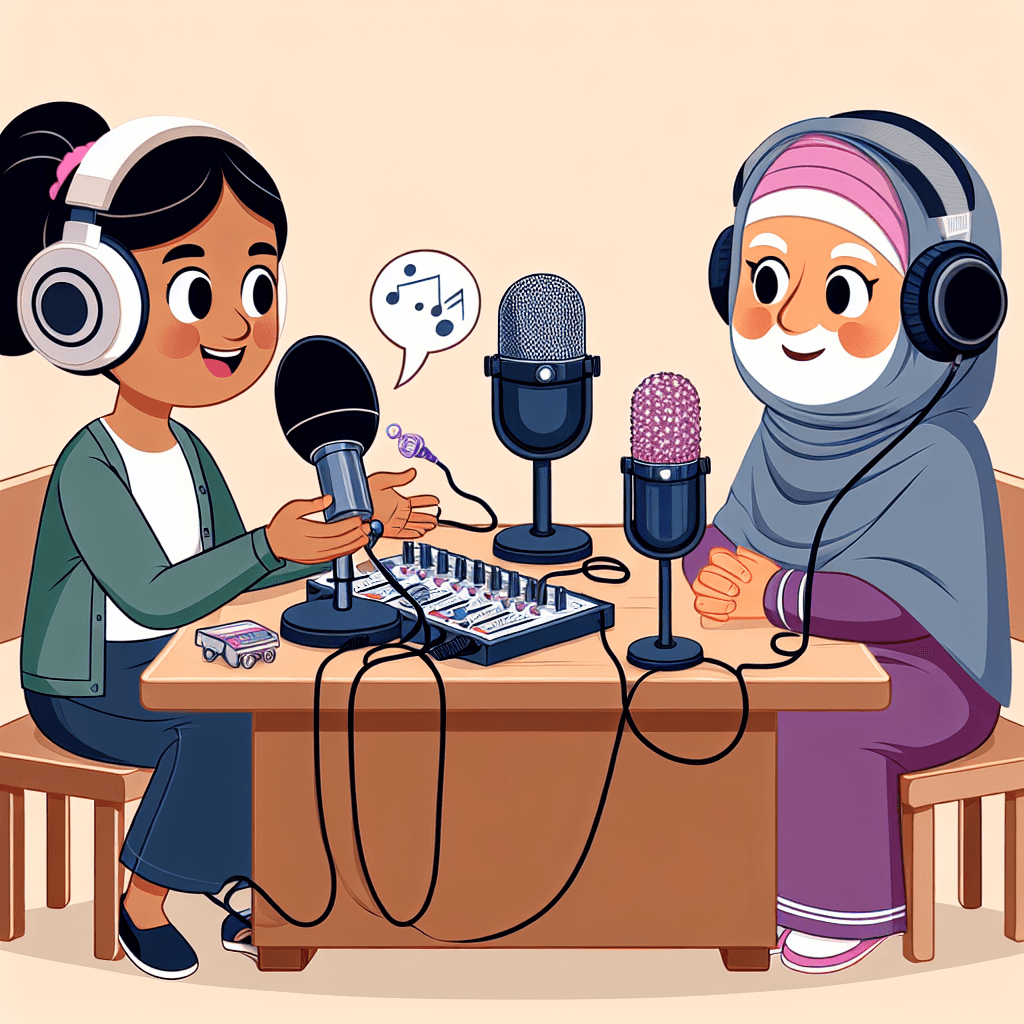
Podcasting Pioneers: Interviewing Famous Female Scientists
Inquiry Framework
Question Framework
Driving Question
The overarching question that guides the entire project.How can we, as podcast creators, use storytelling to highlight the groundbreaking contributions of female scientists and the challenges they overcame, in order to engage a broad audience and inspire future generations?Essential Questions
Supporting questions that break down major concepts.- How do scientists overcome challenges and biases in their fields?
- What are the key elements of an engaging and informative podcast?
- How can we use storytelling to make complex scientific concepts accessible to a wider audience?
- In what ways have female scientists shaped our understanding of the world?
Standards & Learning Goals
Learning Goals
By the end of this project, students will be able to:- Research the lives and accomplishments of female scientists.
- Develop interviewing skills through role-playing and podcast creation.
- Improve storytelling techniques to engage a broad audience.
- Understand the historical context and challenges faced by women in STEM.
- Enhance communication and collaboration skills through group work.
Entry Events
Events that will be used to introduce the project to studentsThe Impossible Challenge
Present students with a seemingly impossible scientific challenge that requires a breakthrough solution. Divide them into teams, each assigned the persona of a different female scientist from history. Teams must research their assigned scientist's work and apply her methods/discoveries to develop a creative solution to the challenge, fostering collaboration and innovative problem-solving.Portfolio Activities
Portfolio Activities
These activities progressively build towards your learning goals, with each submission contributing to the student's final portfolio.Scientist Spotlight: Biographical Beginnings
Students will select a female scientist to research and create a detailed biography.Steps
Here is some basic scaffolding to help students complete the activity.Final Product
What students will submit as the final product of the activityA one-page biography including key achievements, challenges, and contributions.Alignment
How this activity aligns with the learning objectives & standardsAddresses the learning goal: Research the lives and accomplishments of female scientists.Breaking Barriers: Historical Context Analysis
Students will analyze the social and historical context in which their chosen scientist lived and worked, focusing on the challenges and biases she faced as a woman in STEM.Steps
Here is some basic scaffolding to help students complete the activity.Final Product
What students will submit as the final product of the activityA short essay (500 words) detailing the historical context and challenges faced by their scientist.Alignment
How this activity aligns with the learning objectives & standardsAddresses the learning goal: Understand the historical context and challenges faced by women in STEM.The Interview Prep: Question Crafting & Role-Play
Students will develop interview questions tailored to their chosen scientist and practice their interviewing techniques through role-playing.Steps
Here is some basic scaffolding to help students complete the activity.Final Product
What students will submit as the final product of the activityA list of interview questions and a recording of a mock interview.Alignment
How this activity aligns with the learning objectives & standardsAddresses the learning goal: Develop interviewing skills through role-playing and podcast creation.Scripting Success: Crafting the Podcast Narrative
Students will create a script for their fictional podcast episode, incorporating storytelling techniques to make the scientist’s story engaging and accessible to a broad audience.Steps
Here is some basic scaffolding to help students complete the activity.Final Product
What students will submit as the final product of the activityA detailed podcast script, including narration, interview questions, and sound effects.Alignment
How this activity aligns with the learning objectives & standardsAddresses the learning goals: Improve storytelling techniques to engage a broad audience and Enhance communication and collaboration skills through group work.Mic Drop: Recording & Editing the Podcast
Students will record and edit their podcast episode, using audio editing software to create a polished final product.Steps
Here is some basic scaffolding to help students complete the activity.Final Product
What students will submit as the final product of the activityA fully edited podcast episode, ready for distribution.Alignment
How this activity aligns with the learning objectives & standardsAddresses the learning goals: Develop interviewing skills through role-playing and podcast creation, Improve storytelling techniques to engage a broad audience, Enhance communication and collaboration skills through group work.Rubric & Reflection
Portfolio Rubric
Grading criteria for assessing the overall project portfolioPodcast Creation and Historical Analysis Rubric
Research and Historical Analysis
Evaluation of the research depth and historical context understanding related to the chosen scientist.Research Accuracy and Depth
Assessment of the accuracy and depth of research on the chosen scientist, including biographies and historical context.
Exemplary
4 PointsDemonstrates comprehensive research with a strong grasp of the scientist's life, work, and significant contributions, using multiple, credible sources.
Proficient
3 PointsConducts detailed research with a clear understanding of the scientist's achievements and life, utilizing credible sources with minor omissions.
Developing
2 PointsShows partial research with some correct information about the scientist's life and contributions, but lacks depth and some inaccuracies present.
Beginning
1 PointsProvides limited research with significant gaps and inaccuracies in understanding the scientist's contributions and life.
Historical Context and Analysis
Evaluation of the understanding and articulation of the social and historical challenges faced by the scientist due to her gender.
Exemplary
4 PointsOffers insightful analysis of the historical and social context, clearly explaining challenges faced by the scientist in an engaging manner.
Proficient
3 PointsProvides a thorough analysis of the historical context with a good explanation of the challenges faced by the scientist, though lacking some depth.
Developing
2 PointsDescribes historical context with minimal analysis, including some challenges faced but missing critical insights.
Beginning
1 PointsShows limited explanation of historical context and challenges, with minimal insight into the scientist's circumstances.
Storytelling and Script Development
Assessment of the storytelling elements and script quality in conveying the scientist's story engagingly and accurately.Narrative Development and Creativity
Evaluation of creativity and engagement in the storytelling elements, including narrative flow and use of anecdotes.
Exemplary
4 PointsCrafts a compelling, creative narrative that captivates the audience, using vivid details and well-integrated anecdotes.
Proficient
3 PointsDevelops a coherent and engaging narrative with some creative elements, effectively using anecdotes to enhance the story.
Developing
2 PointsCreates a basic narrative with limited engagement and creative elements, lacking coherent flow and detail.
Beginning
1 PointsPresents a disjointed narrative with minimal storytelling elements or creativity, failing to engage the audience.
Script Clarity and Structure
Evaluation of the script's logical organization, coherence, and use of sound effects/music to enhance engagement.
Exemplary
4 PointsProduces a well-structured, clear script with logical flow and effective integration of sound effects/music, enhancing audience engagement.
Proficient
3 PointsWrites a clear script with logical structure, incorporating sound effects/music effectively, though with minor structural issues.
Developing
2 PointsProduces a script with basic structure and clarity, with some use of sound effects/music, but lacking effective integration.
Beginning
1 PointsCreates a poorly structured script with little clarity or use of sound effects/music, resulting in limited audience engagement.
Technical Production and Collaboration
Assessment of the technical quality of the podcast and collaboration during the production process.Audio Quality and Editing
Evaluation of the sound quality, editing proficiency, and use of audio effects/music in the podcast production.
Exemplary
4 PointsAchieves excellent audio quality with seamless editing and effective use of sound effects/music, resulting in a professional-grade podcast.
Proficient
3 PointsProduces good audio quality with minor editing flaws, effectively using some sound effects/music.
Developing
2 PointsProvides variable audio quality with noticeable editing issues and limited use of effects/music.
Beginning
1 PointsPresents poor audio quality with significant editing errors and minimal use of effects/music, impairing professionalism.
Collaboration and Peer Feedback
Assessment of teamwork, collaboration, and the ability to provide and incorporate constructive feedback.
Exemplary
4 PointsDemonstrates outstanding collaboration with peers, effectively incorporating feedback to improve the final product.
Proficient
3 PointsParticipates effectively in collaboration, using feedback to make useful revisions, with room for enhanced integration.
Developing
2 PointsShows basic collaboration skills with limited feedback integration, requiring guidance to enhance teamwork.
Beginning
1 PointsStruggles with collaboration and feedback incorporation, minimally contributing to team efforts.