
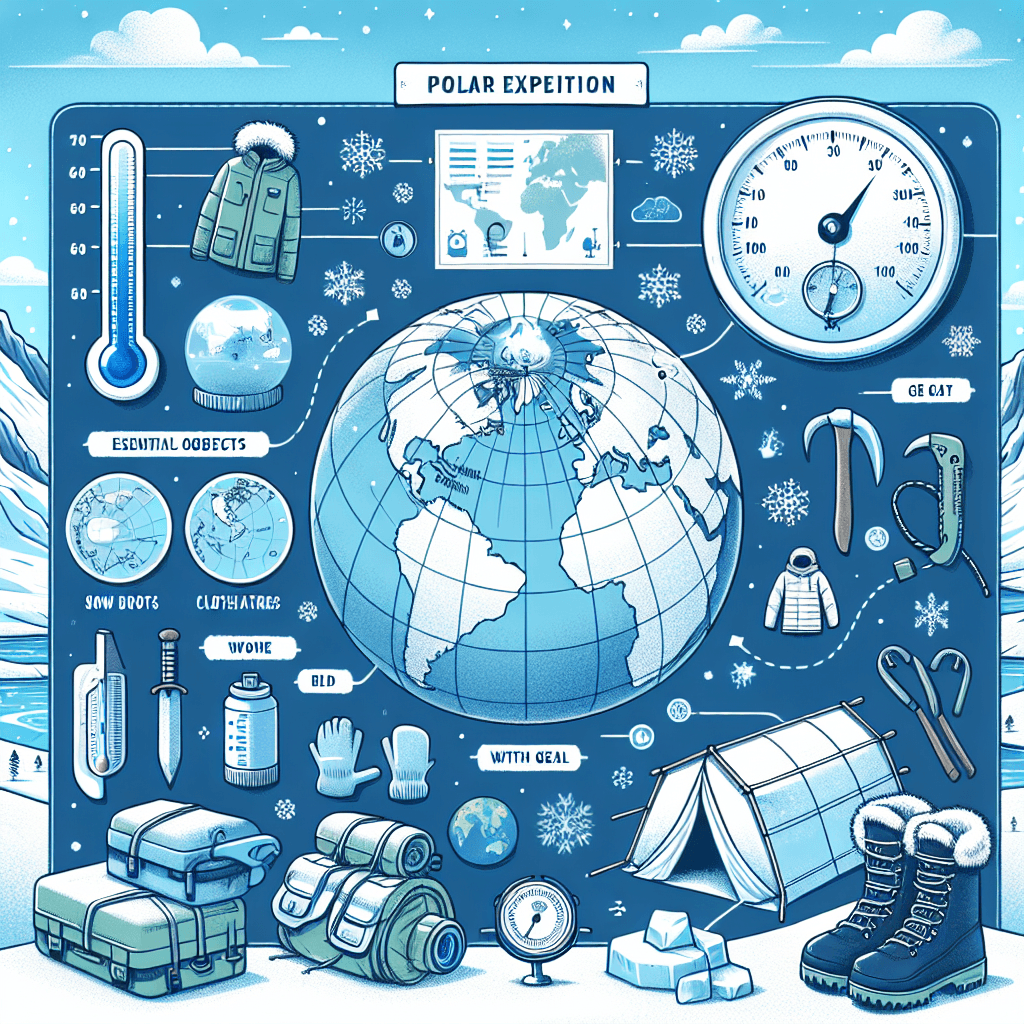
Polar Expedition Planning: Temperature Challenges
Inquiry Framework
Question Framework
Driving Question
The overarching question that guides the entire project.How can we use positive and negative numbers to understand and ensure our safety while planning and conducting a polar expedition, considering the tools, resources, and adaptations needed for extreme temperatures?Essential Questions
Supporting questions that break down major concepts.- What are the positive and negative numbers, and how can they help us understand temperatures?
- How can understanding of positive and negative numbers help us safely plan a polar expedition?
- What tools and resources can we use to measure and record temperatures in a polar climate?
- How do animals and humans adapt to extreme temperatures in the polar regions?
- What safety measures should one consider when planning a journey in polar environments?
Standards & Learning Goals
Learning Goals
By the end of this project, students will be able to:- Understand and apply the concept of positive and negative numbers to real-world scenarios, specifically in measuring temperatures.
- Develop planning and problem-solving skills by simulating a polar expedition, taking into account the tools and safety measures required.
- Analyze and interpret data related to temperatures using positive and negative numbers to make informed decisions for safety in polar environments.
- Explore and describe adaptations of animals and humans to extreme temperatures, enhancing understanding of environmental interactions.
- Utilize mathematical operations like addition and subtraction in practical situations involving temperature variations.
Common Core Standards
Next Generation Science Standards
Entry Events
Events that will be used to introduce the project to studentsBuild Your Polar Base
Students participate in an interactive simulation game where they must design and build a survival base on the polar ice caps, using mathematical skills to budget resources and ensure safety against freezing conditions. The game setting in extreme cold temperatures allows them to apply knowledge of positive and negative numbers in a fun way.Portfolio Activities
Portfolio Activities
These activities progressively build towards your learning goals, with each submission contributing to the student's final portfolio.Temperature Explorer
Students will engage in an activity to understand positive and negative numbers by exploring temperatures. The activity will involve identifying real-life examples and ordering them on a number line, giving a foundational understanding of temperature variations in polar regions.Steps
Here is some basic scaffolding to help students complete the activity.Final Product
What students will submit as the final product of the activityA completed number line worksheet with correctly ordered temperatures, demonstrating an understanding of positive and negative numbers in relation to temperature.Alignment
How this activity aligns with the learning objectives & standardsThis activity aligns with CCSS.MATH.CONTENT.2.NBT.A.3, as students practice reading and placing numbers on a number line.Polar Math: Adding & Subtracting Temperatures
In this activity, students will practice using addition and subtraction with temperature readings, simulating real-world scenarios they might face in polar expeditions. They will use hands-on activities and solve temperature-based math problems.Steps
Here is some basic scaffolding to help students complete the activity.Final Product
What students will submit as the final product of the activityA set of solved temperature problems demonstrating fluency in adding and subtracting temperature values, including negative numbers.Alignment
How this activity aligns with the learning objectives & standardsAligned with CCSS.MATH.CONTENT.2.NBT.B.5, this activity focuses on fluently adding and subtracting within 100, incorporating negative numbers for polar temperatures.Polar Habitat Investigator
Students will become investigators exploring polar habitats by understanding geographical features and resources. This combines learning about the environment with mathematical skills as they analyze how animals and humans adapt to such climates.Steps
Here is some basic scaffolding to help students complete the activity.Final Product
What students will submit as the final product of the activityA model of a polar region showcasing geographic features and a report on human and animal adaptations in polar climates.Alignment
How this activity aligns with the learning objectives & standardsThis activity aligns with NGSS.2-ESS2-2 and NGSS.2-LS4-1 by helping students understand land and water shapes in a region and observe adaptations in diverse polar habitats.Rubric & Reflection
Portfolio Rubric
Grading criteria for assessing the overall project portfolioPolar Expedition Portfolio Assessment
Understanding Positive and Negative Numbers
Assessment of students' comprehension and application of positive and negative numbers in real-world scenarios, specifically related to temperatures.Number Line Proficiency
Ability to read, write, and order numbers using a number line in the context of temperatures.
Exemplary
4 PointsConsistently demonstrates mastery in ordering and identifying positive and negative temperatures on a number line, with no errors.
Proficient
3 PointsAccurately orders and identifies positive and negative temperatures on a number line with minor errors.
Developing
2 PointsAttempts to order and identify temperatures on a number line but with several errors.
Beginning
1 PointsStruggles to order and identify positive and negative temperatures on a number line with significant inaccuracies.
Conceptual Understanding
Understanding the role of positive and negative numbers in measuring and comparing temperatures.
Exemplary
4 PointsDemonstrates sophisticated understanding of how positive and negative numbers relate to temperature changes, providing clear real-world examples.
Proficient
3 PointsShows thorough understanding of positive and negative numbers in relation to temperature changes, with some real-world applications.
Developing
2 PointsShows basic understanding of the concept but struggles to connect it to real-world temperature scenarios.
Beginning
1 PointsShows minimal understanding of positive and negative numbers and their use in temperature measurement.
Mathematical Operations with Temperatures
Evaluates students’ proficiency in applying addition and subtraction to temperature-related problems.Calculation Accuracy
Accuracy in performing addition and subtraction with temperature values, including negative numbers.
Exemplary
4 PointsExecutes calculations with high accuracy and can explain the process clearly.
Proficient
3 PointsCalculates temperature values with minor errors, showing good procedural fluency.
Developing
2 PointsPerforms calculations with some accuracy but inconsistent, requiring guidance.
Beginning
1 PointsStruggles with basic calculations and understanding of addition/subtraction in temperature contexts.
Application in Real-World Scenarios
Application of mathematical operations to plan for a polar expedition considering safety and resource use.
Exemplary
4 PointsInnovatively integrates temperature math in planning scenarios, showing high-level problem-solving.
Proficient
3 PointsEffectively applies temperature calculations in planning scenarios, demonstrating logical thinking.
Developing
2 PointsAttempts to apply calculations but struggles with consistently logical execution.
Beginning
1 PointsShows little ability to apply math operations to real-world expedition planning.
Understanding Polar Environments
Analyzes student’s ability to explore and understand geographic features and adaptations in polar climates.Research and Analysis
Quality of research and analysis regarding polar habitats and adaptations.
Exemplary
4 PointsConducts in-depth research with insightful analysis of polar adaptations and environments, drawing strong connections.
Proficient
3 PointsProvides clear, accurate research with good analysis of adaptations and environments.
Developing
2 PointsResearch is basic with limited analysis or connection between environments and adaptations.
Beginning
1 PointsMinimal research with unclear analysis and lack of connection to polar environments.
Model Creation and Explanation
Ability to create and explain a model representing polar geographies and adaptations.
Exemplary
4 PointsCreates a detailed model with thorough explanations of geographic and adaptive elements, demonstrating deep understanding.
Proficient
3 PointsCreates a clear, accurate model with good descriptions of key features and adaptations.
Developing
2 PointsModel is simplistic with basic descriptions, showing limited understanding.
Beginning
1 PointsLacks a coherent model or explanation of geographic and adaptive features.