
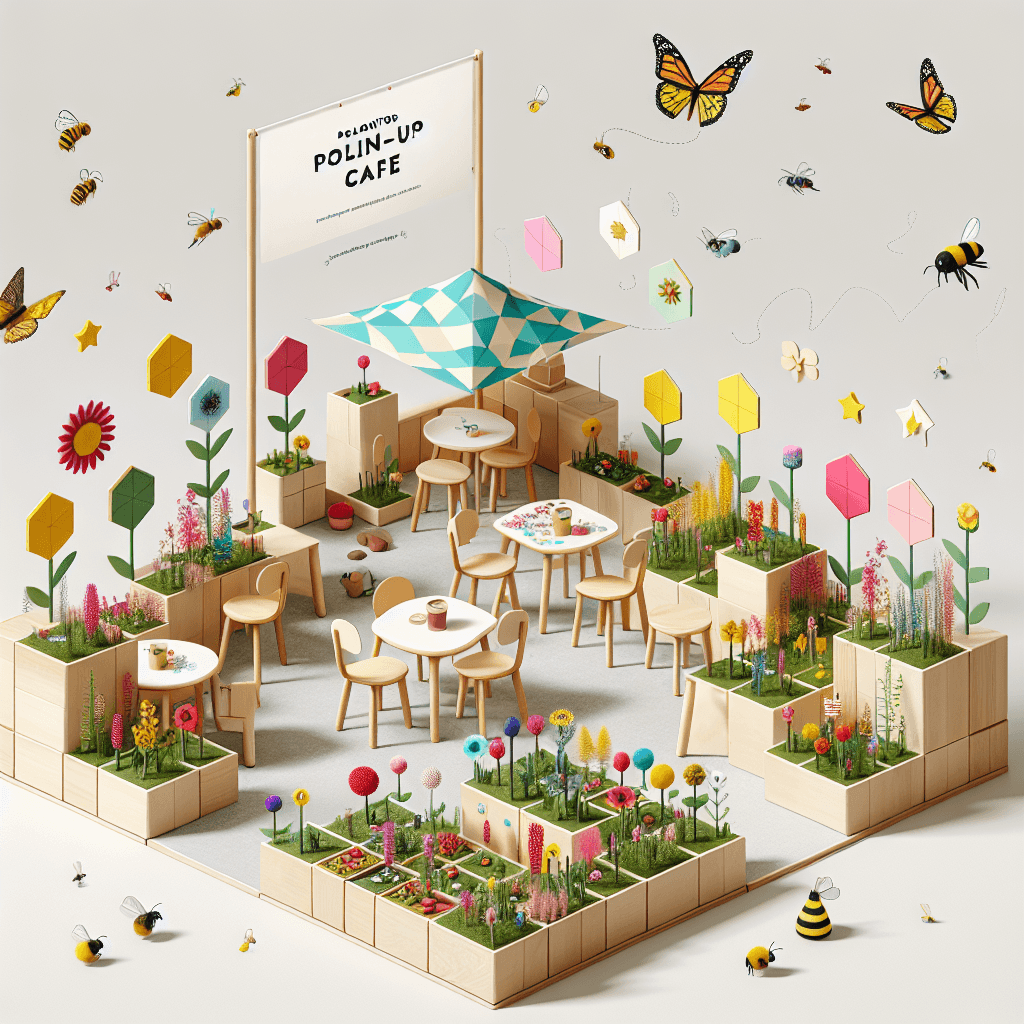
Pollinator Pop-Up Cafe: Designing Tiny Geometric Gardens
Inquiry Framework
Question Framework
Driving Question
The overarching question that guides the entire project.How can we, as garden designers, create a "Pollinator Pop-Up Cafe" using geometric shapes to help local bees and butterflies thrive in our Oklahoma community?Essential Questions
Supporting questions that break down major concepts.- How do bees and butterflies help plants grow and make seeds in our Oklahoma environment? (Science)
- What do pollinators like bees and butterflies need to survive and visit our 'cafe'? (Science)
- How can we use geometric shapes (like hexagons, triangles, and rectangles) to design an efficient garden layout? (Math)
- How does the life cycle of a flowering plant depend on the insects that visit it? (Science)
- In what ways can we use our writing and art to teach our community about the importance of pollinators? (English/Art)
- How can we measure our garden space to ensure our plants have enough room to thrive? (Math)
Standards & Learning Goals
Learning Goals
By the end of this project, students will be able to:- Students will explain the role of pollinators in the plant life cycle and identify the specific needs of local Oklahoma bees and butterflies.
- Students will design a garden layout using specific geometric shapes (hexagons, triangles, rectangles) to demonstrate an understanding of spatial reasoning and shape attributes.
- Students will measure and calculate the dimensions of their garden beds to ensure plants have adequate space to grow, using standard units of measurement.
- Students will compose an informative piece of writing or a visual presentation to educate the school community on why pollinators are essential for the environment.
- Students will create a 2D or 3D model of their 'Pop-Up Cafe' that integrates artistic design with biological function.
Oklahoma Academic Standards for Science (OAS-S)
Oklahoma Academic Standards for Mathematics (OAS-M)
Oklahoma Academic Standards for English Language Arts (OAS-ELA)
Oklahoma Academic Standards for Fine Arts (Visual Arts)
Entry Events
Events that will be used to introduce the project to studentsThe Case of the Missing Cafe
Students find a 'Crime Scene' at a picnic table with a sign saying 'CLOSED: NO POLLINATORS FOUND.' They discover a tiny eviction notice from a local bee and an 'Evidence Bag' containing a single, withered flower and a blueprint for a geometric garden that was never built.The Micro-Grand Opening Invitation
A giant, mysterious envelope arrives for the class containing a microscopic, hand-written 'Menu Request' from a butterfly. The menu asks for specific 'geometric dishes' (like hexagon-shaped nectar pools) and challenges the students to become 'Landscape Architects' for the smallest customers in Oklahoma.The Shape-Shifter’s Blueprints
A local 'Bee Contractor' (guest or teacher in character) arrives with a box of 2D and 3D shapes, explaining that nature is built on math but their current 'blueprints' are missing. Students must solve a 'Shape Puzzle' to reveal the life cycle of a plant, proving they have the skills to design the new Pop-Up Cafe.Portfolio Activities
Portfolio Activities
These activities progressively build towards your learning goals, with each submission contributing to the student's final portfolio.Meet the VIPs (Very Important Pollinators)
To design a cafe, students must first understand their 'customers.' In this activity, students will go on a 'Habitat Hike' around the school to observe current insect activity. They will then choose one specific Oklahoma pollinator (a Honeybee, Monarch Butterfly, or Painted Lady) to research. They will identify what their specific pollinator looks like and what 'menu items' (nectar/pollen) they need to survive.Steps
Here is some basic scaffolding to help students complete the activity.Final Product
What students will submit as the final product of the activityA 'Pollinator VIP Guest Card' featuring a hand-drawn illustration of their insect and a list of three 'Cafe Requirements' (habitat needs).Alignment
How this activity aligns with the learning objectives & standardsAligns with OAS-S 2-LS4-1 (Make observations of plants and animals to compare the diversity of life in different habitats) and OAS-ELA 2.2.W.2 (Write informative texts to introduce a topic).The Shape-Sifter’s Blueprint
Now that students know who their customers are, they must design the cafe layout! Students will act as landscape architects, using geometric shapes to plan the garden. They will use hexagons (mimicking honeycombs), triangles, and rectangles to represent different flower beds and 'nectar pools.' They must measure their design to ensure it fits within the designated 'cafe' footprint.Steps
Here is some basic scaffolding to help students complete the activity.Final Product
What students will submit as the final product of the activityA 'Geometric Garden Blueprint' drawn on grid paper, featuring at least three different types of polygons and labeled measurements.Alignment
How this activity aligns with the learning objectives & standardsAligns with OAS-M 2.GM.1.1 (Recognize and draw shapes like hexagons and triangles) and 2.M.1.1 (Measure length to the nearest whole unit).The Pollination Power-Up Model
Students will create a functional 3D model to show how their cafe actually works. Using craft materials like pipe cleaners (to represent fuzzy bee legs) and glitter or pompoms (to represent pollen), students will demonstrate how a pollinator moves from one 'geometric flower' to another, helping the plant life cycle continue.Steps
Here is some basic scaffolding to help students complete the activity.Final Product
What students will submit as the final product of the activityA 'Pollination in Action' 3D Diorama or moving model showing the transfer of pollen within their geometric garden.Alignment
How this activity aligns with the learning objectives & standardsAligns with OAS-S 2-LS2-2 (Develop a simple model that mimics the function of an animal in pollinating plants) and VA.CP.1.2 (Create works of art about places).The Grand Opening Menu & Guide
To ensure the school community respects the new 'Pollinator Pop-Up Cafe,' students will create educational signage. This 'Menu' will explain what the cafe offers to bees and butterflies and why these insects are vital for Oklahoma's environment. This brings together their science facts, math-based design, and artistic skills.Steps
Here is some basic scaffolding to help students complete the activity.Final Product
What students will submit as the final product of the activityA bi-fold 'Cafe Menu & Guide' that includes an informative paragraph, a diagram of the geometric garden, and a call to action for the community.Alignment
How this activity aligns with the learning objectives & standardsAligns with OAS-ELA 2.2.W.2 (Write informative texts with a concluding statement) and VA.CP.1.2 (Create art for events/places).Rubric & Reflection
Portfolio Rubric
Grading criteria for assessing the overall project portfolioThe Pollinator Pop-Up Cafe Comprehensive Rubric
Scientific Inquiry & Biological Systems
Assesses student understanding of Oklahoma's biodiversity, the role of pollinators, and the plant life cycle (OAS-S 2-LS2-2, 2-LS4-1).Pollinator Research & VIP Identification
Ability to identify and research local Oklahoma pollinators and their specific survival needs.
Exemplary
4 PointsIdentifies more than three specific habitat needs; research is detailed and goes beyond provided sources to explain the 'why' behind pollinator preferences.
Proficient
3 PointsIdentifies three specific habitat needs (food, water, shelter) for an Oklahoma pollinator using provided research materials.
Developing
2 PointsIdentifies one or two habitat needs; research is partially complete or relies on general knowledge rather than specific pollinator facts.
Beginning
1 PointsStruggles to identify pollinator needs or choose a specific Oklahoma insect; card is largely incomplete.
Scientific Modeling of Pollination
Accuracy and clarity of the 3D model demonstrating how animals assist in the plant life cycle through pollination.
Exemplary
4 PointsModel demonstrates a sophisticated understanding of the process, including clear transfer of pollen and accurate labeling of all four plant life cycle stages.
Proficient
3 PointsModel clearly mimics the function of an animal pollinating a flower; includes a demonstration of pollen moving from one plant to another.
Developing
2 PointsModel is constructed but the pollination process (movement of pollen) is unclear or requires significant teacher explanation.
Beginning
1 PointsModel does not demonstrate pollination or is missing key components of the plant/insect interaction.
Mathematical Design & Spatial Reasoning
Assesses the application of geometric attributes and measurement skills to solve design problems (OAS-M 2.GM.1.1, 2.M.1.1).Geometric Shape Identification & Application
Ability to recognize, draw, and utilize specific polygons (hexagons, triangles, quadrilaterals) in a design layout.
Exemplary
4 PointsCorrectly uses all required shapes and can explain their attributes (number of sides/angles); design shows innovative use of space.
Proficient
3 PointsUses at least one hexagon, two triangles, and two rectangles correctly within the garden layout.
Developing
2 PointsUses some geometric shapes correctly, but may misidentify a hexagon or triangle, or shapes are not clearly drawn.
Beginning
1 PointsStruggles to identify or draw the requested shapes; design does not reflect geometric planning.
Measurement & Spatial Planning
Accuracy in measuring the 'Cafe' perimeter and plant zones using whole units.
Exemplary
4 PointsAll measurements are precise and accurately labeled; student identifies why specific measurements are important for plant growth.
Proficient
3 PointsMeasures the perimeter and design zones to the nearest whole unit using a ruler or measuring tool.
Developing
2 PointsMeasurements are present but contain inaccuracies (off by more than 1 unit) or labels are missing.
Beginning
1 PointsMeasurement is not attempted or tools were used incorrectly, resulting in significant errors.
Communication & Community Impact
Assesses the ability to communicate scientific and mathematical ideas through writing and visual arts (OAS-ELA 2.2.W.2, VA.CP.1.2).Informative Writing & Composition
Effectiveness in writing an informative text that introduces a topic, uses facts, and provides a conclusion.
Exemplary
4 PointsWriting is highly engaging, uses multiple specific facts about Oklahoma pollinators, and concludes with a strong call to action for the community.
Proficient
3 PointsWrites an informative paragraph with a clear introduction, at least two facts, and a concluding statement.
Developing
2 PointsWriting includes some facts but may lack a clear introduction or conclusion; paragraph structure is inconsistent.
Beginning
1 PointsWriting is minimal, lacks facts, or is missing a clear topic related to pollinators.
Visual Communication & Artistic Design
Integration of artistic elements and design to create a functional and inviting 'Pop-Up Cafe' guide.
Exemplary
4 PointsArtistic choices (color, layout, 3D construction) significantly enhance the educational message; work is exceptionally neat and professional.
Proficient
3 PointsUses materials effectively to create an attractive menu and sign; colors and drawings support the purpose of attracting pollinators.
Developing
2 PointsWork is complete but lacks attention to detail or artistic effort; visual elements do not clearly support the 'Cafe' theme.
Beginning
1 PointsWork is messy or incomplete; artistic choices do not align with the project goals.