
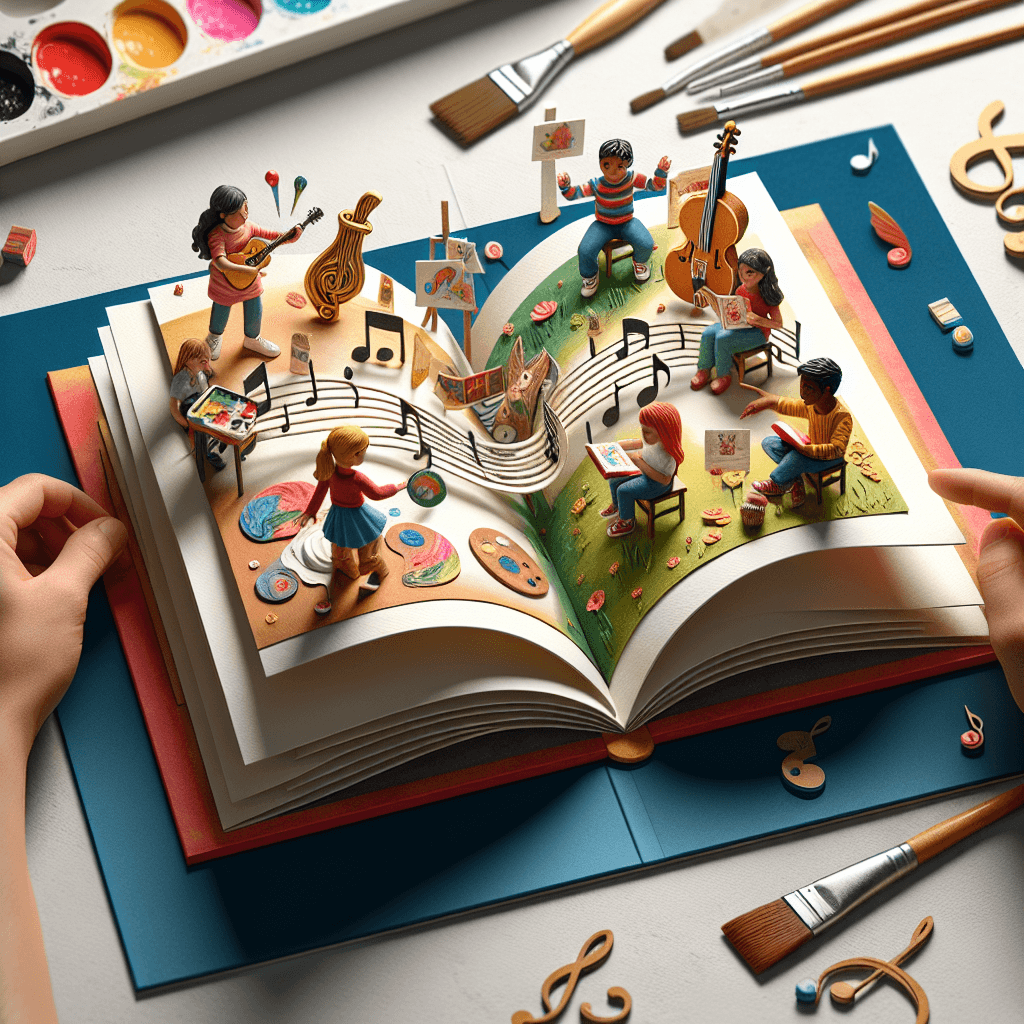
Pop-Up Book: Art, Music, and Storytelling
Inquiry Framework
Question Framework
Driving Question
The overarching question that guides the entire project.Imagine we're building amazing pop-up books that tell stories with art, music, and words! How can we work together to design a pop-up book that's super fun and exciting for anyone who reads it?Essential Questions
Supporting questions that break down major concepts.- How can we make our story flow smoothly with words, pictures, and music?
- What cool art tricks can we use to make our pop-ups jump out and grab the reader's attention?
- How can we write catchy songs that fit our story and make it even more fun to read?
Standards & Learning Goals
Learning Goals
By the end of this project, students will be able to:- Students will design and construct a fully functional pop-up book.
- Students will write an original story suitable for a pop-up book format.
- Students will create original illustrations that enhance the story.
- Students will compose and integrate an original song into the pop-up book.
- Students will demonstrate an understanding of narrative structure and storytelling techniques.
- Students will apply art and design principles to create visually engaging pop-up elements.
- Students will collaborate effectively with peers to create a cohesive final product.
- Students will reflect on their creative process and the effectiveness of their pop-up book in engaging the reader.
- Students will understand the relationship between text, image, and music in storytelling.
- Students will gain practical skills in bookbinding and paper engineering.
- Students will improve skills using art and music.
- Students will improve literacy through writing stories and songs.
- Students will understand the pop-up book's historical context.
- Students will explore different pop-up mechanisms and techniques.
- Students will develop their creative problem-solving skills in the context of book design and production.
- Students will enhance their presentation and communication skills through sharing their work with an audience.
- Students will create an interactive pop-up book that integrates story, illustrations, and song to engage readers
CAPS-ALIGNED
Entry Events
Events that will be used to introduce the project to studentsThe Future of Pop-Up
Present students with a 'silent film' showcasing the evolution of pop-up books throughout history. The film ends with a cliffhanger, challenging students to predict the future of pop-up books and design their own innovative concepts that push the boundaries of the art form.The Unfinished Prototype
A mysterious package arrives containing an unfinished pop-up book prototype with missing elements. Students must reverse-engineer the existing pages and brainstorm solutions to complete the book, sparking their curiosity about the mechanics and storytelling possibilities of pop-up books. The teacher can also include different types of books like fables, myths, or historical narratives to show the range of stories possible in a pop-up format.Portfolio Activities
Portfolio Activities
These activities progressively build towards your learning goals, with each submission contributing to the student's final portfolio.Bookbinding Bonanza: Assembly Time
Students assemble their pop-up book, integrating the illustrations, text, and pop-up elements. They use bookbinding techniques to create a durable and functional final product.Steps
Here is some basic scaffolding to help students complete the activity.Final Product
What students will submit as the final product of the activityA fully assembled interactive pop-up book with original illustrations and story.Alignment
How this activity aligns with the learning objectives & standardsCovers VA.5.1 (Creating illustrations), LA.5.3 (Writing original stories), and TL.5.4 (Technology may be used in the creation of the book).Rubric & Reflection
Portfolio Rubric
Grading criteria for assessing the overall project portfolioInteractive Pop-Up Book Creative Assessment Rubric
Creativity and Originality
Evaluating the uniqueness and inventiveness of the students' illustrations, stories, and music compositions in the pop-up book.Illustrations Originality
Assesses the creativity and originality of the artwork used in the pop-up book.
Exemplary
4 PointsIllustrations are exceptionally creative and original, capturing attention and enhancing the storytelling.
Proficient
3 PointsIllustrations are creative and original, effectively supporting the story.
Developing
2 PointsIllustrations show some original ideas but are inconsistent in creativity.
Beginning
1 PointsIllustrations lack originality and creativity, minimally contributing to the story.
Storytelling and Narrative Creativity
Assesses creativity and structure in writing the pop-up book's narratives.
Exemplary
4 PointsStory is highly engaging and well-structured, with innovative narrative elements.
Proficient
3 PointsStory is engaging and well-structured, with clear narrative elements.
Developing
2 PointsStory has some engaging elements but lacks consistent narrative structure.
Beginning
1 PointsStory is unclear and lacks engaging narrative structure.
Craftsmanship and Technical Skills
Assessing the construction quality and technical execution of the pop-up book.Bookbinding and Assembly
Evaluates the quality of the bookbinding and overall assembly of the pop-up book.
Exemplary
4 PointsAssembly of the book is flawless; binding is impeccable, ensuring durability and functionality.
Proficient
3 PointsAssembly of the book is solid with minor imperfections; binding is functional and neat.
Developing
2 PointsBook assembly shows effort but includes noticeable imperfections in binding.
Beginning
1 PointsAssembly is weak with major binding flaws; book is fragile and non-functional.