
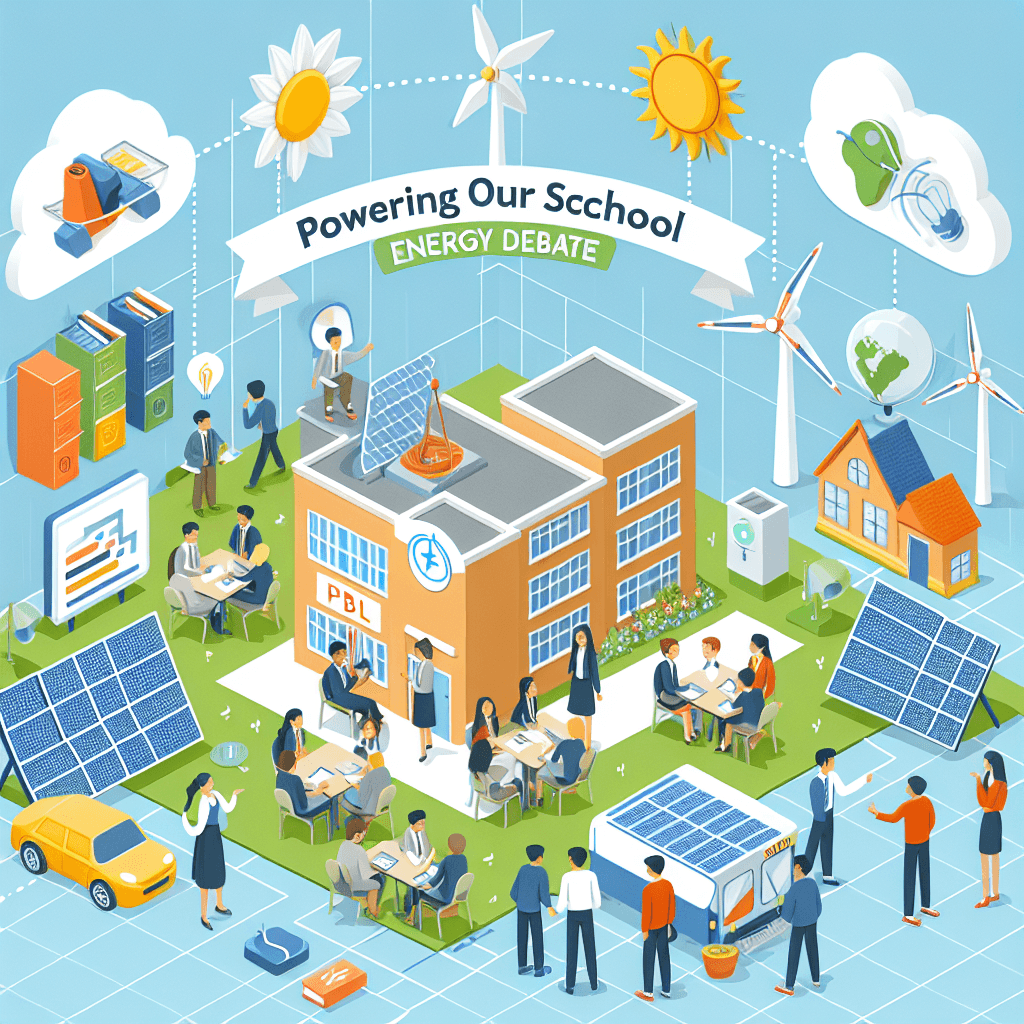
Powering Our School: Energy Debate
Inquiry Framework
Question Framework
Driving Question
The overarching question that guides the entire project.How can we choose the best energy source to power our school while considering its impact on the environment and our community?Essential Questions
Supporting questions that break down major concepts.- How do different energy sources work?
- What are the benefits and drawbacks of each energy source?
- Which energy source would be most suitable for powering our school and why?
- How can we present our findings effectively to convince others?
Standards & Learning Goals
Learning Goals
By the end of this project, students will be able to:- Students will be able to identify and explain the advantages and disadvantages of different energy sources, including renewable and nonrenewable resources.
Texas Essential Knowledge and Skills (TEKS)
Entry Events
Events that will be used to introduce the project to studentsThe School Energy Simulator
Students explore an interactive online simulation of their school, where they can manipulate different energy sources (solar, wind, fossil fuels) and observe the impact on cost, pollution, and energy efficiency. They are tasked with finding the optimal energy mix.The Shocking Energy Bill
Students receive a mock "energy bill" for their school showing exorbitant costs. They are tasked with brainstorming initial ideas for reducing costs and presented with the challenge: Can we power our school more efficiently and sustainably?Portfolio Activities
Portfolio Activities
These activities progressively build towards your learning goals, with each submission contributing to the student's final portfolio.Renewable vs. Non-Renewable Energy Explorers
Students will explore different energy sources and categorize them as renewable or nonrenewable, listing key characteristics of each.Steps
Here is some basic scaffolding to help students complete the activity.Final Product
What students will submit as the final product of the activityA completed graphic organizer categorizing energy sources and listing their characteristics.Alignment
How this activity aligns with the learning objectives & standards4.11A - identify and explain advantages and disadvantages of using Earth's renewable and nonrenewable natural resources.Energy Source Investigators
Students will delve deeper into specific energy sources, researching and presenting their benefits and drawbacks.Steps
Here is some basic scaffolding to help students complete the activity.Final Product
What students will submit as the final product of the activityAn informative presentation on a chosen energy source, highlighting its pros and cons.Alignment
How this activity aligns with the learning objectives & standards4.11A - identify and explain advantages and disadvantages of using Earth's renewable and nonrenewable natural resources.School Energy Solution Architects
Students will apply their knowledge to propose an optimal energy solution for their school, considering various factors like cost, environmental impact, and sustainability.Steps
Here is some basic scaffolding to help students complete the activity.Final Product
What students will submit as the final product of the activityA detailed proposal outlining the recommended energy solution for the school, supported by research and evidence.Alignment
How this activity aligns with the learning objectives & standards4.11A - identify and explain advantages and disadvantages of using Earth's renewable and nonrenewable natural resources.Rubric & Reflection
Portfolio Rubric
Grading criteria for assessing the overall project portfolioEnergy Source Evaluation Rubric
Research and Understanding
Evaluates students' ability to conduct thorough research and demonstrate understanding of energy sources.Identification of Energy Sources
Assess the ability to accurately identify and categorize energy sources as renewable or nonrenewable.
Exemplary
4 PointsAccurately identifies and categorizes all major energy sources, demonstrating a sophisticated understanding of renewable and nonrenewable classifications.
Proficient
3 PointsCorrectly identifies and categorizes most energy sources, showing a thorough understanding of renewable and nonrenewable classifications.
Developing
2 PointsIdentifies and categorizes some energy sources with some errors, indicating an emerging understanding.
Beginning
1 PointsStruggles to identify and categorize energy sources accurately, showing an initial understanding.
Description of Advantages and Disadvantages
Evaluate students' ability to clearly describe the benefits and drawbacks of different energy sources.
Exemplary
4 PointsProvides a comprehensive and clear description of advantages and disadvantages for each energy source, with rich, detailed examples.
Proficient
3 PointsDescribes the main advantages and disadvantages for each energy source with clarity and some examples.
Developing
2 PointsDescribes some advantages and disadvantages with partial clarity and limited examples.
Beginning
1 PointsProvides vague descriptions with minimal understanding of advantages and disadvantages.
Application and Analysis
Measures the ability to apply knowledge and critically analyze information to form conclusions.Application of Research
Measure how well students apply their research to justify their energy source choices for the school proposal.
Exemplary
4 PointsApplies research with exceptional skill, providing a well-justified and innovative proposal supported by compelling evidence.
Proficient
3 PointsApplies research effectively, providing a justified proposal supported by clear evidence.
Developing
2 PointsApplies research with limited justification and partial evidence.
Beginning
1 PointsStruggles to apply research with minimal justification and evidence.
Critical Thinking
Assess the ability to use critical thinking to evaluate different energy sources in making a proposal.
Exemplary
4 PointsDemonstrates exceptional critical thinking, evaluating multiple perspectives and making insightful connections between energy choices and their impacts.
Proficient
3 PointsDemonstrates solid critical thinking by evaluating key perspectives and making relevant connections.
Developing
2 PointsShows emerging critical thinking by evaluating some perspectives with basic connections.
Beginning
1 PointsShows limited critical thinking with minimal evaluation of perspectives.
Presentation and Communication
Focuses on students' ability to effectively communicate and present their findings.Clarity and Organization
Evaluate the clarity and organization of students' presentations or proposals.
Exemplary
4 PointsPresents information in a highly organized manner with exceptional clarity, engaging the audience with well-structured content.
Proficient
3 PointsPresents information clearly and in an organized manner, maintaining audience engagement with structured content.
Developing
2 PointsPresents information with some clarity and organization, showing areas of improvement needed in structure.
Beginning
1 PointsStruggles to present information clearly and is disorganized, leading to audience confusion.
Persuasiveness
Assess the ability to present a convincing argument in favor of a chosen energy solution.
Exemplary
4 PointsMakes a compelling and well-argued case using strong evidence and persuasive techniques that effectively sway the audience.
Proficient
3 PointsMakes a solid argument using good evidence and persuasive techniques that engage the audience.
Developing
2 PointsMakes a basic argument with some evidence, requiring more persuasion and stronger engagement.
Beginning
1 PointsStruggles to make a convincing argument with insufficient evidence, lacking persuasive techniques.