
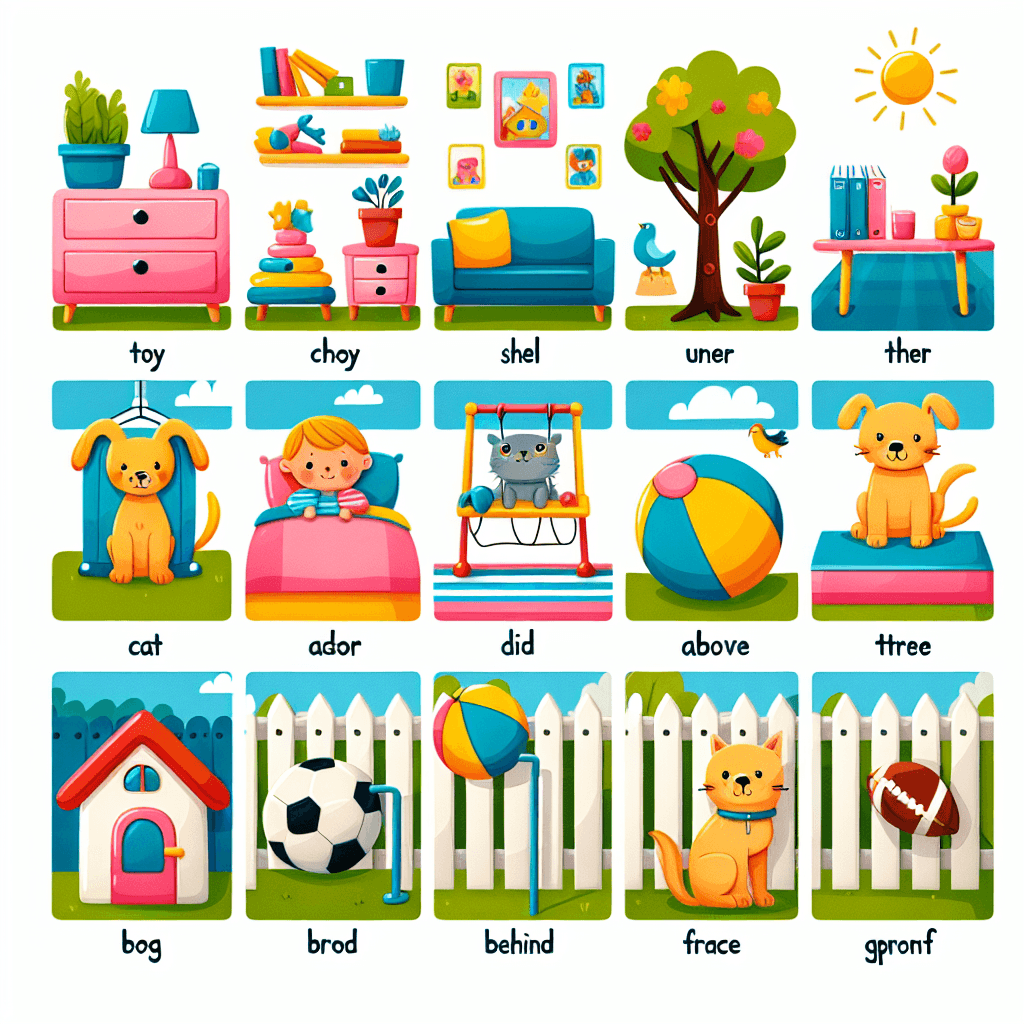
Prepositions in Daily Life: A Scavenger Hunt
Inquiry Framework
Question Framework
Driving Question
The overarching question that guides the entire project.How do prepositions fundamentally shape our understanding and communication of spatial and temporal relationships in everyday life, and how can analyzing their use in various texts deepen our comprehension and interpretation of these relationships?Essential Questions
Supporting questions that break down major concepts.- How do prepositions shape our understanding of space and time in everyday scenarios?
- In what ways do prepositions influence the clarity and precision of our communication?
- How can analyzing the use of prepositions in various texts enhance our comprehension and interpretation?
Standards & Learning Goals
Learning Goals
By the end of this project, students will be able to:- Understand the role of prepositions in conveying spatial relationships.
- Understand the role of prepositions in conveying temporal relationships.
- Analyze prepositional usage in texts to interpret meaning.
- Communicate ideas clearly and precisely using prepositions.
Entry Events
Events that will be used to introduce the project to studentsThe 'Prepositional Time Machine'
Students examine historical events or stories, focusing on how prepositions reflect the time period or cultural context. They then 'travel' to different time periods and rewrite narratives, adjusting prepositional usage to authentically represent the language of that era.Portfolio Activities
Portfolio Activities
These activities progressively build towards your learning goals, with each submission contributing to the student's final portfolio.Spatial Scavenger Hunt
Students participate in a scavenger hunt where they follow clues that use prepositions to describe the location of hidden objects. This activity reinforces understanding of spatial relationships.Steps
Here is some basic scaffolding to help students complete the activity.Final Product
What students will submit as the final product of the activityA completed scavenger hunt worksheet with recorded prepositions and explanations of spatial relationships.Alignment
How this activity aligns with the learning objectives & standardsUnderstand the role of prepositions in conveying spatial relationships.Temporal Timeline Creation
Students create a timeline of their daily activities, using prepositions to indicate the time at which each activity occurs. This activity reinforces understanding of temporal relationships.Steps
Here is some basic scaffolding to help students complete the activity.Final Product
What students will submit as the final product of the activityA visual timeline of daily activities with sentences using prepositions to indicate time.Alignment
How this activity aligns with the learning objectives & standardsUnderstand the role of prepositions in conveying temporal relationships.Prepositional Text Analysis
Students analyze a short text, identifying and interpreting the prepositions used to convey spatial and temporal relationships. This activity enhances their ability to analyze prepositional usage in texts to interpret meaning.Steps
Here is some basic scaffolding to help students complete the activity.Final Product
What students will submit as the final product of the activityAn annotated text with highlighted prepositions and explanations of their meaning.Alignment
How this activity aligns with the learning objectives & standardsAnalyze prepositional usage in texts to interpret meaning.Prepositional Precision Challenge
Students rewrite sentences to improve clarity and precision by using more effective prepositions. This activity focuses on communicating ideas clearly and precisely using prepositions.Steps
Here is some basic scaffolding to help students complete the activity.Final Product
What students will submit as the final product of the activityA set of revised sentences with improved prepositional usage and explanations.Alignment
How this activity aligns with the learning objectives & standardsCommunicate ideas clearly and precisely using prepositions.Rubric & Reflection
Portfolio Rubric
Grading criteria for assessing the overall project portfolioPrepositional Proficiency Portfolio Rubric
Spatial Understanding
Demonstrates understanding of prepositions in conveying spatial relationships through the Spatial Scavenger Hunt activity.Accuracy of Identification
Ability to correctly identify and record prepositions used in clues.
Exemplary
4 PointsAccurately identifies all prepositions in the clues and records them with no errors.
Proficient
3 PointsAccurately identifies most prepositions in the clues and records them with minimal errors.
Developing
2 PointsIdentifies some prepositions in the clues but makes several errors in recording them.
Beginning
1 PointsStruggles to identify prepositions in the clues and makes numerous errors in recording them.
Explanation of Spatial Relationships
Ability to clearly explain the spatial relationships described by the prepositions.
Exemplary
4 PointsProvides thorough and insightful explanations of the spatial relationships described by the prepositions, demonstrating a deep understanding.
Proficient
3 PointsProvides clear and accurate explanations of the spatial relationships described by the prepositions.
Developing
2 PointsProvides basic explanations of the spatial relationships but may lack clarity or detail.
Beginning
1 PointsStruggles to explain the spatial relationships described by the prepositions and demonstrates a limited understanding.
Temporal Understanding
Demonstrates understanding of prepositions in conveying temporal relationships through the Temporal Timeline Creation activity.Timeline Accuracy
Accuracy of the timeline in representing the sequence of daily activities.
Exemplary
4 PointsTimeline accurately and comprehensively represents the sequence of daily activities with precise temporal markers.
Proficient
3 PointsTimeline accurately represents the sequence of daily activities with clear temporal markers.
Developing
2 PointsTimeline represents the sequence of daily activities but may contain some inaccuracies or omissions.
Beginning
1 PointsTimeline is incomplete or inaccurate and does not clearly represent the sequence of daily activities.
Prepositional Usage
Correct and effective use of prepositions to indicate time in sentences.
Exemplary
4 PointsUses a variety of prepositions accurately and effectively to indicate time, demonstrating a sophisticated understanding of temporal relationships.
Proficient
3 PointsUses prepositions accurately to indicate time in most sentences, demonstrating a clear understanding of temporal relationships.
Developing
2 PointsUses prepositions to indicate time in some sentences but may make errors or use them inappropriately.
Beginning
1 PointsStruggles to use prepositions to indicate time and makes frequent errors.
Textual Analysis
Demonstrates the ability to analyze prepositional usage in texts to interpret meaning through the Prepositional Text Analysis activity.Identification of Prepositions
Ability to identify prepositions within the provided text.
Exemplary
4 PointsIdentifies all prepositions in the text accurately and efficiently.
Proficient
3 PointsIdentifies most prepositions in the text with minimal errors.
Developing
2 PointsIdentifies some prepositions in the text but misses several others.
Beginning
1 PointsStruggles to identify prepositions in the text and misses most of them.
Interpretation of Meaning
Ability to explain the spatial or temporal relationship conveyed by each preposition in the context of the text.
Exemplary
4 PointsProvides insightful and nuanced explanations of the spatial or temporal relationships conveyed by each preposition, demonstrating a deep understanding of the text.
Proficient
3 PointsProvides clear and accurate explanations of the spatial or temporal relationships conveyed by each preposition.
Developing
2 PointsProvides basic explanations of the spatial or temporal relationships but may lack depth or accuracy.
Beginning
1 PointsStruggles to explain the spatial or temporal relationships conveyed by the prepositions and demonstrates a limited understanding of the text.
Communication Precision
Demonstrates the ability to communicate ideas clearly and precisely using prepositions through the Prepositional Precision Challenge activity.Sentence Revision
Effectiveness in revising sentences to improve clarity and precision through better prepositional usage.
Exemplary
4 PointsRevises sentences with exceptional skill, using precise and effective prepositions to significantly enhance clarity and meaning.
Proficient
3 PointsRevises sentences effectively, using appropriate prepositions to improve clarity and meaning.
Developing
2 PointsRevises sentences but may not always choose the most effective prepositions, resulting in limited improvement in clarity.
Beginning
1 PointsStruggles to revise sentences effectively and makes little or no improvement in clarity through prepositional usage.
Justification of Revisions
Ability to explain why the revised prepositional usage is more clear and precise.
Exemplary
4 PointsProvides thorough and insightful explanations of why the revised prepositional usage is more clear and precise, demonstrating a deep understanding of language and communication.
Proficient
3 PointsProvides clear and logical explanations of why the revised prepositional usage is more clear and precise.
Developing
2 PointsProvides basic explanations but may lack detail or clarity in justifying the revisions.
Beginning
1 PointsStruggles to explain why the revised prepositional usage is more clear and precise and demonstrates a limited understanding of language and communication.