
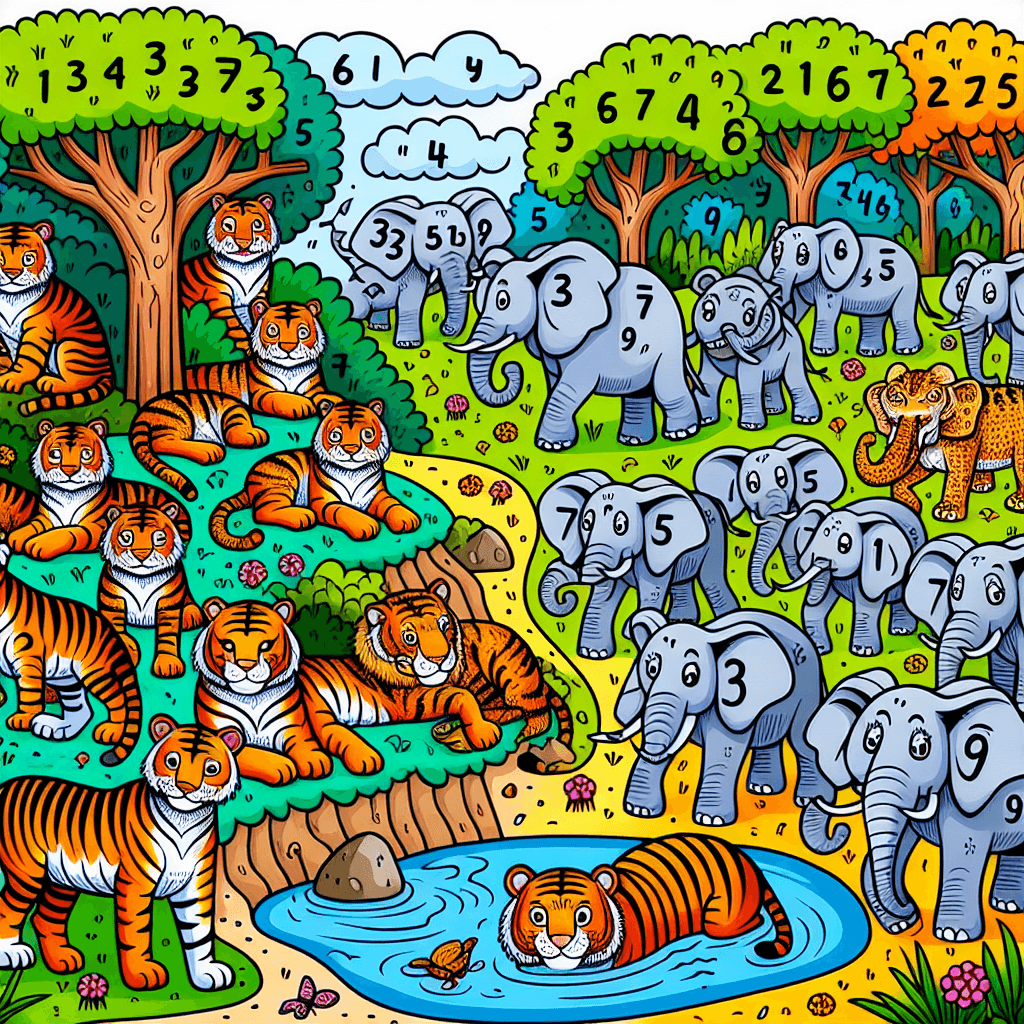
Prime & Composite Number Zoo: A Mathematical Habitat
Inquiry Framework
Question Framework
Driving Question
The overarching question that guides the entire project.How can we design a zoo where the habitats of animals (numbers) are determined by whether they are prime or composite, and what does this tell us about the unique characteristics of each number?Essential Questions
Supporting questions that break down major concepts.- How can we classify numbers based on their factors?
- How do prime and composite numbers differ, and why are they important?
- How can we represent mathematical concepts like prime and composite numbers in a creative and engaging way?
Standards & Learning Goals
Learning Goals
By the end of this project, students will be able to:- Students will be able to identify and list all factor pairs for whole numbers from 1 to 100.
- Students will be able to differentiate between prime and composite numbers within the range of 1 to 100.
- Students will be able to determine if a number from 1 to 100 is a multiple of a given one-digit number.
- Students will be able to apply the concepts of prime and composite numbers to design a creative 'Prime & Composite Number Zoo,' explaining the characteristics of each number-animal.
Entry Events
Events that will be used to introduce the project to studentsNumber Safari Documentary
A renowned zoologist presents a 'Number Safari' documentary, showcasing 'Prime Primitives' and 'Composite Creatures' in their natural mathematical habitats, sparking debate on which numbers deserve conservation efforts due to their unique properties.Portfolio Activities
Portfolio Activities
These activities progressively build towards your learning goals, with each submission contributing to the student's final portfolio.Zoo Designer
Students design habitats for their Prime & Composite Number Zoo, explaining why certain 'number-animals' live in specific habitats based on their mathematical properties.Steps
Here is some basic scaffolding to help students complete the activity.Final Product
What students will submit as the final product of the activityA detailed zoo map with habitat descriptions, explaining the placement of each 'number-animal'.Alignment
How this activity aligns with the learning objectives & standardsApplies understanding of prime/composite numbers to a creative context.Rubric & Reflection
Portfolio Rubric
Grading criteria for assessing the overall project portfolioPrime & Composite Number Zoo Rubric
Mathematical Accuracy
Demonstrates understanding of number theory concepts.Factor Identification
Accuracy in identifying and listing all factor pairs for numbers chosen for the zoo exhibits.
Exemplary
4 PointsAccurately identifies all factor pairs for all numbers chosen, demonstrating a comprehensive understanding of factors.
Proficient
3 PointsAccurately identifies most factor pairs for the numbers chosen, with only minor omissions or errors.
Developing
2 PointsIdentifies some factor pairs, but with significant omissions or inaccuracies.
Beginning
1 PointsStruggles to identify factor pairs, with many inaccuracies and omissions.
Number Classification
Correctly classifies numbers as either prime or composite and provides justification based on the number of factors.
Exemplary
4 PointsCorrectly classifies all numbers and provides clear, concise, and mathematically sound justifications.
Proficient
3 PointsCorrectly classifies most numbers with generally accurate justifications.
Developing
2 PointsShows some understanding of prime and composite numbers but makes classification errors or provides incomplete justifications.
Beginning
1 PointsStruggles to differentiate between prime and composite numbers and provides little or no justification.
Creative Application
Demonstrates creativity and explanatory abilities in zoo design and descriptions.Design Creativity
The creativity and originality demonstrated in the design of the zoo habitats.
Exemplary
4 PointsZoo design is exceptionally creative and original, demonstrating innovative thinking and a unique approach to representing prime and composite numbers.
Proficient
3 PointsZoo design is creative and shows thoughtful consideration of how to represent prime and composite numbers.
Developing
2 PointsZoo design shows some creativity but lacks originality or depth in representing prime and composite numbers.
Beginning
1 PointsZoo design lacks creativity and does not effectively represent prime and composite numbers.
Explanatory Clarity
Clarity and coherence of habitat descriptions, explaining the relationship between the number-animals and their environments.
Exemplary
4 PointsHabitat descriptions are exceptionally clear, detailed, and insightful, demonstrating a deep understanding of the connection between the numbers and their habitats.
Proficient
3 PointsHabitat descriptions are clear and explain the relationship between the number-animals and their environments effectively.
Developing
2 PointsHabitat descriptions are somewhat unclear or lack detail, making the connection between the number-animals and their environments difficult to understand.
Beginning
1 PointsHabitat descriptions are unclear, incomplete, and fail to explain the relationship between the number-animals and their environments.
Presentation & Thoughtfulness
Focuses on the quality of presentation and thought process reflected.Presentation Quality
Overall presentation and organization of the zoo map and habitat descriptions.
Exemplary
4 PointsThe zoo map and habitat descriptions are presented in a highly organized, visually appealing, and professional manner.
Proficient
3 PointsThe zoo map and habitat descriptions are well-organized and presented neatly.
Developing
2 PointsThe zoo map and habitat descriptions show some organization but may be difficult to follow or lack visual appeal.
Beginning
1 PointsThe zoo map and habitat descriptions are poorly organized and difficult to understand.
Thoughtful Selection
Evidence of thoughtful number selection to represent a variety of prime and composite numbers within the zoo.
Exemplary
4 PointsDemonstrates exceptional thoughtfulness in number selection, showcasing a wide variety of prime and composite numbers and explaining their significance within the zoo context.
Proficient
3 PointsDemonstrates thoughtful number selection, representing a good variety of prime and composite numbers.
Developing
2 PointsNumber selection is somewhat limited or lacks variety in representing prime and composite numbers.
Beginning
1 PointsNumber selection is very limited and does not adequately represent prime and composite numbers.