
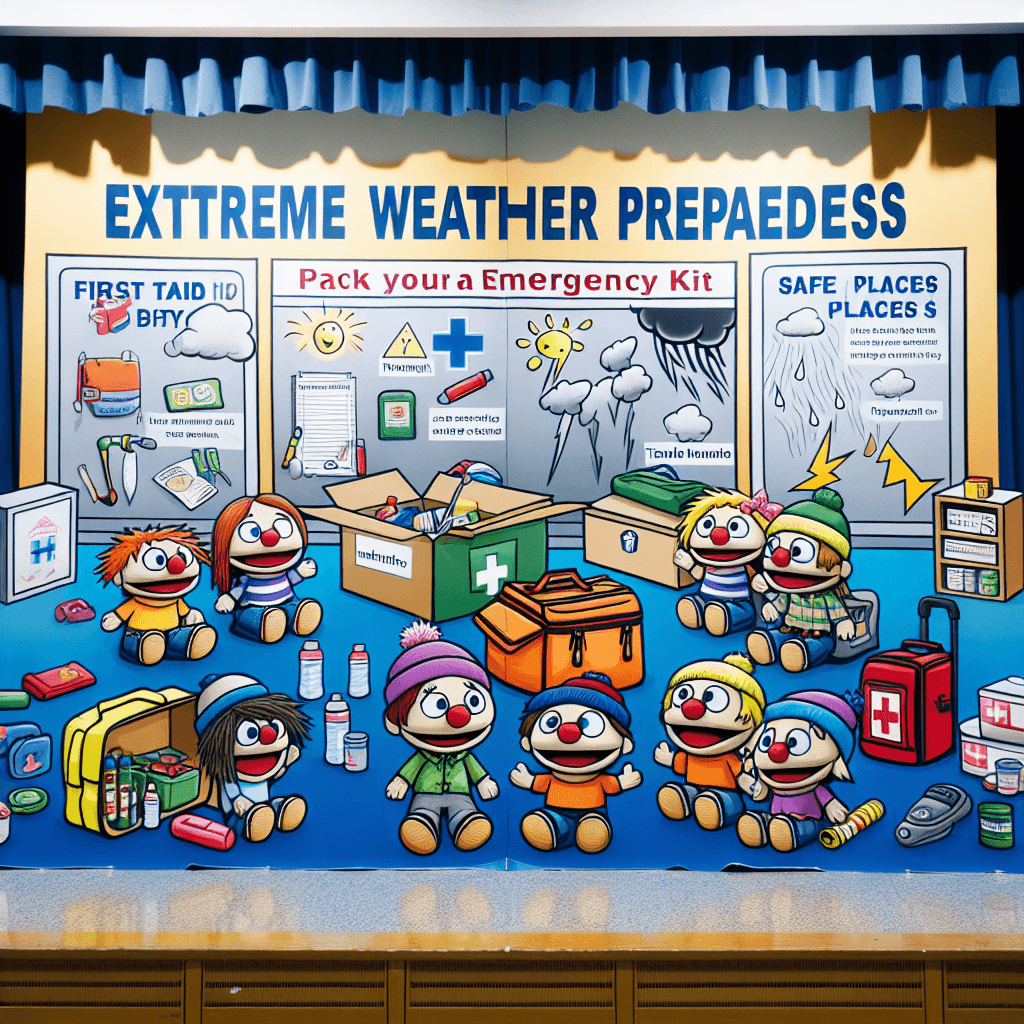
Puppet Shows on Extreme Weather Preparedness
Inquiry Framework
Question Framework
Driving Question
The overarching question that guides the entire project.How can we creatively educate our community about extreme weather safety and preparedness through puppet shows, using knowledge of science, community roles, and effective communication?Essential Questions
Supporting questions that break down major concepts.- What is extreme weather?
- How can we stay safe during a storm or other extreme weather event?
- Why is it important to be prepared for extreme weather?
- What tools or technologies help us during extreme weather events?
- How can we communicate important safety information during extreme weather?
- What role do community helpers play during extreme weather events?
- How can we use puppet shows to inform others about extreme weather and safety?
Standards & Learning Goals
Learning Goals
By the end of this project, students will be able to:- Students will identify different types of extreme weather and understand their characteristics.
- Students will learn the importance of preparedness and safety measures during extreme weather events.
- Students will develop communication skills through performing puppet shows.
- Students will understand the role of community helpers in extreme weather situations.
- Students will collaborate with peers to create educational content for puppet shows.
NGSS
Common Core Standards
Entry Events
Events that will be used to introduce the project to studentsEmergency Adventure Quest
Transform the classroom into an 'Emergency Adventure Park' with obstacle courses and challenges reflecting real-world emergency scenarios like floods or storms. Students must navigate these challenges, fostering inquiry about safety measures and preparedness, ultimately inspiring them to devise puppet shows demonstrating these key concepts.Portfolio Activities
Portfolio Activities
These activities progressively build towards your learning goals, with each submission contributing to the student's final portfolio.Weather Wonders Exploration
Students explore and identify different types of extreme weather through interactive storybooks and videos, building foundational knowledge for their project.Steps
Here is some basic scaffolding to help students complete the activity.Final Product
What students will submit as the final product of the activityA class chart displaying different types of extreme weather and their characteristics.Alignment
How this activity aligns with the learning objectives & standardsAligns with K-ESS3-1 by helping students use a model (chart) to represent the relationship between human needs and their environment.Safety Superheroes
Students learn about the importance of preparedness and safety measures during extreme weather. They brainstorm ideas on how to stay safe and create visual aids to remember these measures.Steps
Here is some basic scaffolding to help students complete the activity.Final Product
What students will submit as the final product of the activityA 'Safety Superhero' booklet containing visual aids of safety measures for extreme weather events.Alignment
How this activity aligns with the learning objectives & standardsSupports K-ESS3-2 by exploring weather forecasts' role in preparation and safety, enabling students to ask relevant questions about preparedness.Community Helpers Theater
Students learn about the roles of community helpers during extreme weather events and act out roles to deepen their understanding.Steps
Here is some basic scaffolding to help students complete the activity.Final Product
What students will submit as the final product of the activityA role-playing session where students perform as community helpers with props and badges.Alignment
How this activity aligns with the learning objectives & standardsAligns with K-SL.1 as students collaborate and engage in conversations about community roles through acting and discussion.Extreme Weather Puppet Masters
With their foundational knowledge in place, students work in small groups to create puppet shows that communicate key safety information about extreme weather to the community.Steps
Here is some basic scaffolding to help students complete the activity.Final Product
What students will submit as the final product of the activityA group puppet show that educates about extreme weather safety, performed for classmates or the community.Alignment
How this activity aligns with the learning objectives & standardsCovers RI.K.10 and K-ESS3-1 by engaging students in collaborative group activities and representing safety in extreme weather through a model (puppet show).Weather Reporters on Duty
Students transform into weather reporters, presenting a mock weather forecast that informs the class about upcoming extreme weather and the necessary preparations.Steps
Here is some basic scaffolding to help students complete the activity.Final Product
What students will submit as the final product of the activityA class news broadcast with students reporting weather forecasts, practicing communication skills and application of weather knowledge.Alignment
How this activity aligns with the learning objectives & standardsAligns with RI.K.1 by supporting students in asking and answering questions about weather forecasts, enhancing understanding of their purpose and importance.Rubric & Reflection
Portfolio Rubric
Grading criteria for assessing the overall project portfolioExtreme Weather Community Education Rubric
Understanding of Extreme Weather
Assess the student's ability to identify and explain different types of extreme weather and their impacts on the environment and people.Identification of Weather Types
Ability to accurately identify and name different types of extreme weather.
Exemplary
4 PointsAccurately identifies and clearly names multiple types of extreme weather, demonstrating a deep understanding of each.
Proficient
3 PointsCorrectly identifies and names familiar types of extreme weather with some understanding.
Developing
2 PointsIdentifies a few types of extreme weather, but may confuse them or miss key details.
Beginning
1 PointsStruggles to identify extreme weather types, with frequent errors or omissions.
Explanation of Weather Impact
Understanding of how extreme weather affects the environment and communities.
Exemplary
4 PointsProvides detailed and accurate explanations of how various extreme weather events impact the environment and communities.
Proficient
3 PointsProvides clear explanations for several extreme weather events, with minor inaccuracies.
Developing
2 PointsOffers basic explanations that may lack detail or accuracy about weather impacts.
Beginning
1 PointsHas difficulty articulating how weather impacts environments, showing little understanding.
Preparedness and Safety Measures
Evaluate student's grasp of preparedness strategies and safety measures for extreme weather.Knowledge of Safety Measures
Understanding and recall of appropriate safety measures for different weather types.
Exemplary
4 PointsAccurately describes and justifies multiple safety measures for various extreme weather events.
Proficient
3 PointsDescribes relevant safety measures for common extreme weather events with minor omissions.
Developing
2 PointsRecalls some basic safety measures, but lacks consistency or detail.
Beginning
1 PointsStruggles to identify appropriate safety measures, showing minimal understanding.
Application of Preparedness Strategies
Skill in applying preparedness strategies in project scenarios.
Exemplary
4 PointsEffectively applies preparedness strategies in creative and applicable ways across projects.
Proficient
3 PointsApplies common preparedness strategies appropriately in projects.
Developing
2 PointsApplies preparedness strategies with inconsistencies or partial success.
Beginning
1 PointsMinimal application of preparedness strategies, often requiring prompts.
Communication and Collaboration
Assess communication clarity and collaboration efficiency during group activities like puppet shows.Clarity of Communication
Effectiveness of student communication during presentations and performances.
Exemplary
4 PointsCommunicates ideas clearly and enthusiastically during all performance segments.
Proficient
3 PointsCommunicates effectively, with minor issues in clarity or engagement.
Developing
2 PointsCommunicates basic ideas with some effort, but with noticeable issues in clarity.
Beginning
1 PointsStruggles with communication during performances, often needing assistance.
Collaboration with Peers
Ability to collaborate effectively with peers during group projects.
Exemplary
4 PointsDemonstrates leadership and proactive teamwork skills, contributing significantly to group efforts.
Proficient
3 PointsCollaborates well with peers, contributing positively to group activities.
Developing
2 PointsParticipates in group work but exhibits challenges with effective collaboration.
Beginning
1 PointsShows limited collaboration, often needing guidance to participate.
Creative Expression through Puppet Shows
Evaluate creativity and skill in using puppet shows as a medium to convey weather safety messages.Creativity in Puppet Shows
Ingenuity and originality in developing puppet show content and characters.
Exemplary
4 PointsDemonstrates high creativity with original themes and appealing characters, enhancing the show's educational impact.
Proficient
3 PointsCreates engaging puppet shows with creative elements and clear educational content.
Developing
2 PointsShows some creativity in puppet shows, though elements may be less coherent or unique.
Beginning
1 PointsMinimal creativity evident in puppet shows, often relying heavily on guidance.
Effectiveness of Safety Messaging
Clarity and impact of safety messages conveyed through the puppet show.
Exemplary
4 PointsConveys safety messages with exceptional clarity and impact, ensuring audience understanding.
Proficient
3 PointsCommunicates safety messages effectively, although some elements may require clarification.
Developing
2 PointsSafety messages understood, but both clarity and impact could be improved.
Beginning
1 PointsConveys safety messages ineffectively, often leading to audience confusion.