
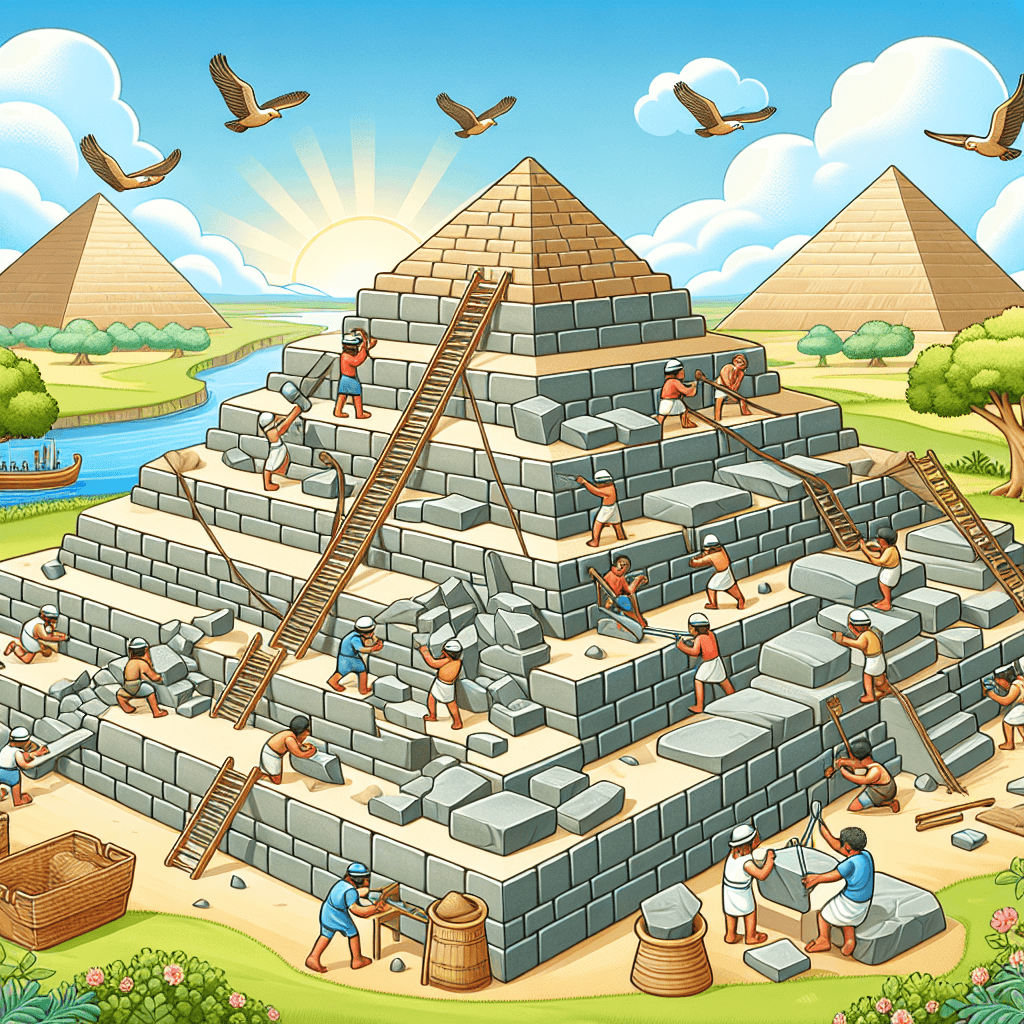
Pyramid Power: Building the Ancient Marvels of Egypt
Inquiry Framework
Question Framework
Driving Question
The overarching question that guides the entire project.How did the construction and significance of the pyramids reflect and influence the ancient Egyptian civilization, and what connections can we draw to modern society?Essential Questions
Supporting questions that break down major concepts.- How were the ancient Egyptian pyramids constructed?
- What was the significance of pyramids in ancient Egyptian civilization?
- How did the ancient Egyptians' lifestyle and food habits contribute to their society?
- What role did agriculture play in the growth of the Egyptian civilization?
- In what ways did art reflect the culture and beliefs of ancient Egypt?
- How did the construction of pyramids demonstrate the social and political structure of ancient Egypt?
- Why were pyramids built and who were they built for?
- How have the pyramids influenced modern architecture and cultural thought?
Standards & Learning Goals
Learning Goals
By the end of this project, students will be able to:- Understand the methods and materials used in the construction of ancient Egyptian pyramids.
- Analyze the social, political, and religious significance of pyramids in ancient Egyptian civilization.
- Examine the lifestyle, food habits, and technological advancements of ancient Egyptians and their impact on society.
- Evaluate the role of agriculture in the growth and sustainability of the Egyptian civilization.
- Explore the artistic expressions of ancient Egypt and how they represented cultural beliefs.
- Investigate the influence of pyramids on modern architecture and societal structures.
Social Studies Standards
Common Core Standards
Entry Events
Events that will be used to introduce the project to studentsPyramid Artifact Puzzle Challenge
Pieces of an ancient artifact puzzle are scattered around the classroom, each offering a clue about pyramid construction and its cultural importance. Students must solve the puzzle collaboratively to reveal the artifact, sparking interest in the methods of pyramid construction and the symbolism of these structures in Egyptian culture. This challenges students to think critically about historical evidence and cultural context.Portfolio Activities
Portfolio Activities
These activities progressively build towards your learning goals, with each submission contributing to the student's final portfolio.Pyramid Significance Storytelling
Students will explore and narrate the significance of pyramids within ancient Egyptian culture through creative storytelling, connecting religious, social, and political elements.Steps
Here is some basic scaffolding to help students complete the activity.Final Product
What students will submit as the final product of the activityA complete fictional narrative demonstrating understanding of pyramids’ cultural significance.Alignment
How this activity aligns with the learning objectives & standardsThis activity supports SS.5.2.a by allowing students to examine religion and social structure through creative expression. Also aligns with CCSS.ELA-LITERACY.W.5.2, guiding students to write effectively and convey ideas clearly.Agriculture and Society Connection Map
Students will map out the relationship between Egyptian agriculture practices and the societal and economic growth of the civilization.Steps
Here is some basic scaffolding to help students complete the activity.Final Product
What students will submit as the final product of the activityA visual map illustrating how agriculture influenced the growth of the Egyptian civilization.Alignment
How this activity aligns with the learning objectives & standardsThe map activity directly aligns with SS.5.3.b by exploring the linkage between natural resources and societal development.Art in Antiquity Gallery Walk
Students will discover ancient Egyptian art and how it reflects their beliefs and lifestyle by creating an interactive gallery walk.Steps
Here is some basic scaffolding to help students complete the activity.Final Product
What students will submit as the final product of the activityAn interactive, educational exhibit display revealing aspects of ancient Egyptian culture through art.Alignment
How this activity aligns with the learning objectives & standardsThis interactive activity aligns with SS.5.2.a by exploring the art aspect of ancient civilizations and supporting CCSS.ELA-LITERACY.RI.5.3 by investigating historical contexts.Pyramids and Modern Society Comparisons
Students will examine the influence of Egyptian pyramids on modern architecture and cultural concepts, drawing parallels between ancient and contemporary society.Steps
Here is some basic scaffolding to help students complete the activity.Final Product
What students will submit as the final product of the activityA comparative analysis and presentation illustrating connections between ancient Egyptian pyramids and modern society.Alignment
How this activity aligns with the learning objectives & standardsSupports SS.5.2.a and CCSS.ELA-LITERACY.W.5.2 by analyzing historical influence on modern architecture while providing opportunities to write informative texts.Rubric & Reflection
Portfolio Rubric
Grading criteria for assessing the overall project portfolioEgyptian Civilization Exploration Rubric
Historical Understanding
Evaluation of student comprehension of historical concepts related to Egyptian civilization, such as pyramid construction, societal roles, and agricultural practices.Pyramids and Society
Understanding the historical and cultural significance of pyramids in ancient Egypt.
Exemplary
4 PointsDemonstrates a comprehensive understanding of the pyramids' roles and significance in society, including religious, social, and political aspects, with advanced insights.
Proficient
3 PointsShows thorough understanding of the pyramids' roles in Egyptian society, covering major religious and social aspects, with some detailed insights.
Developing
2 PointsShows basic understanding of the pyramids' significance, touching on major points but lacking depth and detail.
Beginning
1 PointsExhibits minimal understanding of the pyramids' cultural significance, missing key aspects and details.
Ancient Egyptian Lifestyle and Agriculture
Understanding how lifestyle and agriculture contributed to the Egyptian civilization's development.
Exemplary
4 PointsProvides a detailed analysis of lifestyle and agricultural impacts on society, using multiple sources impeccably.
Proficient
3 PointsClearly outlines how lifestyle and agriculture influenced the society, with appropriate use of sources.
Developing
2 PointsIdentifies some impacts of lifestyle and agriculture with limited source support and detail.
Beginning
1 PointsShows limited awareness of how lifestyle and agriculture influenced Egyptian society, with minimal source support.
Creative Expression and Communication
Assessment of student's ability to effectively express historical understanding through creative and informative mediums.Storytelling and Narrative Development
The ability to convey historical concepts through a fictional narrative, integrating factual elements with creative storytelling.
Exemplary
4 PointsCrafts an engaging and well-structured narrative that seamlessly integrates historical facts, with high creativity and narrative skill.
Proficient
3 PointsDevelops a coherent and informative narrative with a good blend of creativity and historical accuracy.
Developing
2 PointsCreates a narrative that shows basic creativity and factual integration but lacks sophistication in structure or content.
Beginning
1 PointsProduces a minimal narrative with limited creativity or historical accuracy, lacking structure.
Visual and Artistic Presentation
The ability to present historical findings and analysis creatively through visual mediums, demonstrating understanding of Egyptian art and its societal implications.
Exemplary
4 PointsDelivers a visually striking and informative presentation, showcasing a deep understanding of art's societal role and historical context.
Proficient
3 PointsPresents clear and engaging visuals with sound historical interpretation and relevance to societal themes.
Developing
2 PointsProvides basic visual presentation with minimal historical context and understanding.
Beginning
1 PointsOffers an underdeveloped visual presentation with little historical accuracy or context.
Analytical and Critical Thinking
Evaluation of student's analytical skills in relating ancient Egyptian history to modern contexts and drawing relevant conclusions.Comparative Analysis Skills
The ability to relate ancient Egyptian concepts to modern society and architecture effectively, showing analytical depth.
Exemplary
4 PointsProvides insightful and well-supported comparisons between ancient and modern concepts, demonstrating high analytical proficiency.
Proficient
3 PointsConducts clear and logical comparisons with sound analytical reasoning.
Developing
2 PointsAttempts comparisons with limited analytical depth or evidence.
Beginning
1 PointsStruggles to make clear comparisons, with minimal analysis or evidence.