
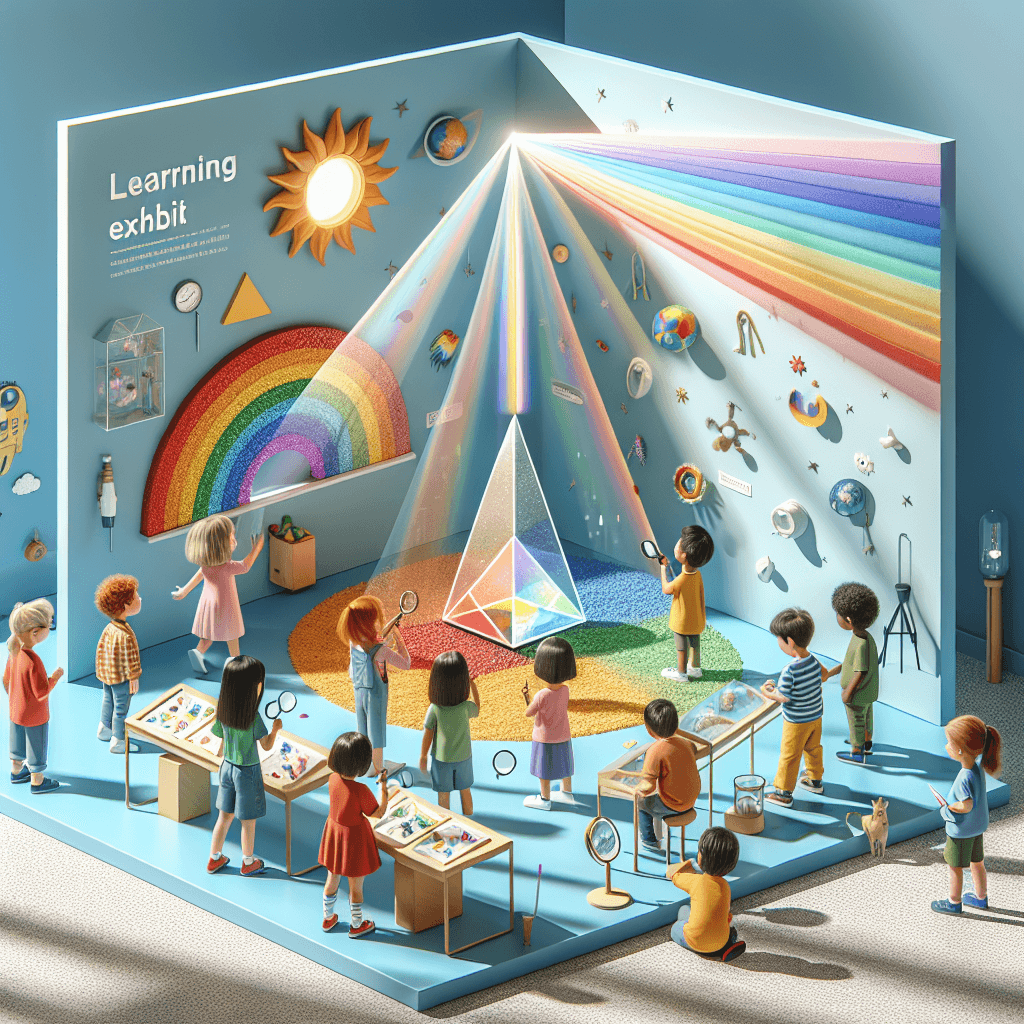
Rainbow Science Exhibit: Exploring Light and Color
Inquiry Framework
Question Framework
Driving Question
The overarching question that guides the entire project.How can we create an exhibit to teach others about the science behind rainbows and explain how light interacts with water droplets to create this colorful phenomenon?Essential Questions
Supporting questions that break down major concepts.- What is light made of?
- How does light travel?
- What happens when light hits water droplets?
- How do water droplets act like prisms?
- How do the colors of light separate to form a rainbow?
- Why do we see rainbows in an arc shape?
- Where can we find rainbows?
- How can we create our own rainbow?
Standards & Learning Goals
Learning Goals
By the end of this project, students will be able to:- Students will be able to explain that white light is composed of different colors.
- Students will be able to explain how light interacts with water droplets to create a rainbow.
- Students will be able to create an exhibit that teaches others about the science behind rainbows.
Entry Events
Events that will be used to introduce the project to studentsRainbow in a Bottle Challenge
Students are presented with various materials (water, prisms, mirrors, flashlights) and challenged to create a rainbow inside a clear bottle. This hands-on challenge sparks curiosity about how rainbows form and connects directly to the project's goal of understanding the science behind them.'Mystery Colors' Experiment
Students receive a kit with seemingly clear liquids that, when combined under specific lighting conditions, produce vibrant colors and a mini-rainbow. This 'magical' reveal encourages inquiry into the properties of light and color, directly relating to the science of rainbows.Rainbow Scavenger Hunt
Students embark on a scavenger hunt, both indoors and outdoors, to find objects that represent each color of the rainbow. Upon finding all objects, they arrange them in the correct order and discuss why these objects appear in those colors, linking to the study of light and color spectrums.Portfolio Activities
Portfolio Activities
These activities progressively build towards your learning goals, with each submission contributing to the student's final portfolio.Rainbow Exhibit Blueprint
Students design a detailed blueprint for their rainbow exhibit, outlining the different components, interactive elements, and informational displays they will include. This activity requires students to integrate their knowledge of light and color to create an engaging and educational exhibit.Steps
Here is some basic scaffolding to help students complete the activity.Final Product
What students will submit as the final product of the activityA comprehensive blueprint of the rainbow exhibit, including sketches, labels, descriptions, and an explanation of its educational purpose.Alignment
How this activity aligns with the learning objectives & standardsAddresses the learning goal: Students will be able to create an exhibit that teaches others about the science behind rainbows.Rubric & Reflection
Portfolio Rubric
Grading criteria for assessing the overall project portfolioRainbow Exhibit Blueprint Rubric
Understanding of Scientific Concepts
Demonstrates accurate understanding of how light interacts with water droplets to create a rainbow.Accuracy of Scientific Explanation
Explains the scientific principles behind rainbow formation (e.g., refraction, reflection, dispersion) accurately and comprehensively.
Exemplary
4 PointsProvides a clear, accurate, and thorough explanation of the scientific principles behind rainbow formation, demonstrating a deep understanding of the concepts. Includes relevant scientific vocabulary.
Proficient
3 PointsProvides an accurate explanation of the scientific principles behind rainbow formation, demonstrating a good understanding of the concepts. Uses some relevant scientific vocabulary.
Developing
2 PointsProvides a partially accurate explanation of the scientific principles behind rainbow formation, demonstrating a basic understanding of the concepts. May have some minor inaccuracies or omissions.
Beginning
1 PointsProvides an inaccurate or incomplete explanation of the scientific principles behind rainbow formation, demonstrating a limited understanding of the concepts. Lacks scientific vocabulary.
Integration of Concepts
Integrates multiple scientific concepts to explain the complete process of rainbow formation.
Exemplary
4 PointsSeamlessly integrates multiple scientific concepts (e.g., refraction, reflection, dispersion, wavelength) to provide a comprehensive and cohesive explanation of rainbow formation.
Proficient
3 PointsIntegrates multiple scientific concepts to explain rainbow formation, demonstrating a clear understanding of how these concepts relate to each other.
Developing
2 PointsAttempts to integrate multiple scientific concepts, but the connections between them may be unclear or incomplete.
Beginning
1 PointsShows limited understanding of how multiple scientific concepts relate to rainbow formation. Presents concepts in isolation.
Exhibit Design and Clarity
Effectiveness and clarity of the exhibit design in communicating the science of rainbows.Blueprint Detail and Organization
The blueprint is detailed, well-organized, and easy to understand.
Exemplary
4 PointsThe blueprint is exceptionally detailed, including clear sketches, labels, and descriptions of each component. The organization is logical and makes the exhibit easy to understand.
Proficient
3 PointsThe blueprint is detailed and well-organized, including sketches, labels, and descriptions of each component. The organization is generally clear and easy to follow.
Developing
2 PointsThe blueprint lacks some detail or organization, making it somewhat difficult to understand. Sketches, labels, or descriptions may be incomplete or unclear.
Beginning
1 PointsThe blueprint is poorly detailed and disorganized, making it difficult to understand. Lacks essential sketches, labels, or descriptions.
Educational Purpose
Clearly explains how the exhibit will teach others about the science behind rainbows.
Exemplary
4 PointsProvides a compelling and insightful explanation of how the exhibit will effectively teach others about the science behind rainbows. Highlights specific interactive elements and informational displays.
Proficient
3 PointsProvides a clear and adequate explanation of how the exhibit will teach others about the science behind rainbows. Identifies key interactive elements and informational displays.
Developing
2 PointsProvides a vague or incomplete explanation of how the exhibit will teach others about the science behind rainbows. Lacks specific details about interactive elements or informational displays.
Beginning
1 PointsFails to explain how the exhibit will teach others about the science behind rainbows. The educational purpose is unclear.
Creativity and Innovation
Demonstrates creativity and innovation in the design of the rainbow exhibit.Originality of Design
The exhibit design is original and demonstrates creative thinking.
Exemplary
4 PointsThe exhibit design is highly original and innovative, demonstrating exceptional creative thinking and a unique approach to teaching about rainbows.
Proficient
3 PointsThe exhibit design is original and demonstrates creative thinking, incorporating novel elements to enhance learning.
Developing
2 PointsThe exhibit design shows some originality but relies on common or conventional approaches. Demonstrates limited creative thinking.
Beginning
1 PointsThe exhibit design lacks originality and demonstrates little creative thinking. Relies heavily on existing ideas or templates.
Engagement and Interactivity
The exhibit includes interactive elements that actively engage the audience.
Exemplary
4 PointsThe exhibit incorporates highly engaging and innovative interactive elements that actively involve the audience in learning about the science behind rainbows. These elements are seamlessly integrated into the design.
Proficient
3 PointsThe exhibit includes well-designed interactive elements that effectively engage the audience in learning about the science behind rainbows.
Developing
2 PointsThe exhibit includes some interactive elements, but they may not be fully engaging or effectively integrated into the design.
Beginning
1 PointsThe exhibit lacks interactive elements or includes elements that are not engaging or relevant to the learning objectives.