
Rainforest Animal Creation: Hybrid Plushie and Storytelling
Inquiry Framework
Question Framework
Driving Question
The overarching question that guides the entire project.How can we create a unique and imaginative animal hybrid for the rainforest and articulate its survival story through art and narrative writing?Essential Questions
Supporting questions that break down major concepts.- How do authors use narrative elements to create a compelling story about an animal's experience?
- What characteristics and adaptations help animals survive in a rainforest environment?
- How can we combine art and writing to creatively express an animal's journey?
- In what ways do two different animals' traits influence the life of a newly imagined creature?
- How does understanding an animal's habitat contribute to writing a realistic and engaging story?
- Why is it important to include details and clear sequences in storytelling?
Standards & Learning Goals
Learning Goals
By the end of this project, students will be able to:- Students will be able to create a new animal by combining traits of two existing rainforest animals, showcasing an understanding of adaptations and survival characteristics.
- Students will demonstrate the ability to write a coherent narrative that includes descriptive details and clear event sequences about their created animal's experiences in the rainforest.
- Students will apply research skills to gather information about animal habitats and traits to incorporate realism into their narrative stories.
- Students will use artistic skills to design and create a paper plushie of their hybrid animal, expressing creative interpretations of their narrative writing.
- Students will articulate the connection between an animal's traits and its habitat, showing how specific adaptations enable survival in the rainforest environment.
Common Core Standards
Entry Events
Events that will be used to introduce the project to studentsHybrid Animal News Flash
Present a breaking news segment where an anchor reports on new hybrid animals discovered in the rainforest. With a multimedia approach, students' curiosity is piqued, encouraging them to contribute by designing their own unique animal to feature in future news segments.Portfolio Activities
Portfolio Activities
These activities progressively build towards your learning goals, with each submission contributing to the student's final portfolio.Animal Traits Spin and Combine
Students will use a spinning wheel tool to randomly select traits from two existing rainforest animals, which they will combine to create a new, imaginative animal hybrid. This activity serves as an introductory step to understanding animal adaptations and characteristics, preparing them for narrative development and artistic expression.Steps
Here is some basic scaffolding to help students complete the activity.Final Product
What students will submit as the final product of the activityAn illustrated sketch of the students’ newly created hybrid animal, highlighting its unique traits.Alignment
How this activity aligns with the learning objectives & standardsAligns with CCSS.W.5.7 and CCSS.W.5.8 by encouraging research and integration of animal traits.Paper Plushie Creation
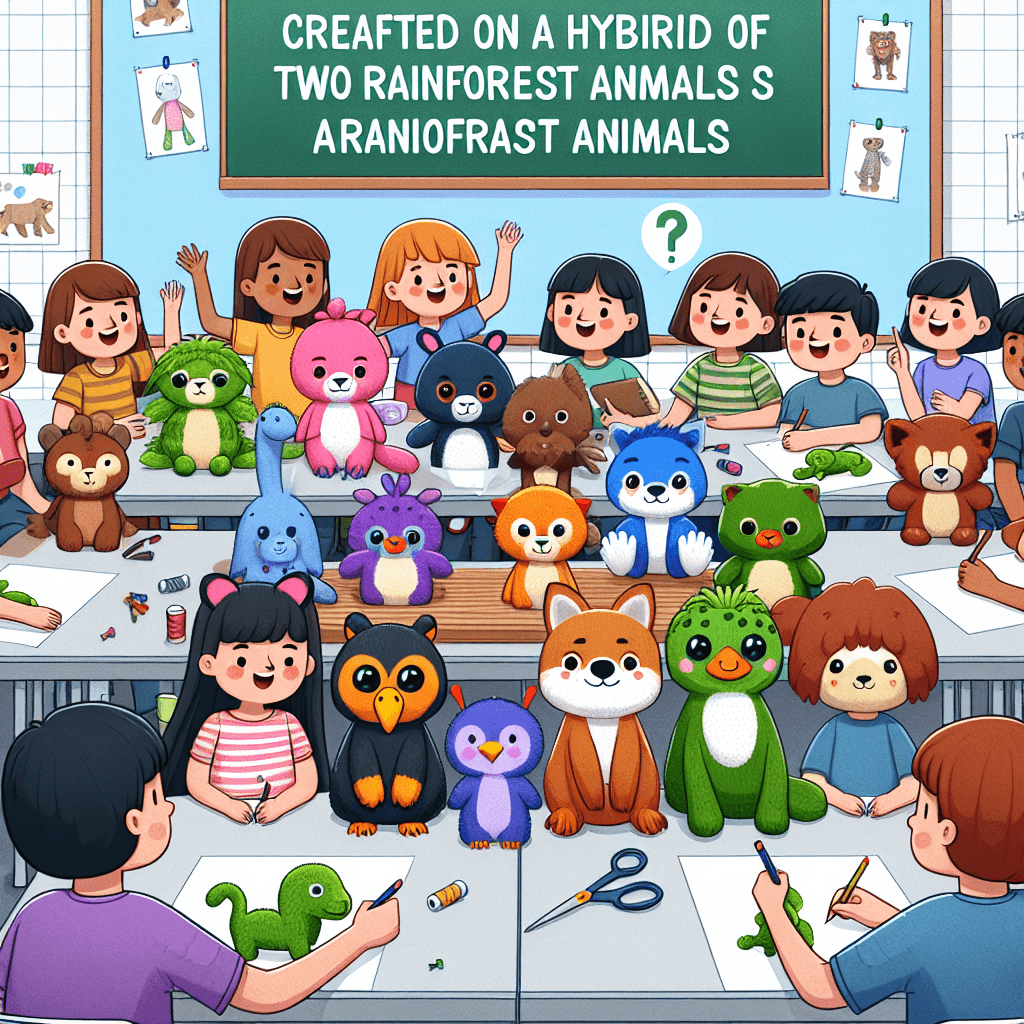
Students will bring their hybrid animal to life by designing and creating a paper plushie, using a variety of art materials to accurately represent selected traits and adaptations. This artistic approach helps solidify their understanding of animal features and supports creative expression within their narrative projects.Steps
Here is some basic scaffolding to help students complete the activity.Final Product
What students will submit as the final product of the activityA completed paper plushie model showcasing the hybrid animal with descriptive tags of its traits.Alignment
How this activity aligns with the learning objectives & standardsSupports CCSS.W.5.1a by organizing ideas logically and W.5.8 by summarizing information visually.Narrative Explorer Journal
Students will write a narrative story in the form of a journal entry, exploring a day in the life of their newly created animal. This activity emphasizes the use of narrative techniques, descriptive details, and clear event sequencing to tell a compelling story.Steps
Here is some basic scaffolding to help students complete the activity.Final Product
What students will submit as the final product of the activityA well-crafted narrative journal entry from the perspective of the hybrid animal, detailing its survival experiences in the rainforest.Alignment
How this activity aligns with the learning objectives & standardsCovers CCSS.W.5.3 and CCSS.W.5.4 by developing narratives using descriptive details and clear sequences.Adaptations Presentation
In this final activity, students will compile and present their research findings, narrative insights, and artistic creations to the class. This activity allows students to articulate the connection between an animal's traits and its habitat, emphasizing specific adaptations for survival.Steps
Here is some basic scaffolding to help students complete the activity.Final Product
What students will submit as the final product of the activityA comprehensive presentation that includes visual, written, and oral elements, effectively summarizing the entire project.Alignment
How this activity aligns with the learning objectives & standardsIntegrates CCSS.W.5.1b by supporting arguments with logical reasons, supported by facts and W.5.4 with clear organization.Rubric & Reflection
Portfolio Rubric
Grading criteria for assessing the overall project portfolioRainforest Animal Hybrid Project Rubric
Creative Concept Development
Evaluates how well students developed their hybrid animal concept using traits from existing rainforest animals, demonstrating understanding of adaptations and survival.Trait Combination and Explanation
Assesses how effectively the student combined animal traits to create a new hybrid and the depth of explanation regarding these choices.
Exemplary
4 PointsThe combination of traits is highly innovative and well-justified, showing deep understanding of adaptations and survival in the rainforest.
Proficient
3 PointsThe combination of traits is creative and well-explained, showing good understanding of rainforest animal adaptations.
Developing
2 PointsThe combination of traits is somewhat creative but lacks clear explanation or deeper understanding of adaptations.
Beginning
1 PointsThe combination of traits is basic with minimal explanation and limited understanding of adaptations.
Artistic Representation
Assesses the student's ability to translate their animal concept into a physical form through art, evaluating creativity, craftsmanship, and expressive capability.Plushie Creation Quality
Measures the craftsmanship, creativity, and accuracy in representing the hybrid animal's traits with art materials.
Exemplary
4 PointsThe plushie is expertly crafted with exceptional creativity, accurately representing the animal's traits and adaptations.
Proficient
3 PointsThe plushie is well-crafted and creative, clearly showing the animal's unique traits.
Developing
2 PointsThe plushie shows some level of creativity but may have inconsistencies and lacks some detail in trait representation.
Beginning
1 PointsThe plushie is poorly crafted with limited creativity and vague representation of traits.
Narrative Writing
Evaluates the student's narrative journal for structure, detail, sequence, and engagement as it communicates the life of the hybrid animal in the rainforest.Descriptive Detail and Sequencing
Assesses the use of descriptive language and logical sequencing in telling the animal's story, ensuring it is engaging and coherent.
Exemplary
4 PointsThe narrative is richly detailed and expertly sequenced, creating a vivid and engaging story about the animal's life.
Proficient
3 PointsThe narrative includes clear details and logical sequence, effectively telling the animal's story.
Developing
2 PointsThe narrative has some descriptive details and sequence but lacks clarity or depth in parts.
Beginning
1 PointsThe narrative is minimally detailed and poorly sequenced, making the story difficult to follow.
Research and Presentation
Assesses the effectiveness of research compiled on animal habitats and traits and the clarity of the final presentation summarizing the project.Research Compilation and Presentation Clarity
Measures how well students gathered, organized, and presented their research and project insights in a coherent and persuasive way.
Exemplary
4 PointsThe presentation is thoroughly researched, highly organized, and persuasively delivered, showcasing in-depth understanding.
Proficient
3 PointsThe presentation is well-researched and organized, clearly delivering project insights.
Developing
2 PointsThe presentation includes some research and organization but lacks clarity or persuasiveness in parts.
Beginning
1 PointsThe presentation is poorly researched and organized, with unclear delivery of project insights.