
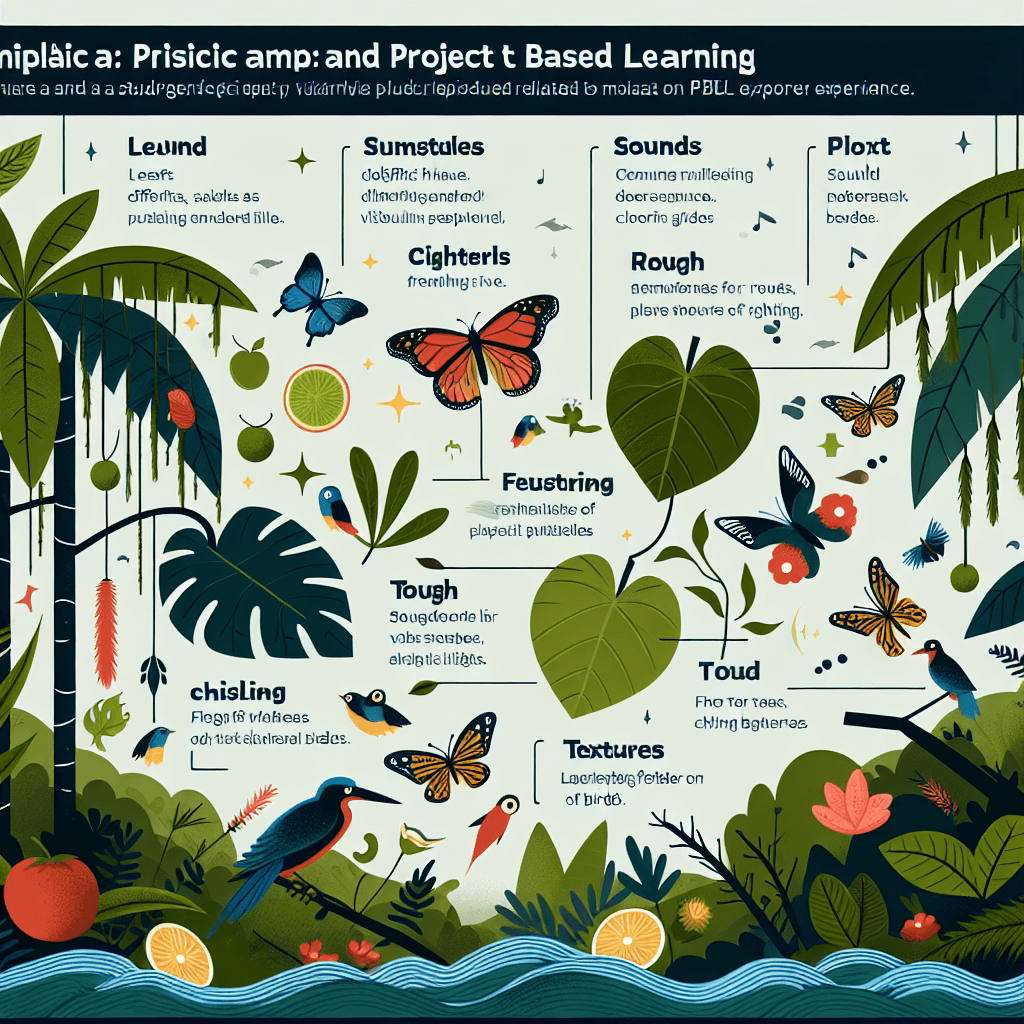
Rainforest Explorer Sensory Details Infographic
Inquiry Framework
Question Framework
Driving Question
The overarching question that guides the entire project.How can we, as rainforest explorers, gather and use sensory details from texts to create an informative and engaging infographic that enhances understanding about the rainforest's environment and its storytelling elements?Essential Questions
Supporting questions that break down major concepts.- What are sensory details and how do they enhance our understanding of a text?
- How can we effectively gather information from multiple sources to understand a topic in depth?
- In what ways can infographics be used to communicate information clearly and effectively?
- Why is it important to understand sensory details when exploring the rainforest or similar environments through literature?
- How does the use of sensory details impact the reader's experience and visualization of a story or topic?
Standards & Learning Goals
Learning Goals
By the end of this project, students will be able to:- Students will understand and identify sensory details in texts about the rainforest.
- Students will conduct research using multiple sources to gather information on the rainforest and its environment.
- Students will learn how to organize and present information effectively using an infographic tool like Canva.
- Students will analyze and interpret the impact of sensory details on reader understanding and engagement in texts.
- Students will enhance their skills in using graphics and visual elements to communicate information clearly and effectively.
Common Core Standards
Entry Events
Events that will be used to introduce the project to studentsSensory Detail Scavenger Hunt
Organize a scavenger hunt where students find and collect items or clues related to rainforest sensory details around the school or classroom. As they collect these elements, they form connections with the descriptions found in texts, inspiring deeper inquiry into how sensory language enhances storytelling and understanding.Virtual Reality Rainforest Immersion
Kick off the project by immersing students in a virtual reality tour of a rainforest. As they explore, they'll jot down sensory details they notice and are intrigued by, which will pique their curiosity about the sights, sounds, and other sensory experiences detailed in rainforest-related texts. This authentic experience serves as a sensory anchor for their upcoming research and infograph creation.Rainforest Sounds Mystery Box
Present students with a mystery box containing various audio clips of rainforest sounds—waterfalls, animal calls, rustling leaves—and challenge them to match these sounds to potential sources found in rainforest texts. This engages students' curiosity and initiates an authentic exploration of sensory details in a format that blends mystery and learning.Create a Mini Rainforest "Experience Zone"
Transform a corner of the classroom into a mini rainforest with plants, ambient sounds, and tactile experiences for students to explore. This hands-on, immersive setup encourages students to engage directly with sensory details, fostering curiosity about how such elements are captured and described in their readings and projects.Portfolio Activities
Portfolio Activities
These activities progressively build towards your learning goals, with each submission contributing to the student's final portfolio.Source Seekers Mission
Students will extend their detective work by conducting research across multiple sources, including digital resources, to gather more information about rainforest sensory details. They'll synthesize this information to deepen their understanding and prepare for the infographic creation process.Steps
Here is some basic scaffolding to help students complete the activity.Final Product
What students will submit as the final product of the activityAn expanded research portfolio containing cited sources and categorized sensory details.Alignment
How this activity aligns with the learning objectives & standardsSupports CCSS.ELA-Literacy.W.5.7 for conducting research projects and CCSS.ELA-Literacy.RI.5.7 for drawing information from various sources.Rubric & Reflection
Portfolio Rubric
Grading criteria for assessing the overall project portfolioRainforest Sensory Details Infographic Rubric
Research Skills
Assessment of the student's ability to effectively conduct research using multiple sources and organize information appropriately.Use of Multiple Sources
Evaluates the degree to which students draw information from various print and digital sources to gain a comprehensive understanding of rainforest sensory details.
Exemplary
4 PointsEffectively uses a diverse range of sources beyond the minimum required, showcasing a sophisticated understanding of the content.
Proficient
3 PointsUses a minimum of two types of sources effectively to gather relevant information for the project.
Developing
2 PointsRelies mostly on a single source type with limited exploration of additional sources.
Beginning
1 PointsStruggles to utilize multiple sources and relies heavily on one type of source with incomplete information collection.
Information Synthesis and Organization
Measures the student's ability to categorize, compare, and synthesize information from research findings.
Exemplary
4 PointsDemonstrates exceptional ability to organize and synthesize information from multiple sources, highlighting insightful comparisons and contrasts.
Proficient
3 PointsEffectively organizes information from research to identify common themes and differences.
Developing
2 PointsAttempts to organize information but shows inconsistent ability to categorize and compare details across sources.
Beginning
1 PointsShows minimal organization or synthesis of information, with isolated facts and little comparison across sources.
Understanding and Application of Sensory Details
Evaluates the student's ability to identify, understand, and contextualize sensory details in texts related to the rainforest.Identification of Sensory Details
Assesses how well the student can recognize and document sensory details within informational texts.
Exemplary
4 PointsConsistently identifies a wide range of sensory details, demonstrating a nuanced understanding of their use in texts.
Proficient
3 PointsIdentifies key sensory details with a clear understanding of their function in enhancing text.
Developing
2 PointsIdentifies some sensory details but lacks clear recognition of their purpose in text.
Beginning
1 PointsStruggles to identify sensory details, missing key information and context.
Contextualization of Sensory Details
Judges the ability to place sensory details within the broader context of enhancing reader engagement and understanding.
Exemplary
4 PointsSkillfully contextualizes sensory details to explain and enhance the reader's understanding and immersion in the rainforest environment.
Proficient
3 PointsContextualizes sensory details to improve reader comprehension, showing effective use in the text's narrative.
Developing
2 PointsAttempts to contextualize details but lacks consistency in linking them to reader engagement or text enhancement.
Beginning
1 PointsRarely contextualizes sensory details; fails to connect them with the purpose of enhancing engagement.
Infographic Design and Presentation
Assesses the student's ability to create an informative and visually appealing infographic utilizing the gathered sensory details.Visual and Graphic Elements
Measures the aesthetic quality and informative value of graphical elements used in the infographic.
Exemplary
4 PointsCreates a highly engaging and visually stunning infographic that integrates graphic elements seamlessly to enhance content understanding.
Proficient
3 PointsDesigns a clear and visually appealing infographic with effective use of graphics to support main ideas.
Developing
2 PointsCreates an infographic with basic design and some graphical elements, which only partially support the content.
Beginning
1 PointsProduces an infographic with minimal visual elements, failing to enhance or support the informational content.
Clarity and Communication
Evaluates the clear and effective communication of information through the infographic layout and text.
Exemplary
4 PointsCommunicates complex information clearly and concisely with a logical layout that guides the reader smoothly through content.
Proficient
3 PointsEffectively communicates information with a logical structure that enhances reader comprehension.
Developing
2 PointsPresents information with some clarity but may include disorganized elements that hinder comprehension.
Beginning
1 PointsStruggles to communicate information clearly, with a disorganized layout that confuses the reader.