
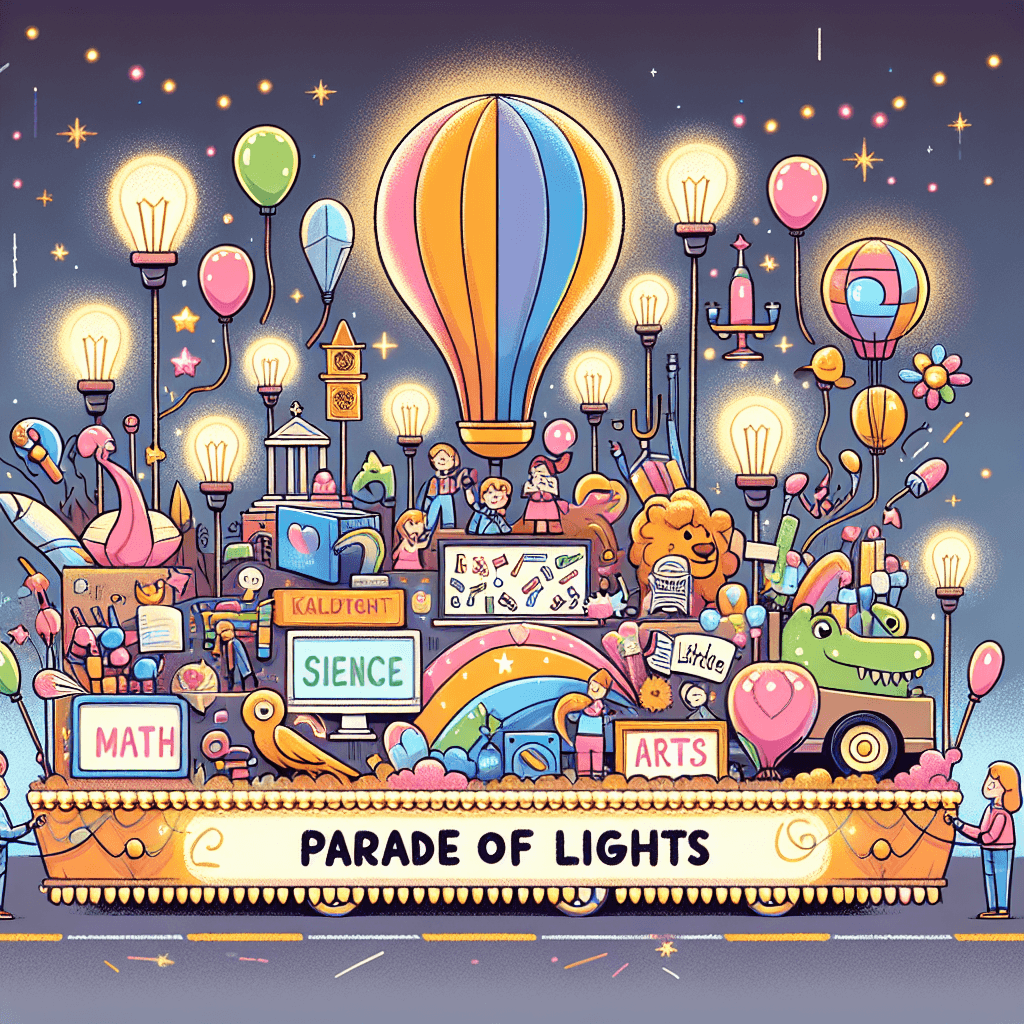
Ray MS Parade of Lights Float: Special Areas Unite!
Inquiry Framework
Question Framework
Driving Question
The overarching question that guides the entire project.How can we collaboratively design and build a parade float that integrates art, technology, and engineering to showcase our special area classes and represent Ray Middle School's values to the Baldwinsville community?Essential Questions
Supporting questions that break down major concepts.- How does collaboration between different disciplines (art, FACS, digital literacy, robotics, and technology/engineering) enhance the design and functionality of a project?
- How can we use the principles of engineering design to create a visually appealing and structurally sound parade float?
- In what ways can we apply our knowledge of technology and computer science to incorporate interactive or automated elements into the float design?
- How can we ensure that our float design effectively communicates our school's values and the learning experiences in our special area classes to the broader community?
- What criteria should we use to evaluate the success of our parade float design, and how can we systematically improve our design based on these criteria?
Standards & Learning Goals
Learning Goals
By the end of this project, students will be able to:- Students will collaborate to design a parade float that integrates art, technology, and engineering.
- Students will apply engineering design principles to create a structurally sound and visually appealing float.
- Students will use technology and computer science to incorporate interactive elements into the float.
- Students will effectively communicate Ray Middle School's values and special area classes' learning experiences through the float design.
- Students will evaluate and improve their float design based on established criteria.
- Students will apply technical skills to construct the float
- Students will understand technical drawings and specifications
- Students will demonstrate an understanding of engineering’s influence
ITEEA
CTE
NGSS
Entry Events
Events that will be used to introduce the project to students'Float Design Challenge: The Mystery Box'
Each special area class receives a mystery box filled with random materials related to their subject. The challenge? To brainstorm and sketch initial float design ideas using ONLY those materials, forcing unconventional thinking and highlighting each subject's unique contribution. This sparks immediate curiosity and demonstrates the creative potential within constraints.Portfolio Activities
Portfolio Activities
These activities progressively build towards your learning goals, with each submission contributing to the student's final portfolio.'Blueprint Bonanza: Initial Design Schematics'
Students create initial design schematics, detailing the float's structure, dimensions, and overall aesthetic. This activity emphasizes visual communication and technical understanding.Steps
Here is some basic scaffolding to help students complete the activity.Final Product
What students will submit as the final product of the activityA detailed hand-drawn or digitally created schematic of the float design with labeled components and a written explanation.Alignment
How this activity aligns with the learning objectives & standardsAligns with CTE Standard (Construction) - Demonstrate understanding of technical drawings and specifications; ITEEA Standard 8 - Focuses on the attributes of design, including creativity and functionality.'Material Marvels: Properties & Practicality'
Students research the properties of different materials and justify their choices for the float construction, considering factors like weight, durability, and environmental impact.Steps
Here is some basic scaffolding to help students complete the activity.Final Product
What students will submit as the final product of the activityA comprehensive report detailing the properties of chosen materials, justifications for their use, and considerations for environmental impact.Alignment
How this activity aligns with the learning objectives & standardsAligns with NGSS MS-PS2-6 - Communicate scientific and technical information about why the molecular-level structure is important in the functioning of designed materials; ITEEA Standard 7 - Develop an understanding of the influence of engineering, technology, and the application of scientific principles on the natural environment.'Motion Magic: Engineering Design Challenges'
Students focus on the mechanical aspects of the float, designing and prototyping systems for movement, lighting, or interactive elements.Steps
Here is some basic scaffolding to help students complete the activity.Final Product
What students will submit as the final product of the activityA functional prototype of a mechanical or interactive element, along with a detailed design process summary.Alignment
How this activity aligns with the learning objectives & standardsAligns with CTE Standard (Engineering Design and Development) - Apply engineering design and development principles to solve real-world problems; NGSS MS-ETS1-2 - Evaluate competing design solutions using a systematic process.Rubric & Reflection
Portfolio Rubric
Grading criteria for assessing the overall project portfolioParade Float Design Rubric
Design Integration & Representation
Focuses on how well the float design integrates elements from all special area classes (art, FACS, digital literacy, robotics, and technology/engineering) and effectively represents Ray Middle School's values.Integration of Special Area Classes
Evaluates the extent to which the design seamlessly incorporates elements from each special area class.
Exemplary
4 PointsDesign innovatively and seamlessly integrates elements from all special area classes, demonstrating a deep understanding of each subject's contribution.
Proficient
3 PointsDesign effectively integrates elements from most special area classes, showing a good understanding of each subject's role.
Developing
2 PointsDesign integrates elements from some special area classes, but connections may be superficial or unclear.
Beginning
1 PointsDesign shows limited integration of special area classes, with minimal connection to subject matter.
Representation of School Values
Assesses how effectively the design communicates Ray Middle School's values and identity to the broader community.
Exemplary
4 PointsDesign powerfully and creatively represents Ray Middle School's values, showcasing the school's unique identity and culture.
Proficient
3 PointsDesign clearly represents Ray Middle School's values, effectively communicating the school's mission and character.
Developing
2 PointsDesign attempts to represent Ray Middle School's values, but the connection may be unclear or underdeveloped.
Beginning
1 PointsDesign shows little to no representation of Ray Middle School's values.
Technical Design & Functionality
Focuses on the technical aspects of the float design, including structural integrity, material selection, and the incorporation of mechanical/interactive elements.Structural Soundness & Material Choice
Evaluates the feasibility and safety of the float's structure, as well as the appropriateness of the chosen materials.
Exemplary
4 PointsDesign demonstrates a sophisticated understanding of structural engineering principles, with innovative and well-justified material choices that ensure safety and durability.
Proficient
3 PointsDesign demonstrates a good understanding of structural engineering principles, with appropriate material choices that ensure safety and durability.
Developing
2 PointsDesign shows basic understanding of structural considerations, but material choices may be questionable or safety concerns may be present.
Beginning
1 PointsDesign lacks structural integrity, with inappropriate material choices that pose safety risks.
Mechanical/Interactive Elements
Assesses the design and functionality of any mechanical or interactive elements incorporated into the float.
Exemplary
4 PointsMechanical/interactive elements are ingeniously designed, flawlessly executed, and significantly enhance the float's visual appeal and engagement.
Proficient
3 PointsMechanical/interactive elements are well-designed, functional, and contribute to the float's overall appeal.
Developing
2 PointsMechanical/interactive elements are attempted, but may be poorly designed, unreliable, or detract from the float's overall appeal.
Beginning
1 PointsNo mechanical/interactive elements are included, or the elements are non-functional and poorly integrated.
Design Communication & Documentation
Evaluates the clarity and completeness of the design schematics, material justifications, and process documentation.Design Schematics
Assesses the clarity, accuracy, and detail of the float design schematics.
Exemplary
4 PointsSchematics are exceptionally clear, detailed, and accurate, providing a comprehensive visual representation of the float design.
Proficient
3 PointsSchematics are clear, detailed, and accurate, providing a good visual representation of the float design.
Developing
2 PointsSchematics are partially complete or lack detail, making it difficult to fully understand the float design.
Beginning
1 PointsSchematics are incomplete, inaccurate, or missing essential information.
Material Justification & Environmental Impact
Evaluates the justification for material choices, considering factors like cost, availability, and environmental impact.
Exemplary
4 PointsMaterial choices are thoroughly justified, demonstrating a deep understanding of material properties, cost-effectiveness, and environmental sustainability.
Proficient
3 PointsMaterial choices are well-justified, considering material properties, cost-effectiveness, and environmental impact.
Developing
2 PointsMaterial justifications are incomplete or lack sufficient detail, with limited consideration of environmental impact.
Beginning
1 PointsMaterial choices are poorly justified, with no consideration of cost, availability, or environmental impact.
Design Process Documentation
Assesses the clarity and completeness of the documentation of the design process.
Exemplary
4 PointsDocumentation provides a comprehensive and insightful account of the entire design process, including initial ideas, prototypes, testing results, and proposed modifications.
Proficient
3 PointsDocumentation clearly describes the design process, including initial ideas, prototypes, testing results, and proposed modifications.
Developing
2 PointsDocumentation provides a partial account of the design process, with some gaps or omissions.
Beginning
1 PointsDocumentation is incomplete, poorly organized, or missing essential information.