
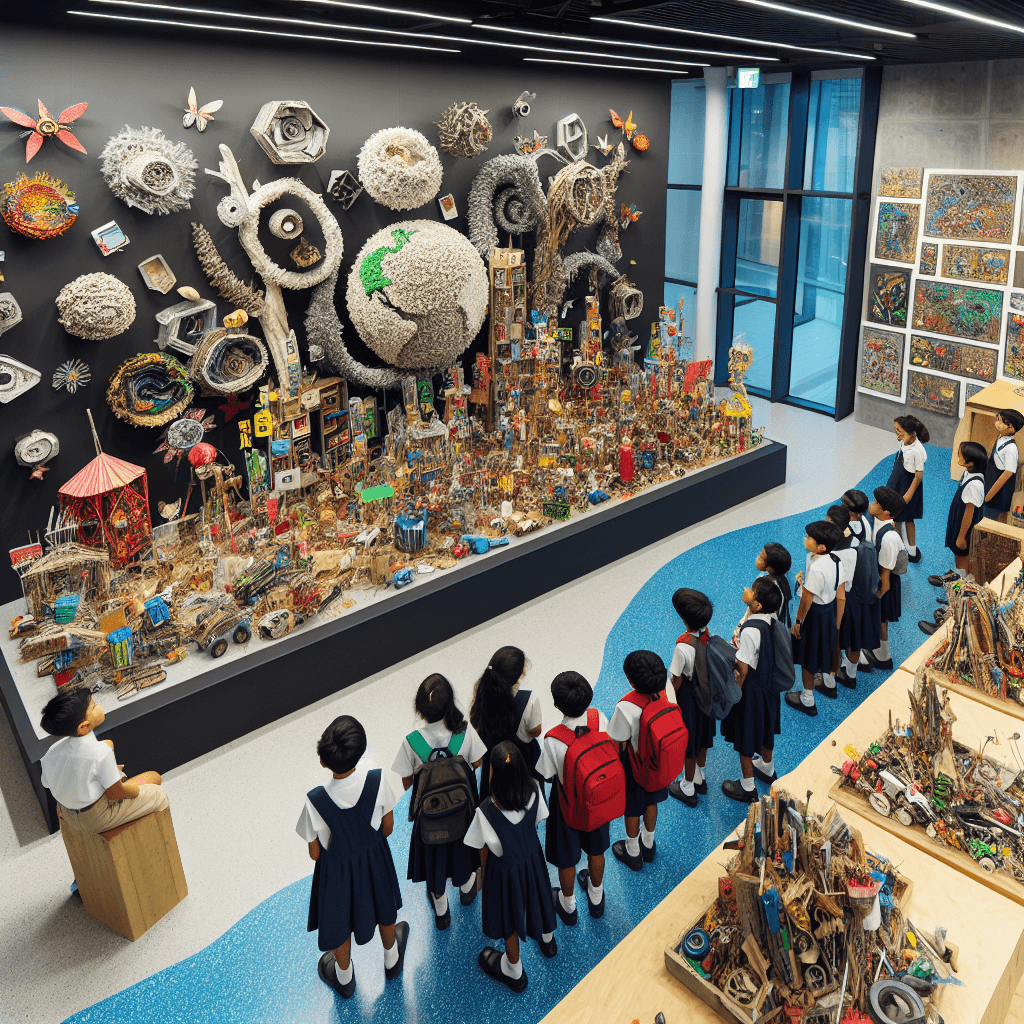
Recycled Art Gallery: Crafting Beauty from Waste
Inquiry Framework
Question Framework
Driving Question
The overarching question that guides the entire project.How can we use our understanding of recycling and material properties to create art that raises environmental awareness and promotes sustainable practices?Essential Questions
Supporting questions that break down major concepts.- What is the impact of waste on our environment and how can recycling mitigate these effects?
- How can we creatively transform waste into art?
- What are the scientific principles behind recycling processes?
- How does understanding material properties help in creating art from recycled materials?
- What role does art play in promoting environmental awareness and sustainable practices?
Standards & Learning Goals
Learning Goals
By the end of this project, students will be able to:- Students will understand the impact of waste on the environment and how recycling can mitigate those effects.
- Students will learn how to transform waste materials into creative art pieces, understanding the artistic and practical processes involved.
- Students will explore and apply scientific principles behind recycling processes and understand material properties.
- Students will develop skills in evaluating the design solutions of their art projects to meet sustainability and artistic impact criteria.
- Students will be able to discuss the role of art in raising environmental awareness and promoting sustainable practices.
Next Generation Science Standards
Common Core Standards for Mathematics
Entry Events
Events that will be used to introduce the project to studentsMysterious Artifacts
As students walk into the classroom, they discover a collection of intriguing 'artifacts' made from recycled materials. Each artifact comes with a mysterious backstory that challenges students to imagine the artist's world and message. This interactive setup encourages students to explore their own artistic expressions using recycled resources.Portfolio Activities
Portfolio Activities
These activities progressively build towards your learning goals, with each submission contributing to the student's final portfolio.Artistic Archaeologists
Students become 'artistic archaeologists,' examining recycled art artifacts and decoding their environmental messages. This activity introduces students to the concept of using art as a medium for environmental communication, emphasizing recycling.Steps
Here is some basic scaffolding to help students complete the activity.Final Product
What students will submit as the final product of the activityAn analysis report detailing the materials used in the chosen artifact and the interpreted environmental message.Alignment
How this activity aligns with the learning objectives & standardsAligns with MS-ESS3-3, understanding impact on the environment and using art to raise awareness.Material Marvels
In this activity, students will investigate various recycled materials, learning about their properties and how these can influence artistic decisions in their projects. This groundwork helps them understand material selection and usage.Steps
Here is some basic scaffolding to help students complete the activity.Final Product
What students will submit as the final product of the activityA completed material properties chart detailing the properties of different recycled materials.Alignment
How this activity aligns with the learning objectives & standardsAligns with MS-PS1-3, understanding material properties and their societal impacts.Creative Construction
Students individually plan and design an art piece using their learned skills about recycled materials' properties. They draft designs, keeping in mind the sustainability and artistic impact.Steps
Here is some basic scaffolding to help students complete the activity.Final Product
What students will submit as the final product of the activityDetailed sketches of their recycled art projects, accompanied by notes on material usage and artistic intent.Alignment
How this activity aligns with the learning objectives & standardsAligns with MS-ETS1-2 by evaluating designs based on sustainability and artistic criteria.Rubbish to Riches: Art Creation
Students bring their designs to life by constructing their recycled art pieces. This is the culmination of their understanding of materials, design, and environmental impact.Steps
Here is some basic scaffolding to help students complete the activity.Final Product
What students will submit as the final product of the activityA completed art piece made from recycled materials, ready for display in the gallery.Alignment
How this activity aligns with the learning objectives & standardsAligns with MS-ESS3-3 and MS-ETS1-2, applying design and scientific principles to minimize environmental impact.Gallery Gala
Students prepare to exhibit their art, planning the gallery layout and crafting artist statements. This provides a platform for students to communicate their understanding of art's role in promoting sustainability.Steps
Here is some basic scaffolding to help students complete the activity.Final Product
What students will submit as the final product of the activityAn artist statement and a public exhibition of their recycled art pieces.Alignment
How this activity aligns with the learning objectives & standardsSupports MS-ESS3-3, using art to discuss environmental issues, and 6.SP.B.5 by summarizing data (artist statements) in context.Rubric & Reflection
Portfolio Rubric
Grading criteria for assessing the overall project portfolioRecycled Art Gallery Evaluation Rubric
Creativity and Innovation
This category measures the student's ability to creatively use recycled materials in ways that raise environmental awareness while promoting sustainable practices.Artistic Creativity
Measures the degree of creativity and originality in transforming recycled materials into art.
Exemplary
4 PointsArtwork demonstrates outstanding creativity, with innovative use of materials that effectively conveys a powerful environmental message.
Proficient
3 PointsArtwork shows good creativity and makes effective use of recycled materials to communicate an environmental message.
Developing
2 PointsArtwork demonstrates some creativity and partial success in using materials to communicate an environmental message.
Beginning
1 PointsArtwork shows limited creativity with minimal use of recycled materials to convey an environmental message.
Originality of Concept
Assesses the uniqueness and originality of the art concept and its alignment with sustainability themes.
Exemplary
4 PointsConcept is highly original and deeply aligned with sustainability themes, offering new insights or perspectives.
Proficient
3 PointsConcept is original and well-aligned with sustainability themes, offering clear insights.
Developing
2 PointsConcept shows some originality and attempts alignment with sustainability themes.
Beginning
1 PointsConcept lacks originality and has minimal alignment with sustainability themes.
Understanding and Application of Material Properties
Evaluates the student's understanding of the properties of recycled materials and their effective application within the art piece.Material Selection and Usage
Assesses the appropriateness and effectiveness of chosen materials in the art project.
Exemplary
4 PointsSelection and use of materials are outstanding, showing sophisticated understanding of material properties and purpose.
Proficient
3 PointsSelection and use of materials are suitable, showing clear understanding of material properties and purpose.
Developing
2 PointsSelection and use of materials show some understanding of properties, with limited effectiveness.
Beginning
1 PointsSelection and use of materials show minimal understanding of properties and purpose.
Integration of Material Properties
Measures how effectively material properties are utilized in design elements to enhance the artistic intent.
Exemplary
4 PointsMaterial properties are seamlessly integrated into the art piece, effectively enhancing artistic and environmental intent.
Proficient
3 PointsMaterial properties are well integrated, adequately enhancing artistic and environmental intent.
Developing
2 PointsMaterial properties are partially integrated, with some enhancement of artistic and environmental intent.
Beginning
1 PointsMaterial properties are poorly integrated, with minimal enhancement of artistic and environmental intent.
Communication and Reflection
Assesses the effectiveness of the student's communication regarding their art piece and the reflection on their learning process.Artist Statement Clarity
Evaluates how clearly and effectively the student communicates the intent and environmental significance of their art piece.
Exemplary
4 PointsArtist statement is exceptionally clear and insightful, effectively communicating the intent and environmental significance of the piece.
Proficient
3 PointsArtist statement is clear and communicates the intent and environmental significance well.
Developing
2 PointsArtist statement provides some communication about the intent and environmental significance, but lacks clarity.
Beginning
1 PointsArtist statement lacks clarity and only minimally communicates intent and significance.
Reflection on Learning and Process
Measures the student's ability to reflect on their learning journey and the creative process.
Exemplary
4 PointsReflection is thorough and insightful, demonstrating a deep understanding of the learning process and creative journey.
Proficient
3 PointsReflection is clear and demonstrates good understanding of the learning process and creative journey.
Developing
2 PointsReflection shows some understanding of the learning process and creative journey.
Beginning
1 PointsReflection lacks depth and demonstrates minimal understanding of the learning process.
Collaboration and Problem-Solving
This category evaluates students' ability to work collaboratively and solve problems encountered during the creative process.Collaboration and Teamwork
Assesses the ability to effectively collaborate with peers during the project.
Exemplary
4 PointsConsistently engages in effective collaboration, demonstrating leadership and support for peers.
Proficient
3 PointsEngages in collaborative efforts, contributing effectively and supporting peers.
Developing
2 PointsParticipates in collaboration with some contributions and limited support for peers.
Beginning
1 PointsMinimal collaboration, often requiring support to engage with peers.
Problem-Solving Skills
Measures the ability to address and solve problems throughout the art creation process.
Exemplary
4 PointsDemonstrates outstanding problem-solving skills, effectively overcoming challenges with creative solutions.
Proficient
3 PointsDemonstrates good problem-solving skills, effectively addressing challenges.
Developing
2 PointsShows some ability to solve problems, with limited success in overcoming challenges.
Beginning
1 PointsStruggles to solve problems, often unable to address challenges effectively.