
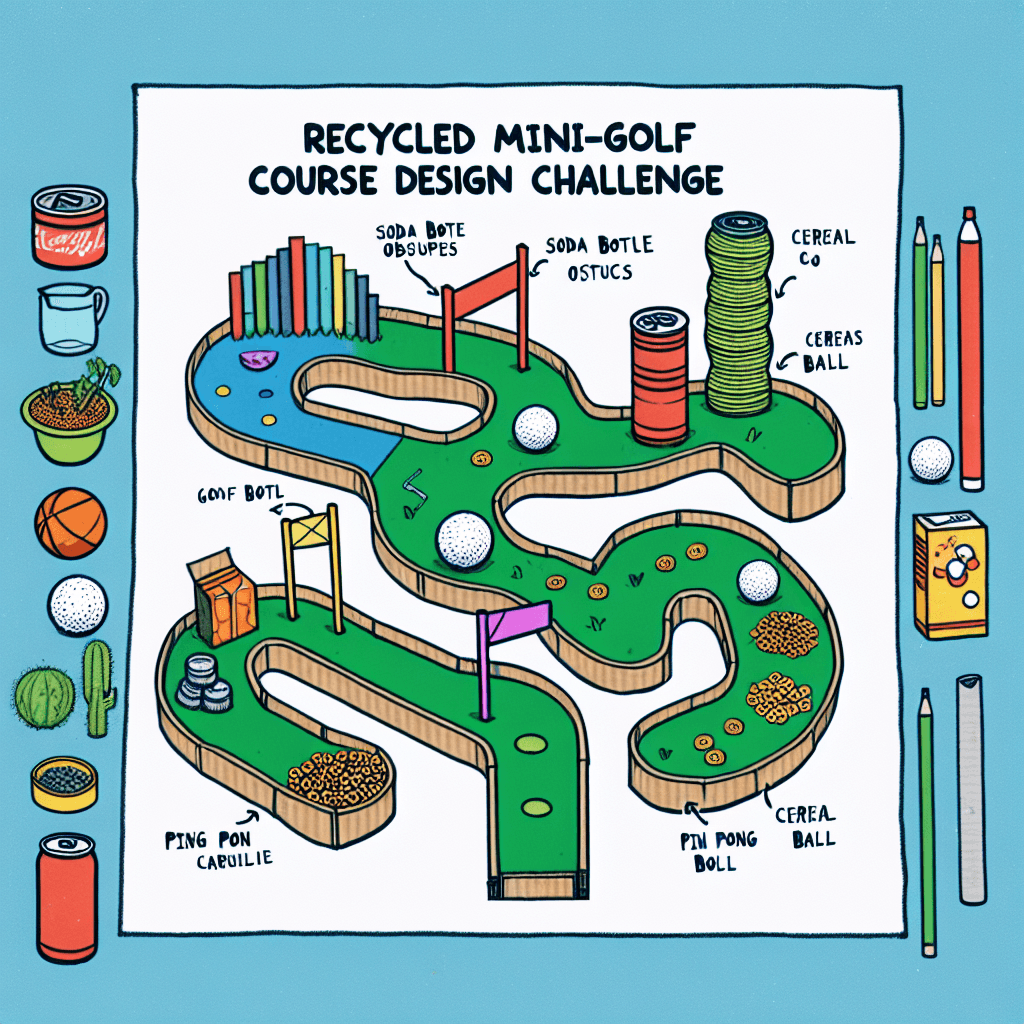
Recycled Mini-Golf Course Design Challenge
Inquiry Framework
Question Framework
Driving Question
The overarching question that guides the entire project.How can we design and build a miniature golf course using recycled materials that is both fun and educational, incorporating geometric principles, physics concepts, and persuasive communication to attract players and investors?Essential Questions
Supporting questions that break down major concepts.- How can we repurpose recycled materials to create functional and engaging miniature golf course elements?
- What geometric shapes and angles are most effective for creating challenging and fun obstacles in a miniature golf course?
- How can we use scale and proportion to design a miniature golf course that is both aesthetically pleasing and playable?
- What forces and motion concepts affect the movement of a golf ball on different surfaces and inclines?
- How can we use descriptive language and persuasive techniques to present our miniature golf course design to potential investors or players?
Standards & Learning Goals
Learning Goals
By the end of this project, students will be able to:- Students will design and construct a miniature golf course hole using recycled materials.
- Students will apply geometric principles to design challenging obstacles.
- Students will understand and apply physics concepts related to force, motion, and angles.
- Students will use persuasive communication to present their design ideas.
- Students will calculate and apply scale and proportion in their designs.
- Students will collaborate effectively in teams to complete the project.
- Students will reflect on the environmental impact of using recycled materials.
- Students will improve problem-solving skills through iterative design and testing.
- Students will enhance their understanding of the properties of different materials and their suitability for various purposes in the golf course.
- Students will learn how to present their design ideas effectively to potential investors
Entry Events
Events that will be used to introduce the project to studentsMiniature Golf Showcase
The teacher brings in several unique and quirky miniature golf holes from around the world (photos/videos). Students analyze what makes them fun and challenging, then brainstorm how to achieve similar effects with recycled materials.Portfolio Activities
Portfolio Activities
These activities progressively build towards your learning goals, with each submission contributing to the student's final portfolio.Recycled Golf Hole Brainstorm
Students will brainstorm different ideas for their miniature golf hole, focusing on how recycled materials can be used creatively and effectively. They will sketch initial designs and gather inspiration from various sources.Steps
Here is some basic scaffolding to help students complete the activity.Final Product
What students will submit as the final product of the activityA detailed sketch of the miniature golf hole design with a list of required recycled materials.Alignment
How this activity aligns with the learning objectives & standardsLearning Goal: Students will design and construct a miniature golf course hole using recycled materials.Geometry in Golf Design
Students will learn about geometric shapes and angles, and how they can be incorporated into their miniature golf hole design to create challenging obstacles. They will experiment with different shapes and angles to understand their effect on the golf ball's trajectory.Steps
Here is some basic scaffolding to help students complete the activity.Final Product
What students will submit as the final product of the activityA design plan that incorporates geometric shapes and angles to create obstacles, along with explanations of how these elements will affect gameplay.Alignment
How this activity aligns with the learning objectives & standardsLearning Goal: Students will apply geometric principles to design challenging obstacles.Physics of the Fairway
Students will investigate the physics concepts of force, motion, and angles, and how they relate to the movement of a golf ball. They will conduct simple experiments to understand how these concepts can be applied in their golf hole design.Steps
Here is some basic scaffolding to help students complete the activity.Final Product
What students will submit as the final product of the activityA written explanation of how physics concepts (force, motion, angles) are applied in their golf hole design, including diagrams illustrating these concepts.Alignment
How this activity aligns with the learning objectives & standardsLearning Goal: Students will understand and apply physics concepts related to force, motion, and angles.Pitch Perfect: Persuade the Investors
Students will develop a persuasive presentation to pitch their miniature golf hole design to potential investors (the class or a panel). They will learn about persuasive language and presentation techniques to effectively communicate the unique features and benefits of their design.Steps
Here is some basic scaffolding to help students complete the activity.Final Product
What students will submit as the final product of the activityA persuasive presentation script and visual aids (e.g., posters, models) to showcase their golf hole design and convince investors of its potential.Alignment
How this activity aligns with the learning objectives & standardsLearning Goal: Students will use persuasive communication to present their design ideas.Scale It Up & Materialize
Students will learn about scale and proportion and apply these concepts to create a scaled model of their miniature golf hole. They will also research the properties of different recycled materials and determine their suitability for constructing various elements of the golf hole.Steps
Here is some basic scaffolding to help students complete the activity.Final Product
What students will submit as the final product of the activityA scaled model of their golf hole design and a materials analysis report detailing the properties of the chosen recycled materials and their suitability for the project.Alignment
How this activity aligns with the learning objectives & standardsLearning Goals: Students will calculate and apply scale and proportion in their designs AND Students will enhance their understanding of the properties of different materials and their suitability for various purposes in the golf course.Building Bridges: Teamwork & Troubleshooting
Students will work in teams to build their miniature golf hole based on their design, testing and refining their creation as they go. They will document their problem-solving process and collaborative efforts.Steps
Here is some basic scaffolding to help students complete the activity.Final Product
What students will submit as the final product of the activityA completed miniature golf hole built from recycled materials, along with a team journal documenting the design, construction, testing, and problem-solving process.Alignment
How this activity aligns with the learning objectives & standardsLearning Goals: Students will collaborate effectively in teams to complete the project AND Students will improve problem-solving skills through iterative design and testing.Eco-Reflection: Recycle, Reuse, Re-Golf
Students will reflect on the environmental benefits of using recycled materials in their project and create a presentation that highlights the impact of repurposing materials.Steps
Here is some basic scaffolding to help students complete the activity.Final Product
What students will submit as the final product of the activityA presentation (poster, video, or short report) that details the environmental benefits of using recycled materials in the miniature golf course project.Alignment
How this activity aligns with the learning objectives & standardsLearning Goal: Students will reflect on the environmental impact of using recycled materials.Rubric & Reflection
Portfolio Rubric
Grading criteria for assessing the overall project portfolioRecycled Miniature Golf Course Rubric
Design & Construction
Focuses on the practical design and construction aspects of the miniature golf hole.Use of Recycled Materials
Accuracy and creativity in using recycled materials
Exemplary
4 PointsDemonstrates exceptional creativity and resourcefulness in repurposing a wide variety of recycled materials to create unique and functional golf hole elements. The use of materials enhances the design aesthetically and functionally.
Proficient
3 PointsDemonstrates creativity and resourcefulness in repurposing recycled materials to create functional golf hole elements. The use of materials generally enhances the design.
Developing
2 PointsShows some creativity in using recycled materials, but the materials' functionality or aesthetic integration is limited. The selection of materials may not be fully appropriate for the design.
Beginning
1 PointsStruggles to effectively use recycled materials in the golf hole design. The materials may be poorly chosen or not functional.
Geometric Design
Application of geometric principles in the golf hole design
Exemplary
4 PointsMasterfully integrates geometric shapes and angles to create challenging, innovative, and aesthetically pleasing obstacles. Demonstrates an advanced understanding of geometric principles and their impact on gameplay.
Proficient
3 PointsEffectively integrates geometric shapes and angles to create challenging and functional obstacles. Demonstrates a solid understanding of geometric principles.
Developing
2 PointsIncorporates basic geometric shapes and angles, but their application is inconsistent or doesn't significantly enhance the challenge or aesthetics of the design.
Beginning
1 PointsDemonstrates a limited understanding of geometric principles and their application to the golf hole design. The use of geometric shapes and angles is minimal or ineffective.
Physics Application
Understanding and application of physics concepts (force, motion, angles)
Exemplary
4 PointsDemonstrates a deep and nuanced understanding of physics concepts, applying them in innovative ways to optimize the design for playability and challenge. The explanation is comprehensive and insightful.
Proficient
3 PointsDemonstrates a solid understanding of physics concepts, applying them effectively to the golf hole design. The explanation is clear and accurate.
Developing
2 PointsShows a basic understanding of physics concepts, but their application to the golf hole design is limited or not fully explained.
Beginning
1 PointsDemonstrates a limited understanding of physics concepts and their relevance to the golf hole design. The explanation is incomplete or inaccurate.
Presentation & Reflection
Focuses on the communication, modeling, and reflective aspects of the project.Persuasive Communication
Effectiveness of the persuasive presentation in conveying the design's merits
Exemplary
4 PointsDelivers a highly compelling and persuasive presentation with exceptional clarity and creativity. Effectively anticipates and addresses potential investor concerns, demonstrating a strong command of persuasive techniques.
Proficient
3 PointsDelivers a clear and persuasive presentation, effectively communicating the design's key features and benefits. Employs persuasive techniques appropriately.
Developing
2 PointsPresents the design with some persuasive elements, but the presentation lacks clarity or impact. Persuasive techniques are used inconsistently.
Beginning
1 PointsStruggles to effectively present the design in a persuasive manner. The presentation is unclear and lacks compelling arguments.
Scale & Proportion
Accuracy and application of scale and proportion in the model and design
Exemplary
4 PointsDemonstrates a sophisticated understanding of scale and proportion, applying it meticulously to create a highly accurate and detailed scaled model. The model enhances the understanding and appreciation of the design.
Proficient
3 PointsDemonstrates a solid understanding of scale and proportion, applying it accurately to create a scaled model. The model is functional and represents the design effectively.
Developing
2 PointsShows a basic understanding of scale and proportion, but the scaled model contains some inaccuracies or lacks detail.
Beginning
1 PointsDemonstrates a limited understanding of scale and proportion. The scaled model is inaccurate or poorly constructed.
Environmental Reflection
Depth and insightfulness of the reflection on the environmental benefits of using recycled materials
Exemplary
4 PointsProvides a highly insightful and comprehensive reflection on the environmental benefits of using recycled materials. Demonstrates a deep understanding of the broader environmental impact and proposes innovative solutions for sustainability.
Proficient
3 PointsProvides a thorough and thoughtful reflection on the environmental benefits of using recycled materials. Demonstrates a clear understanding of the environmental impact.
Developing
2 PointsOffers a basic reflection on the environmental benefits of using recycled materials, but the reflection lacks depth or detail.
Beginning
1 PointsProvides a limited or superficial reflection on the environmental benefits of using recycled materials.
Collaboration & Materials
Focuses on the collaborative process, problem-solving, and material selection.Teamwork & Collaboration
Effectiveness of teamwork and collaboration throughout the project
Exemplary
4 PointsDemonstrates exceptional teamwork, with all members actively contributing and supporting each other. The team effectively resolves conflicts and makes decisions collaboratively, resulting in a cohesive and successful project.
Proficient
3 PointsDemonstrates effective teamwork, with all members contributing to the project. The team collaborates well and resolves conflicts effectively.
Developing
2 PointsShows some evidence of teamwork, but collaboration is inconsistent or uneven. Some members may dominate while others are less engaged.
Beginning
1 PointsDemonstrates limited teamwork or collaboration. Members struggle to work together effectively, leading to conflicts or uneven contributions.
Problem-Solving Process
Thoroughness and effectiveness of the problem-solving process in the team journal
Exemplary
4 PointsThe team journal provides a meticulous and insightful record of the problem-solving process, demonstrating a proactive and iterative approach to design challenges. Solutions are innovative and well-justified.
Proficient
3 PointsThe team journal provides a thorough record of the problem-solving process, documenting challenges and solutions effectively. The approach to design challenges is logical and well-reasoned.
Developing
2 PointsThe team journal documents some aspects of the problem-solving process, but the record is incomplete or lacks detail. The approach to design challenges is sometimes unclear.
Beginning
1 PointsThe team journal provides a limited or superficial record of the problem-solving process. Challenges are not clearly identified or addressed.
Material Selection
Quality and suitability of chosen recycled materials for the project
Exemplary
4 PointsDemonstrates exceptional knowledge of recycled materials, selecting materials that are perfectly suited for their intended purpose in the golf hole design. The materials are used in innovative and sustainable ways.
Proficient
3 PointsDemonstrates good knowledge of recycled materials, selecting materials that are suitable for their intended purpose in the golf hole design.
Developing
2 PointsShows some awareness of recycled materials, but the materials chosen may not be ideal for their intended purpose or may not be used effectively.
Beginning
1 PointsDemonstrates limited knowledge of recycled materials, and the materials chosen are unsuitable for their intended purpose or are poorly used.