
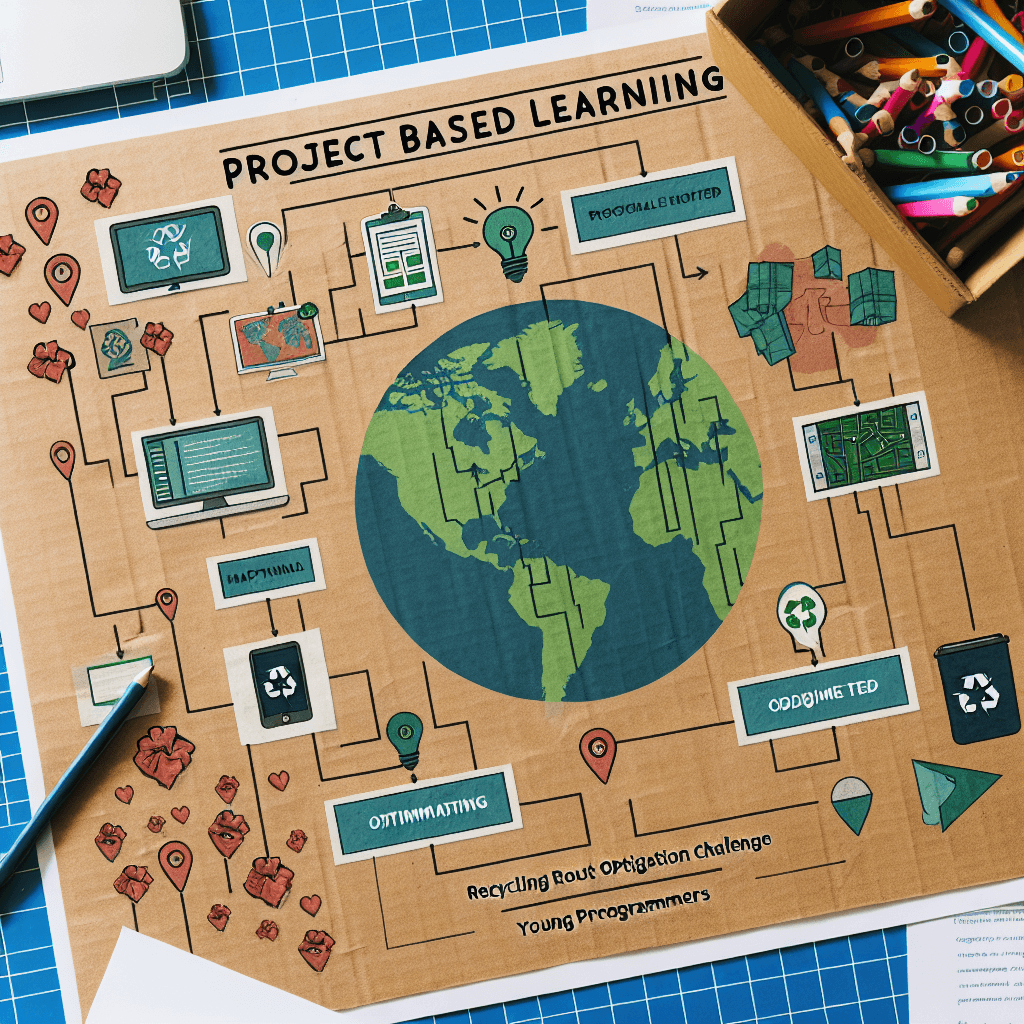
Recycling Route Optimization Challenge for Young Programmers
Inquiry Framework
Question Framework
Driving Question
The overarching question that guides the entire project.How can we leverage programming to design an efficient system that optimizes recycling routes in our community, addressing both environmental and logistical challenges?Essential Questions
Supporting questions that break down major concepts.- How can programming be used to solve real-world problems in our community, specifically related to waste management?
- What are the basic components of a computer program and how do they contribute to creating an effective solution?
- In what ways does technology facilitate collaboration and problem-solving in our local environment?
- How can we optimize recycling routes using algorithms, and why is this important for our community and environment?
- What challenges might we face in using technology to solve local issues, and how can we overcome them?
Standards & Learning Goals
Learning Goals
By the end of this project, students will be able to:- Students will understand and apply basic programming concepts, including algorithms, loops, and conditionals, to create a program supporting recycling route optimization.
- Students will learn to identify and articulate community issues that can be addressed through technology, promoting civic engagement and problem-solving.
- Students will collaborate with peers to enhance their programming skills and develop solutions that address real-world challenges.
- Students will improve their ability to use visual programming tools effectively to develop functional and creative solutions for community problems.
- Students will conduct short research projects to identify local environmental challenges and propose technology-based solutions.
- Students will evaluate their programming solutions through testing and receive constructive feedback to improve their final product.
ISTE Standards for Students
Common Core State Standards
NGSS
Entry Events
Events that will be used to introduce the project to studentsJourney of a Plastic Bottle
Kick off the project with a role-playing activity, where students follow the lifecycle of a plastic bottle from usage to disposal. Students will explore its journey through recycling processes, witnessing challenges and opportunities for technological intervention to optimize recycling routes.Recycling Plant Virtual Tour
Host a virtual tour of a local recycling plant. During the tour, students will observe current practices and identify inefficiencies in the system. This hands-on experience will spark ideas for their programming project to streamline recycling routes.Portfolio Activities
Portfolio Activities
These activities progressively build towards your learning goals, with each submission contributing to the student's final portfolio.Community Problem Spotter
In this activity, students will identify and discuss issues in their community that can be addressed through the use of technology. This discussion will set the foundation for recognizing the role of technology in problem-solving.Steps
Here is some basic scaffolding to help students complete the activity.Final Product
What students will submit as the final product of the activityA list of community issues that can be addressed through technology, discussed in pairs.Alignment
How this activity aligns with the learning objectives & standardsAligns with ISTE-5a, fostering an understanding of how technology can address community issues.Programming Concept Explorer
Students will explore basic programming concepts such as algorithms, loops, and conditionals through a hands-on activity using a visual programming tool like Scratch.Steps
Here is some basic scaffolding to help students complete the activity.Final Product
What students will submit as the final product of the activityA simple class-developed program using loops and conditionals, created in Scratch.Alignment
How this activity aligns with the learning objectives & standardsSupports NGSS K-2-ETS1-1 by helping students understand problem solving with technology.Recycling Route Designer
Students apply their programming knowledge to design an optimized recycling route in Scratch, focusing on real-world environmental challenges.Steps
Here is some basic scaffolding to help students complete the activity.Final Product
What students will submit as the final product of the activityAn initial draft of a program designed to optimize recycling routes.Alignment
How this activity aligns with the learning objectives & standardsAligns with NGSS 3-5-ETS1-2 and ISTE-5b, focusing on programming solutions to community issues.Prototype Tester
Students implement, test, and refine their recycling optimization programs, learning the importance of iteration and feedback.Steps
Here is some basic scaffolding to help students complete the activity.Final Product
What students will submit as the final product of the activityA refined program that considers feedback and improves recycling route optimization.Alignment
How this activity aligns with the learning objectives & standardsConnects with NGSS 3-5-ETS1-3, emphasizing iterative testing and refinement.Tech-Driven Presentation
Students will present their programs and explain their design process and how it optimizes recycling routes, demonstrating their understanding of both computer science and community impact.Steps
Here is some basic scaffolding to help students complete the activity.Final Product
What students will submit as the final product of the activityA comprehensive digital presentation showcasing the student’s project, including programming solutions and community benefits.Alignment
How this activity aligns with the learning objectives & standardsMeets ISTE-5a and CCSS.ELA-LITERACY.W.5.7, supporting digital tool usage and research projects.Rubric & Reflection
Portfolio Rubric
Grading criteria for assessing the overall project portfolioTech for Trash Transformation Rubric
Understanding of Programming Concepts
Evaluates students' grasp of basic programming concepts such as algorithms, loops, and conditionals, and their ability to apply these concepts in projects.Algorithm Application
Measures the effectiveness of algorithm use to solve recycling route problems.
Exemplary
4 PointsDemonstrates innovative use of algorithms to create highly efficient recycling routes, with minimal errors and comprehensive understanding.
Proficient
3 PointsEffectively employs algorithms to enhance recycling routes, showing clear understanding and application.
Developing
2 PointsDemonstrates partial use of algorithms with some errors, showing basic understanding and need for improvement.
Beginning
1 PointsStruggles to apply algorithms effectively, with significant errors and limited understanding.
Use of Programming Tools
Assesses students' ability to use visual programming tools effectively in their projects.
Exemplary
4 PointsUtilizes programming tools with exceptional skill, creating creative and functional solutions for identified community problems.
Proficient
3 PointsShows proficiency in using programming tools, generating effective solutions with minor challenges.
Developing
2 PointsDemonstrates basic skill with programming tools, leading to partially functional solutions.
Beginning
1 PointsStruggles significantly with programming tools, leading to incomplete or ineffective solutions.
Problem-Solving and Innovation
Assesses students' ability to identify community problems and apply programming solutions creatively and effectively.Problem Identification
Measures ability to recognize community issues that can be addressed with technology.
Exemplary
4 PointsIdentifies nuanced community problems with deep insight, providing innovative technological solutions.
Proficient
3 PointsClearly identifies relevant community problems and suggests practical solutions.
Developing
2 PointsIdentifies basic community problems with superficial solutions, lacking depth.
Beginning
1 PointsStruggles to identify specific community problems, offering vague and ineffective solutions.
Creativity in Solutions
Evaluates the creativity and effectiveness of students' programming solutions to community issues.
Exemplary
4 PointsDelivers exceptionally creative and effective solutions that demonstrate novel applications of programming.
Proficient
3 PointsProvides creative and effective solutions with room for further innovation.
Developing
2 PointsOffers basic solutions with limited creativity and effectiveness.
Beginning
1 PointsPresents solutions that lack creativity and effectiveness, failing to address issues adequately.
Collaboration and Feedback
Assesses student collaboration and use of feedback to improve programming solutions.Collaboration
Measures how effectively students work with peers to enhance their projects.
Exemplary
4 PointsDemonstrates leadership and fosters collaborative spirit, significantly enhancing project outcomes.
Proficient
3 PointsEngages constructively with peers, contributing positively to group efforts.
Developing
2 PointsParticipates with peers, though collaboration is inconsistent and requires improvement.
Beginning
1 PointsLimited participation in collaborative efforts, needing significant support.
Feedback Utilization
Evaluates how well students use feedback to refine their projects and solutions.
Exemplary
4 PointsProactively seeks and incorporates feedback, resulting in substantial improvements to projects.
Proficient
3 PointsReceives and applies feedback effectively, leading to noticeable project enhancements.
Developing
2 PointsMakes limited use of feedback, resulting in minor improvements to projects.
Beginning
1 PointsDemonstrates minimal use of feedback, showing little to no project improvement.
Presentation and Communication
Assesses the clarity, engagement, and depth in students' presentation of their programming projects.Presentation Clarity
Measures clarity and coherence in describing programming projects and their impact.
Exemplary
4 PointsCommunicates with exceptional clarity and depth, demonstrating thorough understanding and impact of the project.
Proficient
3 PointsPresents with clarity and logical structure, effectively conveying project details and impact.
Developing
2 PointsPresentation lacks clarity at times, omitting key details and impacts.
Beginning
1 PointsPresents incoherently, with significant gaps in information and understanding of the project.
Engagement
Evaluates the engagement level in presenting the project, focusing on interactive and engaging communication.
Exemplary
4 PointsEngages the audience fully with interactive and captivating presentation techniques.
Proficient
3 PointsMaintains audience engagement through clear and structured presentation techniques.
Developing
2 PointsShows some engagement with the audience, but lacks interactive presentation techniques.
Beginning
1 PointsStruggles to engage the audience, presenting in a monotonous and uninspiring manner.