
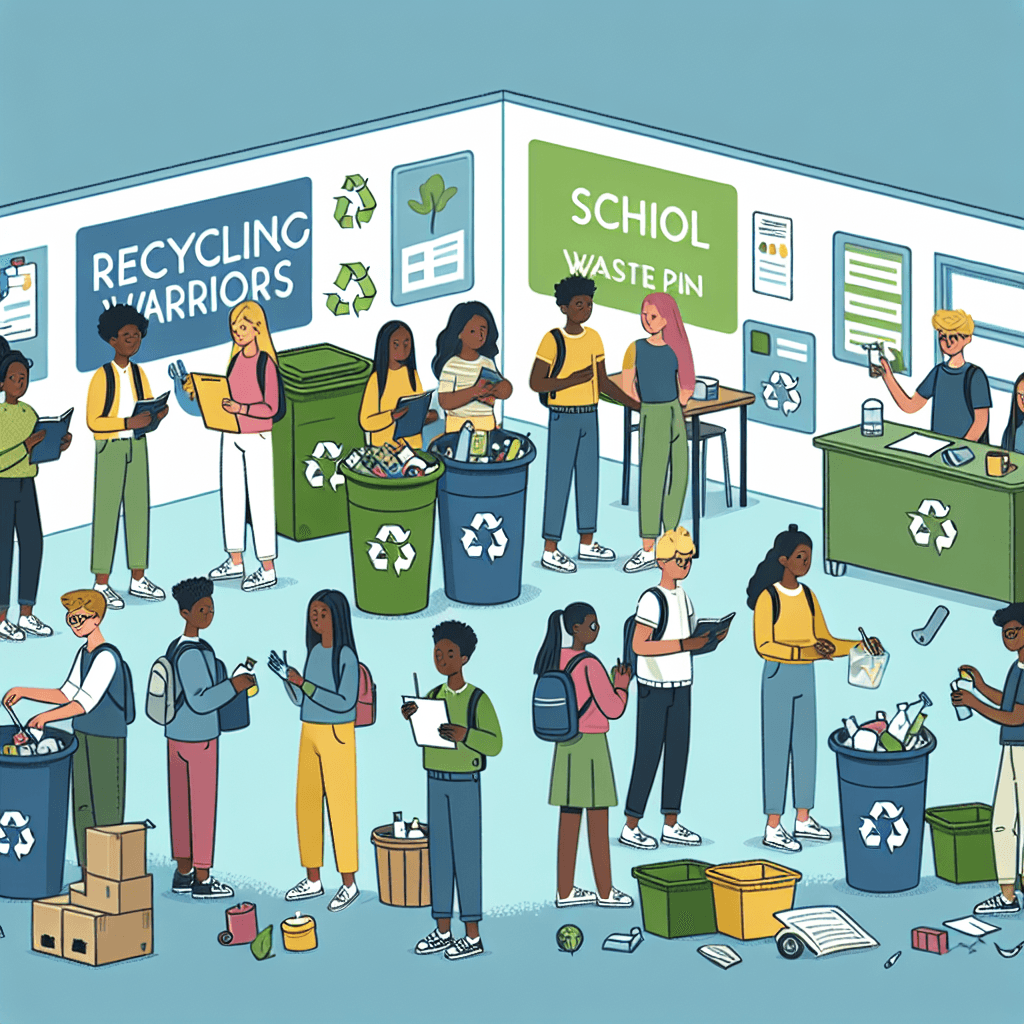
Recycling Warriors: School Waste Reduction Plan
Inquiry Framework
Question Framework
Driving Question
The overarching question that guides the entire project.How can we, as Recycling Warriors, develop and implement a sustainable recycling plan for our school to effectively reduce waste, considering human impact, material properties, and community involvement?Essential Questions
Supporting questions that break down major concepts.- What patterns exist in our school's waste, and how can we identify them?
- How do human actions affect environmental change within a school setting?
- In what ways can the school community reduce its environmental impact through recycling?
- What roles do individuals play in contributing to or solving environmental problems at school?
- How can scientific data guide us in creating effective recycling plans?
- How can understanding the properties of materials help us decide what can and cannot be recycled?
- What are the potential benefits to our school and the broader community of implementing a strong recycling plan?
- How can we ensure that our recycling efforts are sustainable over the long term?
- How do living organisms, including humans, depend on waste management for healthier environments?
- In what ways can we communicate our recycling plan to influence others to participate?
Standards & Learning Goals
Learning Goals
By the end of this project, students will be able to:- Students will identify and explain patterns in waste generated at school.
- Students will analyze human actions and their impacts on the school environment.
- Students will explore and propose methods for reducing environmental impact through recycling.
- Students will evaluate their roles in contributing to and solving environmental problems.
- Students will gather and analyze data to support the development of a recycling plan.
- Students will apply understanding of material properties to make informed recycling decisions.
- Students will communicate the benefits of recycling to influence community participation.
- Students will propose sustainable practices to maintain recycling efforts long term.
- Students will explore interdependencies among living organisms, including humans, concerning waste management.
Social Science Domains
Science Domains
Entry Events
Events that will be used to introduce the project to studentsEco-Investigation: The School Trash Audit
Conduct a school-wide trash audit where students will collect and analyze data on the types and quantities of waste generated in different areas of the school. This hands-on exploration ties deeply into scientific inquiry and data analysis, stimulating curiosity about waste patterns and leading to informed decisions on improving school recycling efforts.Portfolio Activities
Portfolio Activities
These activities progressively build towards your learning goals, with each submission contributing to the student's final portfolio.Impact Analysts: Understanding Our Actions
Students will explore and discuss how their daily actions contribute to environmental change, specifically in the school setting. By analyzing their findings from the waste audit, students articulate how human processes affect waste generation and recycling opportunities.Steps
Here is some basic scaffolding to help students complete the activity.Final Product
What students will submit as the final product of the activityA class-generated list of human impacts on waste and proposed methods to address key issues.Alignment
How this activity aligns with the learning objectives & standardsAligns with 4SSPES2 (Understanding physical and human processes) and 4S06 (Using results to draw conclusions and suggest improvements).Recycle Designers: Planning for Change
Students will use the analyzed data and identified human impacts to develop a sustainable recycling plan for the school. This step involves planning and proposing practical ways to manage waste more effectively, considering material properties and sustainability.Steps
Here is some basic scaffolding to help students complete the activity.Final Product
What students will submit as the final product of the activityA detailed recycling plan presented by each team that incorporates data analysis and sustainable practices.Alignment
How this activity aligns with the learning objectives & standardsAligns with 4SSPES4 (Sustainably managing environments) and 4S05 (Organizing data to propose solutions).Sustainability Champions: Action in Motion
In this final activity, students take action by implementing components of their recycling plans and encourage the school community to join the effort. This activity fosters personal involvement in sustainability as they become leaders and advocates.Steps
Here is some basic scaffolding to help students complete the activity.Final Product
What students will submit as the final product of the activityA successfully launched recycling program with recorded engagement and improvement strategies.Alignment
How this activity aligns with the learning objectives & standardsAligns with 4SSPES5 (Opportunities for personal involvement in sustainability) and 4S07 (Applying scientific understanding to daily life).Eco-Investigators: Data Scouts
In this activity, students will conduct a school-wide trash audit to learn how to gather and record data on the types and quantities of waste generated in various areas of the school. This hands-on exploration encourages data-driven inquiry, helping students recognize waste patterns and make informed decisions to improve school recycling efforts.Steps
Here is some basic scaffolding to help students complete the activity.Final Product
What students will submit as the final product of the activityA class presentation of collected waste data, highlighting observable patterns and preliminary recycling ideas.Alignment
How this activity aligns with the learning objectives & standardsAligns with 4SSPES1 (Recognising patterns made by physical and human features) and 4S04 (Gathering and presenting data).Rubric & Reflection
Portfolio Rubric
Grading criteria for assessing the overall project portfolioRecycling Warriors: Comprehensive Assessment Rubric
Data Collection and Analysis
Evaluates students' abilities to gather, organize, and present data related to school waste, as part of the Eco-Investigators activity.Data Gathering
Measures the ability to gather accurate and relevant data on school waste.
Exemplary
4 PointsCollected data is comprehensive, accurate, and highly detailed across various school areas.
Proficient
3 PointsCollected data is complete and accurate for the majority of school areas.
Developing
2 PointsData collection is somewhat complete; some areas or details may be missing.
Beginning
1 PointsLimited data collected with many gaps and inaccuracies across school areas.
Data Presentation
Assesses how well students organize and present their collected waste data using appropriate formats.
Exemplary
4 PointsData is organized and presented using innovative charts or tables with exceptional clarity.
Proficient
3 PointsData is organized and presented clearly using appropriate charts or tables.
Developing
2 PointsData presentation is basic, with some errors or lacks organization clarity.
Beginning
1 PointsData is poorly organized and haphazardly presented with minimal clarity or logic.
Critical Thinking and Problem Solving
Measures students' abilities to analyze data, recognize patterns, and propose effective recycling solutions in the Impact Analysts activity.Pattern Recognition
Ability to identify patterns in school waste and relate them to human and material factors.
Exemplary
4 PointsIdentifies complex patterns and makes insightful connections between data and human impact.
Proficient
3 PointsCorrectly identifies patterns and draws relevant connections to human impact.
Developing
2 PointsSome patterns identified, but connections to human impact are superficial.
Beginning
1 PointsStruggles to identify relevant patterns in data or make clear connections to human factors.
Solution Proposal
Evaluates the creativity and feasibility of proposed solutions to improve waste management.
Exemplary
4 PointsProposes innovative, practical solutions with detailed action plans and potential impacts.
Proficient
3 PointsDevelops feasible solutions with clear action steps and anticipated outcomes.
Developing
2 PointsProposes basic solutions with some action steps or lacks thorough planning.
Beginning
1 PointsStruggles to propose viable solutions or action steps to address waste issues.
Collaboration and Communication
Assesses the effectiveness of teamwork and communication in developing and advocating for sustainable recycling plans in the Recycle Designers and Sustainability Champions activities.Team Collaboration
Measures the ability to work effectively as a team to achieve recycling objectives.
Exemplary
4 PointsDemonstrates exceptional teamwork with clear roles, cooperative tasks, and significant contributions from all members.
Proficient
3 PointsWorks well as a team; most members contribute effectively to group tasks.
Developing
2 PointsSome collaboration evident, with uneven contributions from team members.
Beginning
1 PointsStruggles to collaborate effectively with minimal role fulfillment or teamwork.
Public Advocacy
Evaluates the ability to communicate recycling plans and advocate for sustainability within the school community.
Exemplary
4 PointsCommunicates plans persuasively and engages effectively with community members, demonstrating leadership in advocacy.
Proficient
3 PointsCommunicates plans clearly and encourages community involvement.
Developing
2 PointsBasic communication of plans, with scope for more persuasive engagement.
Beginning
1 PointsStruggles to communicate plans or engage community members effectively.