
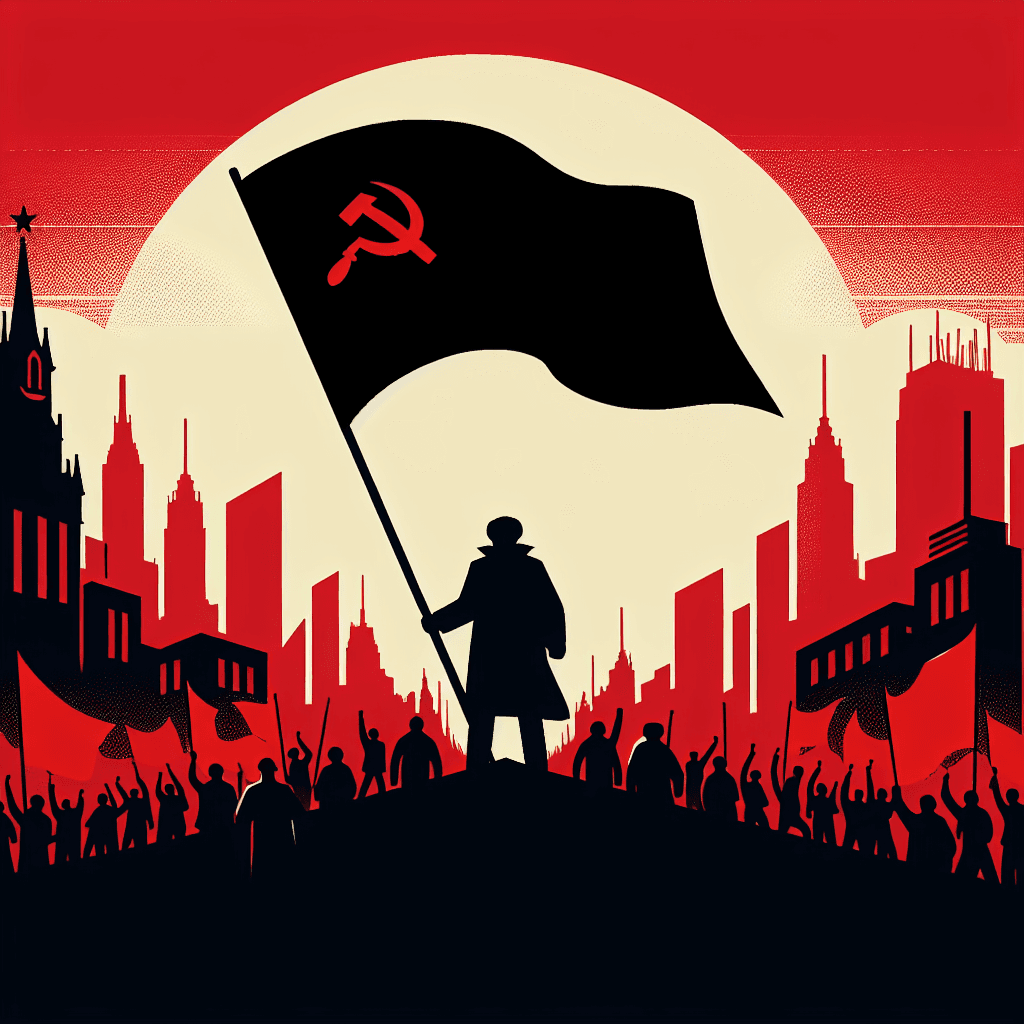
Red Revolution: Lenin and the Rise of Totalitarianism
Inquiry Framework
Question Framework
Driving Question
The overarching question that guides the entire project.How can we, as historians, evaluate whether the Russian Revolution fulfilled its promise of "Peace, Land, and Bread," or if it simply replaced an old monarchy with a new system of totalitarian control?Essential Questions
Supporting questions that break down major concepts.- What were the social, economic, and political conditions that led the Russian people to seek a radical change in government?
- How did the Bolsheviks use the promise of 'Peace, Land, and Bread' to gain public support, and to what extent were these promises fulfilled?
- In what ways did Lenin’s transition from revolutionary leader to head of state redefine the relationship between the individual and the government?
- How does a totalitarian regime use systems like the Gulag and secret police to eliminate dissent and maintain absolute control?
- How can we determine if a revolution has successfully met its goals or simply replaced one form of tyranny with another?
Standards & Learning Goals
Learning Goals
By the end of this project, students will be able to:- Analyze the social, economic, and political factors that contributed to the collapse of the Romanov dynasty and the rise of the Bolsheviks.
- Evaluate the effectiveness of the 'Peace, Land, and Bread' slogan in mobilizing the Russian populace and compare it to the post-revolutionary reality.
- Define totalitarianism and identify specific mechanisms used by Lenin, such as the Cheka and the early Gulag system, to consolidate power and suppress political opposition.
- Synthesize multiple perspectives from primary and secondary sources to construct a historical argument regarding the success or failure of the Russian Revolution.
- Compare and contrast the autocratic governance of Tsar Nicholas II with the totalitarian governance of Vladimir Lenin to determine the extent of political change.
World History Content Standards
Common Core State Standards (History/Social Studies)
Entry Events
Events that will be used to introduce the project to studentsThe Grade Redistribution Coup
The teacher announces a 'Grade Redistribution Policy' where all students' accumulated points are pooled and redistributed equally, regardless of effort. As 'unrest' begins, a student 'Secret Police' is appointed to monitor dissent, forcing students to decide whether to comply for stability or resist for fairness.Portfolio Activities
Portfolio Activities
These activities progressively build towards your learning goals, with each submission contributing to the student's final portfolio.Forensic History: The Anatomy of a Collapse
Before students can understand the revolution, they must investigate the 'rot' in the foundation of the Russian Empire. In this activity, students act as political forensic investigators to diagnose the social, economic, and political causes of the Romanov dynasty's collapse. They will explore key events like Bloody Sunday, the impact of WWI, and the disconnect between the aristocracy and the working class (the proletariat).Steps
Here is some basic scaffolding to help students complete the activity.Final Product
What students will submit as the final product of the activityA 'Cause and Effect' Diagnostic Map (Digital or Physical) that visually connects the failures of the Tsarist regime to the specific grievances of the Russian people.Alignment
How this activity aligns with the learning objectives & standardsAligns with WH.10.6.1 (Analyze the causes... including loss of confidence in the tsar) and CCSS.ELA-LITERACY.RH.9-10.4 (Determine the meaning of words... describing political, social, or economic aspects).Slogans of Change: The Power of 'Peace, Land, and Bread'
Students will analyze the most famous marketing campaign in political history: 'Peace, Land, and Bread.' They will explore how Lenin and Trotsky used these three simple promises to mobilize the masses and outmaneuver the Provisional Government. Students will look at Bolshevik propaganda posters and speeches to see how complex Marxist theory was distilled into catchy, revolutionary slogans.Steps
Here is some basic scaffolding to help students complete the activity.Final Product
What students will submit as the final product of the activityA 'Propaganda Deconstruction Portfolio' featuring one original Bolshevik source and one student-created analysis piece that breaks down the persuasive techniques used.Alignment
How this activity aligns with the learning objectives & standardsAligns with WH.10.6.1 (Rise of the Bolsheviks and the revolutionary role of Lenin) and CCSS.ELA-LITERACY.RH.9-10.1 (Cite specific textual evidence to support analysis).The Iron Blueprint: Tools of Totalitarian Control
As the revolution shifts from seizing power to maintaining it, students will investigate the birth of the totalitarian machine. This activity focuses on the transition from revolutionary idealism to the 'Red Terror.' Students will research the establishment of the Cheka (secret police) and the early development of the Gulag system as tools to eliminate 'enemies of the people.'Steps
Here is some basic scaffolding to help students complete the activity.Final Product
What students will submit as the final product of the activityAn 'Architect’s Guide to Totalitarianism'—a structured report or infographic detailing the four main pillars Lenin used to consolidate power (Censorship, Secret Police, Economic Control, and Force).Alignment
How this activity aligns with the learning objectives & standardsAligns with WH.10.7.1 (Trace the development of the Soviet Union... including the rise of a totalitarian state) and CCSS.ELA-LITERACY.RH.9-10.4 (Vocabulary describing political and social aspects).The People's Verdict: Conflicting Voices of 1917-1924
History is rarely a single story. In this activity, students will engage with 'conflicting voices' from the Russian Revolution. They will read accounts from a Bolshevik supporter, a peasant who lost land to 'War Communism,' a political prisoner in the Gulag, and a foreign observer. Students must identify the bias and perspective in each account.Steps
Here is some basic scaffolding to help students complete the activity.Final Product
What students will submit as the final product of the activityA 'Perspectives Perspective' Table that compares four different primary source accounts of life under Lenin’s rule.Alignment
How this activity aligns with the learning objectives & standardsAligns with CCSS.ELA-LITERACY.RH.9-10.9 (Compare and contrast treatments of the same topic in several primary and secondary sources).The Historian’s Verdict: Revolution or Replacement?
In this final summative activity, students take on the role of a 'Historical Commission.' They must answer the driving question: Did the Russian Revolution fulfill its promise, or did it simply replace one form of tyranny with another? They will use all the evidence gathered in the previous four activities to build a final argument that evaluates the legacy of Lenin and the Bolsheviks.Steps
Here is some basic scaffolding to help students complete the activity.Final Product
What students will submit as the final product of the activityA 'Historian’s Final Briefing' presented as a formal written essay, a podcast episode, or a multimedia presentation that argues a specific thesis using cited evidence.Alignment
How this activity aligns with the learning objectives & standardsAligns with WH.10.6.1, WH.10.7.1, and CCSS.ELA-LITERACY.RH.9-10.1 (Synthesize evidence to support historical analysis).Rubric & Reflection
Portfolio Rubric
Grading criteria for assessing the overall project portfolioRussian Revolution Portfolio: From Monarchy to Totalitarianism
Historical Context and Revolutionary Rise
This category assesses the student's ability to analyze the 'why' and 'how' of the revolution's start and the Bolsheviks' rise to power.Historical Causality & Diagnostic Mapping
Ability to diagnose and map the social, economic, and political factors that led to the collapse of the Romanov dynasty and the rise of the Bolsheviks.
Exemplary
4 PointsThe diagnostic map provides a sophisticated analysis of the 'Three Pillars of Despair' and trigger events. It draws innovative connections between long-term rot and immediate triggers, showing a deep understanding of historical causality. Key terms (Autocracy, Proletariat, etc.) are used with precision and nuance.
Proficient
3 PointsThe diagnostic map clearly explains the social, economic, and political causes of the collapse. Trigger events are accurately identified and linked to the Tsar's abdication. Key vocabulary is defined and applied correctly within the historical context.
Developing
2 PointsThe diagnostic map identifies some causes of the revolution, but the links between events may be inconsistent or basic. Vocabulary is defined but not always integrated into the analysis of the Romanovs' collapse.
Beginning
1 PointsThe diagnostic map is incomplete or contains significant historical inaccuracies. There is little to no connection made between the grievances of the Russian people and the fall of the monarchy.
Rhetoric and Public Mobilization
Analysis of Bolshevik propaganda techniques and the effectiveness of the 'Peace, Land, and Bread' slogan in mobilizing various social groups.
Exemplary
4 PointsAnalysis offers a profound breakdown of how complex Marxist ideology was distilled into slogans. The student provides an exceptional deconstruction of propaganda symbols and provides compelling evidence of how different social groups (soldiers, peasants, workers) interpreted these promises differently.
Proficient
3 PointsAnalysis accurately identifies the persuasive techniques in Bolshevik propaganda. The student explains the meaning of 'Peace, Land, and Bread' for specific groups and provides a clear rationale for the failure of the Provisional Government.
Developing
2 PointsAnalysis identifies the slogans and some propaganda elements but lacks depth in explaining how they targeted specific groups. The comparison between the Bolsheviks and the Provisional Government is superficial.
Beginning
1 PointsAnalysis fails to explain the significance of the slogans or the propaganda posters. The student struggles to articulate why the Bolsheviks gained public support.
The Mechanics of Control and Lived Experience
This category focuses on the transition to state power and the reality of life under the new regime.Structural Analysis of Totalitarianism
Evaluation of the specific mechanisms (Cheka, Gulag, Censorship) used by Lenin to consolidate power and the transition from revolutionary idealism to state control.
Exemplary
4 PointsThe 'Architect’s Guide' provides a sophisticated structural analysis of totalitarianism. It masterfully connects the Bolsheviks' justification of 'protecting the revolution' to the actual systematic suppression of dissent, using the Solovki prison as a detailed case study.
Proficient
3 PointsThe student accurately defines totalitarianism and identifies the four main pillars of control (Censorship, Secret Police, Economic Control, Force). The roles of the Cheka and the early Gulag system are clearly explained.
Developing
2 PointsThe student identifies some tools of control but struggles to differentiate totalitarianism from autocracy. The explanation of the Cheka or Gulag system is basic or lacks historical context.
Beginning
1 PointsThe student provides an incomplete report that fails to identify the core mechanisms of Lenin’s control. Definitions of key terms are missing or incorrect.
Evidence-Based Synthesis of Perspectives
Capability to synthesize multiple, conflicting primary and secondary sources to understand the diverse experiences of the Russian people under Lenin's rule.
Exemplary
4 PointsThe student demonstrates exceptional historical empathy and critical thinking by expertly navigating conflicting accounts. Bias is identified with nuance, and the synthesis highlights complex contradictions and corroborations between Bolsheviks, peasants, and prisoners.
Proficient
3 PointsThe student provides a clear comparative table that identifies the perspectives of four different sources. Textual evidence is used effectively to show how the revolution both fulfilled and broke its promises.
Developing
2 PointsThe student identifies different perspectives but struggles to find specific textual evidence for each. The analysis of bias or the relationship of the author to the party is inconsistent.
Beginning
1 PointsThe student struggles to identify the author's perspective or central argument. The comparative table is incomplete or fails to address the conflicting nature of the sources.
Summative Synthesis and Argumentation
Assessment of the student's ability to unify their findings into a cohesive historical judgment.Historical Argumentation and Final Verdict
The ability to construct a final historical argument that addresses the driving question: Did the revolution fulfill its promise or simply replace one form of tyranny with another?
Exemplary
4 PointsThe final briefing presents a compelling, nuanced thesis that synthesizes evidence from all five activities. The argument masterfully balances the 'Peace, Land, and Bread' promises against the reality of the Gulag, supported by a professional bibliography and advanced historical reasoning.
Proficient
3 PointsThe student develops a clear thesis that addresses the driving question. The argument is supported by cited evidence and accurately compares the autocratic rule of the Tsar with the totalitarian rule of Lenin. A bibliography is included.
Developing
2 PointsThe student presents a basic argument but the thesis may be weak or not fully address the driving question. Use of evidence from previous activities is inconsistent, and the bibliography may be incomplete.
Beginning
1 PointsThe final product lacks a clear thesis or fails to use historical evidence to support the argument. The student does not effectively address whether the revolution was a 'replacement' of tyranny.