
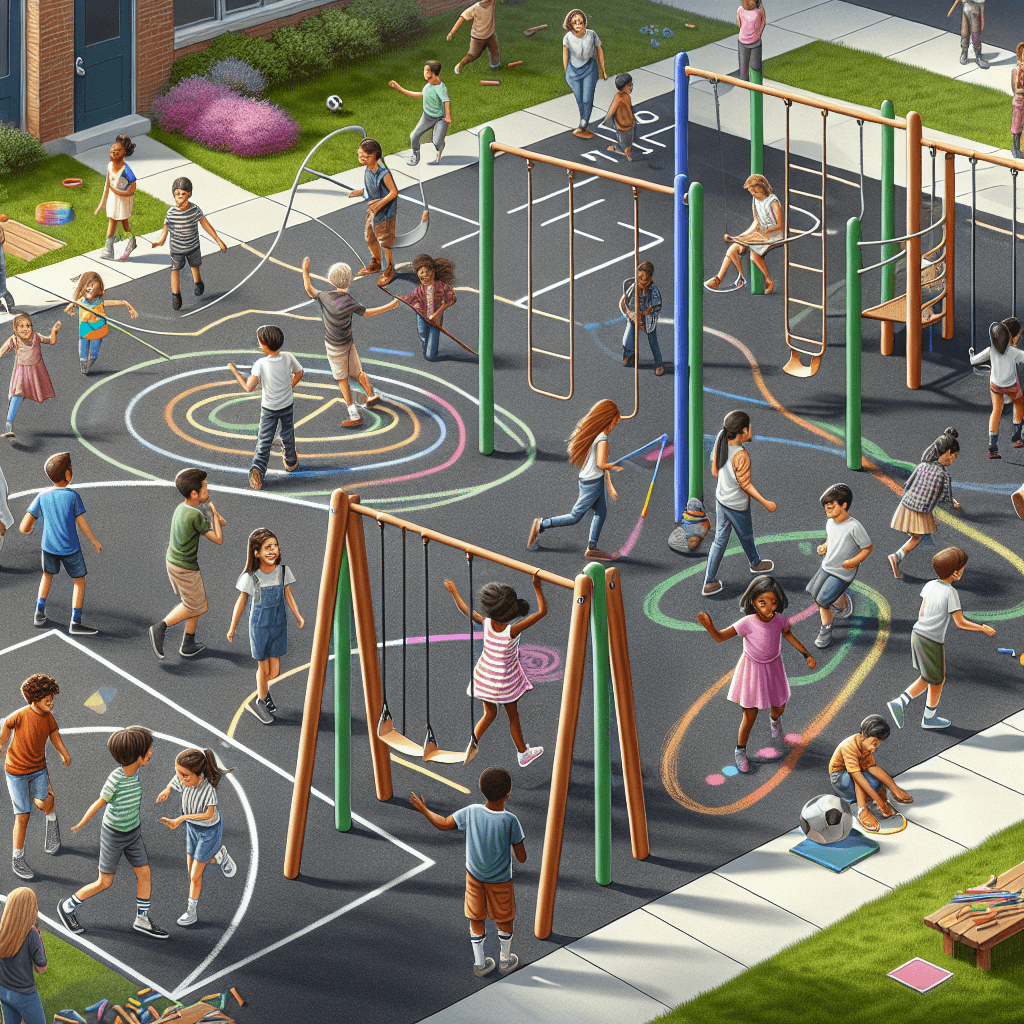
Redesigning Recess: Fun for All at Morey School
Inquiry Framework
Question Framework
Driving Question
The overarching question that guides the entire project.How can we redesign our school recess to create an engaging, inclusive, and well-organized experience for all students, utilizing effective communication, mathematical strategies, and digital tools?Essential Questions
Supporting questions that break down major concepts.- What are the key components of an enjoyable and inclusive recess for everyone at our school?
- How can we use effective communication to gather ideas and feedback from our peers and school community about recess?
- How can we apply addition and subtraction strategies to manage following rules and equipment allocation in recess activities?
- What digital tools can we use to gather data and propose a redesign of recess?
- How can collaborating with peers help in creating a better recess experience for everyone?
Standards & Learning Goals
Learning Goals
By the end of this project, students will be able to:- Students will demonstrate effective communication skills to gather feedback and ideas from peers and the community.
- Students will apply addition and subtraction strategies in practical scenarios, such as managing resources during recess.
- Students will use digital tools to collect, analyze, and visualize data to support their recess redesign proposals.
- Students will collaborate with peers to create inclusive and engaging recess activities.
- Students will express curiosity and eagerness to learn by exploring innovative ways to improve recess.
Social Emotional Learning (SEL)
Approaches to Learning (APL)
Common Core Mathematics
Computational Thinking and Data
Entry Events
Events that will be used to introduce the project to studentsRecess Detective Day
Transformed into "Recess Detectives," students receive mysterious files containing clues about how past generations played at the Morey School. They are charged with using math and technology to compare these findings with today’s recess activities, sparking ideas for innovative, inclusive designs tailored to modern needs and diverse interests. This event draws from their curiosity about the past while inviting them to create a future-focused solution.Reimagining Playground Spaces
Students engage in a virtual reality tour of unconventional playgrounds around the world, showing imaginative and inclusive designs. Prompted to consider why certain features captivate or fail to excite, they are encouraged to brainstorm and sketch original concepts that cater to all students, using critical and creative thinking sparked by their own experiences. This tour encourages global awareness including economic considerations, ensuring ideas are viable.Cultural Festival of Play
A "Cultural Festival of Play" is hosted where students and community members demonstrate traditional games from different cultures. Students explore how these diverse games can be modified or merged to be more inclusive, honing their communication and cooperative skills. This festive entry primes them for interdisciplinary learning and opens channels for empathetic understanding and inclusive design discussions.Community Recess Forum
A panel of community leaders, parents, and school staff convene to discuss the benefits and challenges of current recess activities, sharing insights and stories. Students, acting as 'reporters', gather data and identify key areas needing improvement, guiding their research and design process to ensure the recess redesign reflects genuine community needs and enhances social and emotional well-being for all.Recess Innovation Showcase
The school hosts a "Recess Innovation Showcase" where students observe demonstrations of advanced playground technologies and equipment. They are challenged to think critically about incorporating these technologies into a new recess model that supports cooperative play and learning in sustainable ways. This showcases advanced tools accessible even to second graders, making future-forward thinking an everyday skill.Portfolio Activities
Portfolio Activities
These activities progressively build towards your learning goals, with each submission contributing to the student's final portfolio.Recess Detective Clue Hunt
Students will play the role of detectives to uncover how past generations enjoyed recess at their school. This will help spark ideas for a modern and inclusive design.Steps
Here is some basic scaffolding to help students complete the activity.Final Product
What students will submit as the final product of the activityA detective journal that outlines past and present recess activities, including possible changes for the future.Alignment
How this activity aligns with the learning objectives & standardsAligns with SEL7 by encouraging communication and APL2 by fostering curiosity about past and present activities.Global Playground Exploration
Students take a virtual reality tour of global playgrounds to identify exciting features, trends, and innovative designs that can inspire their new playground.Steps
Here is some basic scaffolding to help students complete the activity.Final Product
What students will submit as the final product of the activityA list of global playground features that students would like to see in their redesigned recess area.Alignment
How this activity aligns with the learning objectives & standardsSupports APL2 through curiosity-driven exploration and APL5 by promoting collective brainstorming.Cultural Games Fusion Fair
Students participate in a cultural festival where they explore traditional games from different cultures and discuss how they can be adapted for inclusivity.Steps
Here is some basic scaffolding to help students complete the activity.Final Product
What students will submit as the final product of the activityA presentation that shows how traditional games can be adapted for inclusivity, promoting empathy and understanding.Alignment
How this activity aligns with the learning objectives & standardsAligns with SEL7 for communication and APL5 for cooperation and teamwork.Recess Equipment Budgeting
Utilizing math skills, students will manage a budget to allocate resources for new recess equipment, promoting effective use of addition and subtraction.Steps
Here is some basic scaffolding to help students complete the activity.Final Product
What students will submit as the final product of the activityA 'shopping list' of playground equipment chosen within the budget, showing calculations and decision reasoning.Alignment
How this activity aligns with the learning objectives & standardsConforms to 3.NBT.2 by applying mathematical strategies in budgeting exercises.Data Wizards: Visualization Day
Students learn to collect recess activity data through surveys and create compelling visual presentations using digital tools.Steps
Here is some basic scaffolding to help students complete the activity.Final Product
What students will submit as the final product of the activityCharts and infographics displaying data on recess activity preferences, created using digital tools.Alignment
How this activity aligns with the learning objectives & standardsMeets K-2.CT.c standards by using digital technology to collect and visualize data for informed decision making.Rubric & Reflection
Portfolio Rubric
Grading criteria for assessing the overall project portfolioRecess Redesign Portfolio Rubric
Communication and Collaboration
Evaluates students' ability to communicate ideas and work collaboratively with peers and the community to enhance the recess experience.Effective Communication
Assesses how well students communicate their ideas clearly and gather feedback from peers and the school community.
Exemplary
4 PointsDemonstrates sophisticated communication skills, effectively gathering and integrating feedback from diverse groups to improve recess plans.
Proficient
3 PointsDemonstrates clear communication skills, gathering and using feedback from peers and community effectively in recess redesign.
Developing
2 PointsShows emerging communication skills, attempting to gather feedback but with inconsistent integration into redesign plans.
Beginning
1 PointsStruggles to communicate ideas clearly or gather feedback, requiring significant support to incorporate community input.
Collaboration
Evaluates students' ability to work effectively in groups to co-create innovative solutions for recess improvements.
Exemplary
4 PointsExhibits outstanding collaboration, leading and facilitating group discussions and effectively synthesizing group ideas into the recess redesign.
Proficient
3 PointsParticipates actively in collaboration, contributing valuable ideas and integrating group input into the redesign.
Developing
2 PointsEngages in group work but with limited contributions and some difficulty in integrating group ideas.
Beginning
1 PointsParticipates minimally in group activities, requiring support to engage and integrate ideas from peers.
Critical Thinking and Problem Solving
Assesses students' ability to apply mathematical strategies and digital tools to solve problems associated with recess design.Mathematical Reasoning
Measures the ability to apply addition and subtraction strategies to manage resources for recess redesign.
Exemplary
4 PointsUses advanced mathematical reasoning to efficiently allocate resources, demonstrating innovative solutions within budget constraints.
Proficient
3 PointsApplies mathematical strategies effectively to manage resources, showing clear understanding of budget constraints.
Developing
2 PointsDemonstrates basic mathematical reasoning, attempting resource management with varying success and understanding.
Beginning
1 PointsStruggles with mathematical applications and resource management, needing guided support to participate in budgeting activities.
Data Collection and Visualization
Assesses the ability to use digital tools to collect and visualize data supporting recess redesign decisions.
Exemplary
4 PointsUtilizes digital tools expertly to gather, analyze, and create sophisticated visual data representations, enhancing decision making.
Proficient
3 PointsUses digital tools effectively to collect, analyze, and present data visually, supporting redesign decisions clearly.
Developing
2 PointsShows emerging ability in using digital tools, with partial success in data collection and visualization.
Beginning
1 PointsDemonstrates minimal use of digital tools, needing significant support to collect, analyze, and visualize data.
Creativity and Innovation
Evaluates students' ability to integrate global cultural inspiration into local recess designs innovatively and inclusively.Cultural Integration and Inclusivity
Assesses how well students incorporate diverse cultural elements and inclusive concepts into their recess proposals.
Exemplary
4 PointsCreates highly innovative recess designs integrating diverse cultural elements inclusively, with deep understanding and creativity.
Proficient
3 PointsProposes creative recess designs that effectively integrate various cultural elements with inclusivity.
Developing
2 PointsIncorporates some cultural elements into recess designs but with limited creativity and inclusivity.
Beginning
1 PointsStruggles to incorporate cultural diversity into designs, requiring guidance to create inclusive proposals.