
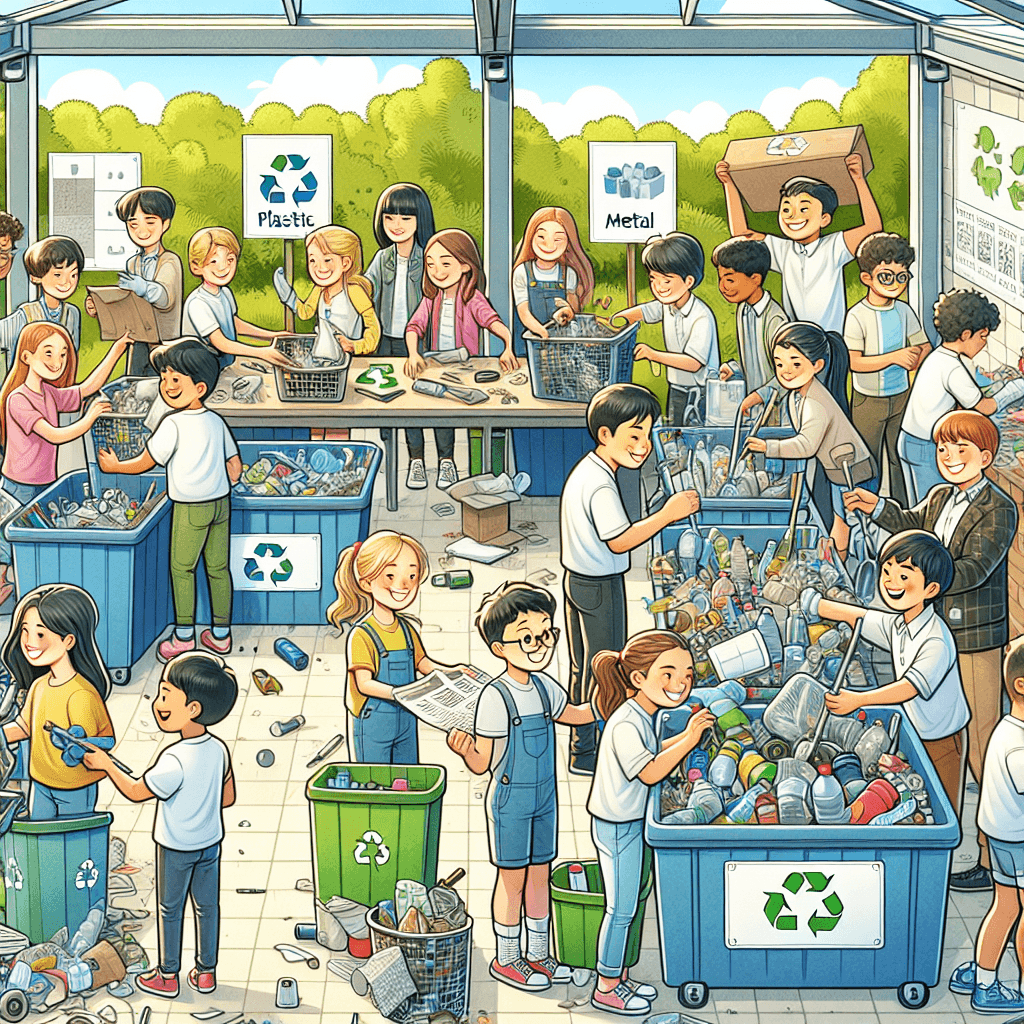
Reduce, Reuse, Recycle: Student-Run Senior Recycling Station
Inquiry Framework
Question Framework
Driving Question
The overarching question that guides the entire project.How can we, as student innovators, design and manage a sustainable recycling station that minimizes waste, benefits our community, and integrates math and technology to track our impact?Essential Questions
Supporting questions that break down major concepts.- How can we minimize waste in our daily lives?
- What are the different methods of recycling and their impact on the environment?
- How can we design and create new products from recycled materials?
- How can we use math to track and improve our recycling efforts?
- How does recycling affect our local community and economy?
- How can we use technology to promote and manage our recycling station?
Standards & Learning Goals
Learning Goals
By the end of this project, students will be able to:- Students will be able to explain the importance of reducing, reusing, and recycling.
- Students will be able to design and manage a recycling station.
- Students will be able to use math to track and improve recycling efforts.
- Students will be able to create new products from recycled materials.
- Students will be able to use technology to promote and manage the recycling station.
Entry Events
Events that will be used to introduce the project to studentsThe Mystery Upcycling Challenge
The school receives a mysterious package filled with seemingly useless discarded items (e.g., broken toys, old electronics, fabric scraps). Students are challenged to collaboratively brainstorm creative ways to upcycle these items into something new and useful for the school or community. This activity sparks interest in the possibilities of reuse and sets the stage for the recycling station project.The Trash Audit
Students participate in a "Trash Audit" of their own homes and school, documenting the types and amounts of waste generated. They analyze their findings to identify areas where they can reduce, reuse, and recycle more effectively. This personal connection to the issue motivates them to create a recycling station that addresses the specific needs and challenges of their school and community.Portfolio Activities
Portfolio Activities
These activities progressively build towards your learning goals, with each submission contributing to the student's final portfolio.The 3 R's Awareness Campaign
Students create a public service announcement (PSA) to educate their peers about the importance of the three R's. They research statistics, write a script, and design visuals.Steps
Here is some basic scaffolding to help students complete the activity.Final Product
What students will submit as the final product of the activityA video or poster PSA promoting the importance of reducing, reusing, and recycling.Alignment
How this activity aligns with the learning objectives & standardsAddresses the learning goal of explaining the importance of reducing, reusing, and recycling.Recycling Station Architect
Students work in teams to design a model of the recycling station, considering factors like location, types of materials accepted, flow of materials, and aesthetics.Steps
Here is some basic scaffolding to help students complete the activity.Final Product
What students will submit as the final product of the activityA detailed model (physical or digital) of the recycling station, with a presentation explaining the design choices.Alignment
How this activity aligns with the learning objectives & standardsCovers the learning goal of designing a recycling station.The Recycling Data Tracker
Students develop a system for tracking the amount of materials recycled at the station. They collect data, create graphs, and analyze the results to identify areas for improvement.Steps
Here is some basic scaffolding to help students complete the activity.Final Product
What students will submit as the final product of the activityA data report with graphs and analysis of the recycling station's performance, including recommendations for improvement.Alignment
How this activity aligns with the learning objectives & standardsSupports the learning goal of using math to track and improve recycling efforts.Upcycled Creations Challenge
Students experiment with upcycling different materials into new and useful products. They document their process and present their creations to the class.Steps
Here is some basic scaffolding to help students complete the activity.Final Product
What students will submit as the final product of the activityA functional upcycled product with a presentation explaining the design process and the materials used.Alignment
How this activity aligns with the learning objectives & standardsAddresses the learning goal of creating new products from recycled materials.Digital Recycling Promoters
Students create a website or social media page for the recycling station to promote its activities, educate the community, and share data on its impact.Steps
Here is some basic scaffolding to help students complete the activity.Final Product
What students will submit as the final product of the activityA functional website or social media page for the recycling station with regular updates and information for the community.Alignment
How this activity aligns with the learning objectives & standardsSupports the learning goal of using technology to promote and manage the recycling station.Rubric & Reflection
Portfolio Rubric
Grading criteria for assessing the overall project portfolioRecycling Station Project Rubric
3 R's Awareness Campaign
Assesses students' ability to create a PSA that educates peers about reducing, reusing, and recycling.Research Depth
Extent of research on waste impact and benefits of 3 R's
Exemplary
4 PointsDemonstrates sophisticated understanding of waste's environmental impact, providing comprehensive data and innovative solutions.
Proficient
3 PointsDemonstrates thorough understanding of waste's impact, providing clear data and effective strategies.
Developing
2 PointsShows emerging understanding of waste's impact, providing basic data and some strategies.
Beginning
1 PointsShows initial understanding of waste's impact, providing limited data and minimal strategies.
Script Quality
Clarity, persuasiveness, and call to action in the PSA script
Exemplary
4 PointsScript is exceptionally clear, highly persuasive, and includes a compelling call to action that inspires immediate engagement.
Proficient
3 PointsScript is clear, persuasive, and includes a strong call to action.
Developing
2 PointsScript is somewhat clear, partially persuasive, and includes a basic call to action.
Beginning
1 PointsScript lacks clarity, is not persuasive, and has a weak or missing call to action.
Visual Appeal
Quality and impact of visuals used in the PSA
Exemplary
4 PointsVisuals are exceptionally engaging, creative, and significantly enhance the PSA's message, demonstrating advanced design skills.
Proficient
3 PointsVisuals are engaging, creative, and enhance the PSA's message.
Developing
2 PointsVisuals are somewhat engaging and relate to the PSA's message.
Beginning
1 PointsVisuals are not engaging and have limited relation to the PSA's message.
PSA Effectiveness
Overall effectiveness and polish of the final PSA
Exemplary
4 PointsPSA is exceptionally polished, professional, and highly effective in promoting the 3 R's, demonstrating outstanding technical skills.
Proficient
3 PointsPSA is polished, professional, and effective in promoting the 3 R's.
Developing
2 PointsPSA is somewhat polished and promotes the 3 R's with some effectiveness.
Beginning
1 PointsPSA lacks polish and is not very effective in promoting the 3 R's.
Recycling Station Architect
Evaluates students' ability to design a functional and aesthetically pleasing recycling station model.Design Innovation
Creativity and practicality of the recycling station design
Exemplary
4 PointsDesign is exceptionally creative, highly practical, and demonstrates innovative problem-solving, pushing beyond conventional ideas.
Proficient
3 PointsDesign is creative, practical, and demonstrates effective problem-solving.
Developing
2 PointsDesign is somewhat creative and practical, showing basic problem-solving.
Beginning
1 PointsDesign lacks creativity and practicality, with minimal problem-solving.
Practicality
Consideration of space, materials, and traffic flow in the design
Exemplary
4 PointsDesign demonstrates exceptional consideration of space, efficient use of materials, and optimized traffic flow, creating a seamless user experience.
Proficient
3 PointsDesign demonstrates thorough consideration of space, materials, and traffic flow.
Developing
2 PointsDesign shows some consideration of space, materials, and traffic flow.
Beginning
1 PointsDesign shows limited consideration of space, materials, and traffic flow.
Model Quality
Quality of the scale model (physical or digital)
Exemplary
4 PointsModel is exceptionally detailed, accurately represents the design, and demonstrates advanced construction or digital design skills.
Proficient
3 PointsModel is detailed, accurately represents the design, and demonstrates good construction or digital design skills.
Developing
2 PointsModel has some detail and represents the design adequately.
Beginning
1 PointsModel lacks detail and poorly represents the design.
Presentation Skills
Clarity and justification of design choices in the presentation
Exemplary
4 PointsPresentation is exceptionally clear, persuasive, and provides compelling justifications for all design choices, demonstrating advanced communication skills.
Proficient
3 PointsPresentation is clear, persuasive, and provides strong justifications for the design choices.
Developing
2 PointsPresentation is somewhat clear and provides basic justifications for the design choices.
Beginning
1 PointsPresentation lacks clarity and provides weak or missing justifications for the design choices.
The Recycling Data Tracker
Assesses students' ability to track recycling data, create visualizations, and suggest improvements.Data System Design
Effectiveness of the data collection system
Exemplary
4 PointsData collection system is exceptionally well-designed, efficient, and provides comprehensive data with minimal effort, demonstrating advanced analytical skills.
Proficient
3 PointsData collection system is well-designed, efficient, and provides comprehensive data.
Developing
2 PointsData collection system is adequately designed and provides some data.
Beginning
1 PointsData collection system is poorly designed and provides limited data.
Data Integrity
Consistency and accuracy of data collection
Exemplary
4 PointsData collection is exceptionally consistent and accurate, demonstrating meticulous attention to detail and advanced understanding of data integrity.
Proficient
3 PointsData collection is consistent and accurate.
Developing
2 PointsData collection is somewhat consistent and accurate.
Beginning
1 PointsData collection is inconsistent and inaccurate.
Data Visualization
Clarity and effectiveness of data visualization (graphs and charts)
Exemplary
4 PointsGraphs and charts are exceptionally clear, visually appealing, and effectively communicate complex data insights, demonstrating advanced data visualization skills.
Proficient
3 PointsGraphs and charts are clear, visually appealing, and effectively communicate data insights.
Developing
2 PointsGraphs and charts are somewhat clear and communicate basic data.
Beginning
1 PointsGraphs and charts are unclear and poorly communicate data.
Recommendations
Insightfulness and feasibility of recommendations for improvement
Exemplary
4 PointsRecommendations are exceptionally insightful, highly feasible, and demonstrate a deep understanding of recycling processes and community impact, showing leadership in sustainability.
Proficient
3 PointsRecommendations are insightful and feasible.
Developing
2 PointsRecommendations are somewhat insightful and feasible.
Beginning
1 PointsRecommendations lack insight and feasibility.
Upcycled Creations Challenge
Assesses students' ability to upcycle materials into new products and document the process.Product Innovation
Creativity and functionality of the upcycled product
Exemplary
4 PointsProduct is exceptionally creative, highly functional, and demonstrates innovative use of recycled materials, exceeding expectations for usefulness and design.
Proficient
3 PointsProduct is creative, functional, and demonstrates effective use of recycled materials.
Developing
2 PointsProduct is somewhat creative and functional, with basic use of recycled materials.
Beginning
1 PointsProduct lacks creativity and functionality, with limited use of recycled materials.
Process Documentation
Documentation of the upcycling process
Exemplary
4 PointsDocumentation is exceptionally thorough, detailed, and provides a comprehensive record of the entire upcycling process, including challenges and solutions.
Proficient
3 PointsDocumentation is thorough and detailed, providing a clear record of the upcycling process.
Developing
2 PointsDocumentation is somewhat thorough and provides a basic record of the upcycling process.
Beginning
1 PointsDocumentation is incomplete and provides a limited record of the upcycling process.
Presentation Quality
Clarity and engagement of the product presentation
Exemplary
4 PointsPresentation is exceptionally clear, engaging, and effectively communicates the design process, material choices, and product benefits, captivating the audience.
Proficient
3 PointsPresentation is clear, engaging, and effectively communicates the design process, material choices, and product benefits.
Developing
2 PointsPresentation is somewhat clear and communicates basic information about the design process and product.
Beginning
1 PointsPresentation lacks clarity and provides limited information about the design process and product.
Material Sustainability
Sustainability and resourcefulness of material use
Exemplary
4 PointsDemonstrates exceptional sustainability, minimizing waste, maximizing recycled content, and innovating material use beyond expectations for environmental responsibility.
Proficient
3 PointsDemonstrates good sustainability, minimizing waste, and maximizing recycled content.
Developing
2 PointsShows some awareness of sustainability with moderate waste and recycled content use.
Beginning
1 PointsShows little awareness of sustainability with high waste and minimal recycled content use.
Digital Recycling Promoters
Assesses students' ability to create a website or social media page to promote the recycling station.Website Design
Design and layout of the website or social media page
Exemplary
4 PointsLayout and design are exceptionally user-friendly, visually appealing, and effectively organized, providing a seamless and engaging online experience, demonstrating advanced web design skills.
Proficient
3 PointsLayout and design are user-friendly, visually appealing, and effectively organized.
Developing
2 PointsLayout and design are somewhat user-friendly and organized.
Beginning
1 PointsLayout and design are not user-friendly and poorly organized.
Content Quality
Quality and engagement of content (photos, videos, articles)
Exemplary
4 PointsContent is exceptionally engaging, informative, and creatively presented, attracting a wide audience and fostering a strong sense of community involvement.
Proficient
3 PointsContent is engaging, informative, and creatively presented.
Developing
2 PointsContent is somewhat engaging and informative.
Beginning
1 PointsContent is not engaging and provides limited information.
Community Engagement
Effectiveness of promotion and community engagement
Exemplary
4 PointsPromotion strategies are exceptionally effective, reaching a wide audience, generating significant interest, and fostering strong community engagement, leading to demonstrable impact.
Proficient
3 PointsPromotion strategies are effective in reaching the target audience and generating interest.
Developing
2 PointsPromotion strategies have limited effectiveness in reaching the target audience.
Beginning
1 PointsPromotion strategies are ineffective and fail to reach the target audience.
Content Updates
Regularity and relevance of updates
Exemplary
4 PointsUpdates are exceptionally regular, highly relevant, and provide valuable new information and data, keeping the community informed and engaged, demonstrating a commitment to transparency.
Proficient
3 PointsUpdates are regular and relevant, providing new information and data.
Developing
2 PointsUpdates are somewhat regular and provide some new information.
Beginning
1 PointsUpdates are infrequent and provide limited new information.