
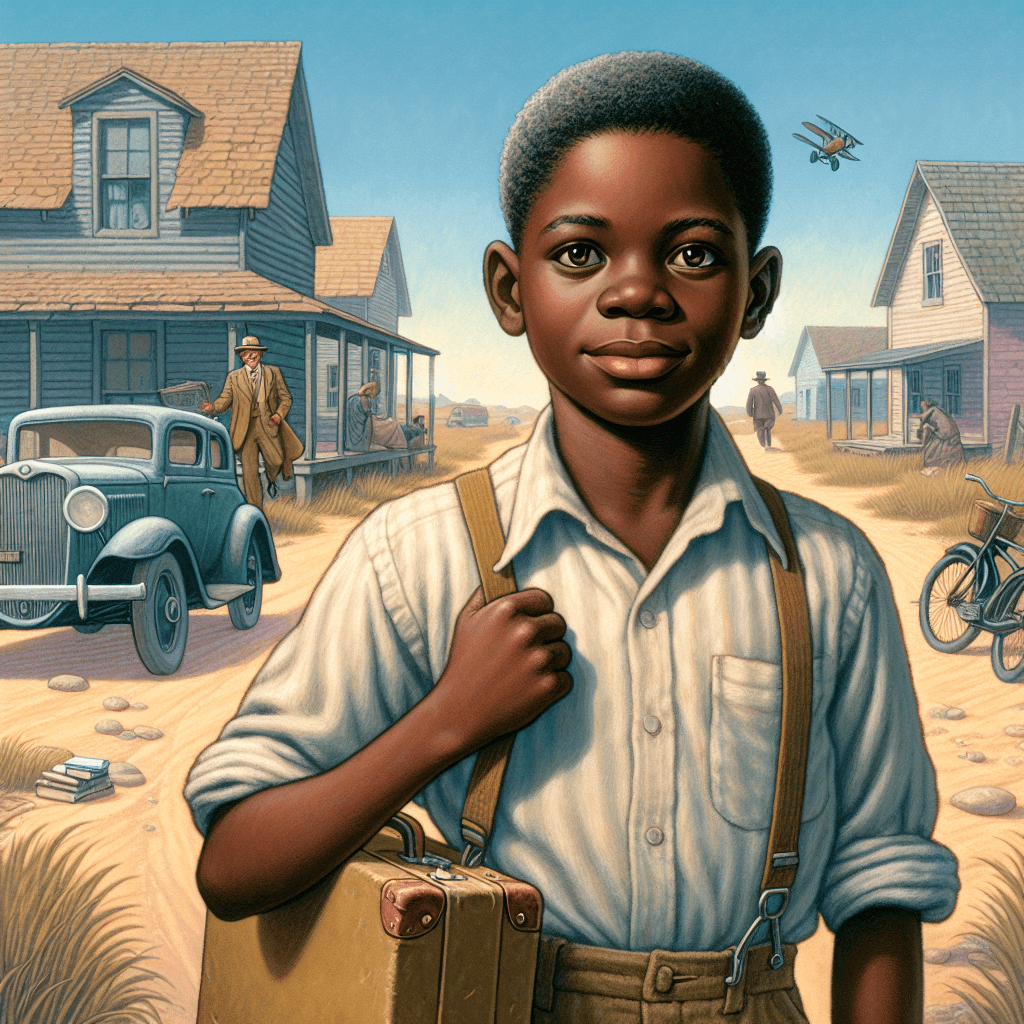
Reflecting on Bud, Not Buddy: Understanding and Expression
Inquiry Framework
Question Framework
Driving Question
The overarching question that guides the entire project.How can we express our understanding and interpretations of 'Bud, Not Buddy' by exploring its themes, character development, historical context, and personal connections to family and resilience?Essential Questions
Supporting questions that break down major concepts.- What are the major themes presented in the novel 'Bud, Not Buddy' and how do they relate to our own lives?
- How does the author use language to develop the characters and setting in 'Bud, Not Buddy'?
- In what ways does the historical context of the Great Depression affect the events and characters in 'Bud, Not Buddy'?
- How do Bud's decisions and actions demonstrate resilience and personal growth throughout the novel?
- What is the significance of family and friendship in 'Bud, Not Buddy', and how can we compare this to our own experiences?
Standards & Learning Goals
Learning Goals
By the end of this project, students will be able to:- Students will identify and analyze major themes in 'Bud, Not Buddy' and relate them to their own experiences.
- Students will examine how language is used by the author to develop characters, setting, and plot in 'Bud, Not Buddy'.
- Students will explore the historical context of the Great Depression and its impact on the events and characters in 'Bud, Not Buddy'.
- Students will interpret the resilience and personal growth of the main character, Bud, and compare his journey to their personal experiences.
- Students will evaluate the roles of family and friendship in the novel and connect these elements to their own lives.
Common Core Standards
Entry Events
Events that will be used to introduce the project to studentsThe Survival Guide Challenge: Bud Edition
Present students with a challenge to create a 'Depression Era Survival Guide' inspired by Bud’s journey. They must research the historical context and devise strategies for survival, encouraging them to think critically about resourcefulness and resilience during tough times.Virtual Journey into the Great Depression
Students start with a virtual reality experience that transports them back in time to the Great Depression era. As they explore the virtual landscape, they'll encounter characters and scenarios from 'Bud, Not Buddy,' prompting them to reflect on the challenges of the time and how Bud's journey fits into this historical context.Mystery Detour: Unraveling Bud's Suitcase
Students receive a mysterious locked suitcase, resembling Bud’s from the novel, filled with items and clues that represent key moments and themes from the story. They're tasked with solving puzzles to open the suitcase, piquing their curiosity and leading them to explore the connections between the items and Bud’s adventures.Jazz Through the Ages – A Musical Connection
Host a workshop where students listen to music from the Great Depression era, much like what Bud would have experienced. Invite a local jazz musician to demonstrate and discuss the importance of music in Bud's life, sparking inquiries into how music influences culture and personal growth.Storytelling Festival: Bud’s Hidden Narratives
Organize a storytelling festival where students reimagine chapters from Bud's perspective, focusing on cultural, historical, and personal narratives. As they craft and share these stories, they explore different viewpoints and cultural influences within the novel's context.Portfolio Activities
Portfolio Activities
These activities progressively build towards your learning goals, with each submission contributing to the student's final portfolio.Theme Investigation: Unpacking Bud's Journey
In this activity, students will delve into the major themes of 'Bud, Not Buddy'. They will identify key themes such as resilience, resourcefulness, and family, and make connections to their own lives by reflecting on personal experiences and beliefs. This will build a foundation for understanding the broader context of the novel.Steps
Here is some basic scaffolding to help students complete the activity.Final Product
What students will submit as the final product of the activityA personal reflection journal entry connecting individual experiences to the themes in 'Bud, Not Buddy'.Alignment
How this activity aligns with the learning objectives & standardsAligns with CCSS.ELA-LITERACY.RL.5.2, as students determine and reflect on the themes of the story.Character Contrast: Bud vs. Historical Figures
Students will perform a character study by comparing and contrasting Bud with key historical figures from the Great Depression. The aim is to analyze how different characters respond to challenges and to understand the novel's characters in a broader historical context.Steps
Here is some basic scaffolding to help students complete the activity.Final Product
What students will submit as the final product of the activityA comparative analysis Venn diagram showcasing similarities and differences between Bud and a historical figure.Alignment
How this activity aligns with the learning objectives & standardsAligns with CCSS.ELA-LITERACY.RL.5.3 by comparing and contrasting characters, and CCSS.ELA-LITERACY.RI.5.3 by analyzing historical interactions.Historical Context Explorer: The Great Depression Impact
This activity focuses on exploring how the historical context of the Great Depression influences the events and characters in the novel. Students will delve into different aspects of the era, from economic conditions to cultural impacts, and relate these to Bud's experiences.Steps
Here is some basic scaffolding to help students complete the activity.Final Product
What students will submit as the final product of the activityA multimedia presentation providing insight into the Great Depression's influence on the novel.Alignment
How this activity aligns with the learning objectives & standardsSupports CCSS.ELA-LITERACY.RI.5.3 by explaining interactions between historical concepts and the novel, and aligns with CCSS.ELA-LITERACY.RL.5.3 by examining setting and events.Creative Rewriting: Bud’s Diary Entries
Students will rewrite key events from 'Bud, Not Buddy' from Bud’s perspective in the form of diary entries. This will help them explore character development, personal growth, and emotional depth, while practicing narrative writing.Steps
Here is some basic scaffolding to help students complete the activity.Final Product
What students will submit as the final product of the activityA series of diary entries from Bud’s perspective, capturing his emotional journey.Alignment
How this activity aligns with the learning objectives & standardsAligns with CCSS.ELA-LITERACY.W.5.1, practicing narrative writing, and CCSS.ELA-LITERACY.RL.5.3 by focusing on character development.Opinion Piece: Reflections on Family and Friendship
In this culminating activity, students will write an opinion piece reflecting on the significance of family and friendship in 'Bud, Not Buddy' and comparing it to their own lives. This not only draws on textual evidence but also encourages personal reflection and critical thinking.Steps
Here is some basic scaffolding to help students complete the activity.Final Product
What students will submit as the final product of the activityA polished opinion piece essay examining family and friendship themes in the novel.Alignment
How this activity aligns with the learning objectives & standardsSupports CCSS.ELA-LITERACY.W.5.1 by crafting an opinion essay, and CCSS.ELA-LITERACY.W.5.9 by using textual evidence for analysis.Rubric & Reflection
Portfolio Rubric
Grading criteria for assessing the overall project portfolioBud, Not Buddy Portfolio Assessment Rubric
Theme Analysis
This category assesses students' ability to identify and analyze key themes from 'Bud, Not Buddy' and relate them to personal experiences.Identification of Themes
Evaluates the student's ability to identify central themes in 'Bud, Not Buddy'.
Exemplary
4 PointsClear and insightful identification of multiple central themes with strong textual evidence.
Proficient
3 PointsCorrectly identifies multiple themes with adequate textual support.
Developing
2 PointsIdentifies at least one theme but provides limited or unclear textual support.
Beginning
1 PointsStruggles to identify themes or lacks textual support for identified themes.
Personal Reflection
Assesses the depth of personal reflection and connection to themes from the novel.
Exemplary
4 PointsDeep, reflective connections drawn between personal experiences and novel themes with detailed explanations.
Proficient
3 PointsClear connections made between personal experiences and novel themes with sufficient detail.
Developing
2 PointsBasic connections attempted between personal experiences and themes but lacks detail.
Beginning
1 PointsMinimal or no personal connections made to the novel's themes.
Character and Historical Analysis
Evaluates the student's ability to compare and contrast characters from 'Bud, Not Buddy' with historical figures and analyze historical context impact.Character Comparison
Judges student's ability to compare Bud with historical figures, focusing on similarities and differences in traits and challenges.
Exemplary
4 PointsComprehensive and nuanced comparison with clear, insightful details.
Proficient
3 PointsDetailed comparison with clear evidence of similarities and differences.
Developing
2 PointsBasic comparison with limited details or support.
Beginning
1 PointsLimited or unclear comparison lacking detail.
Historical Context Integration
Assesses understanding of the Great Depression's influence on the novel's events and characters.
Exemplary
4 PointsThorough and insightful integration of historical context with clear connections to the novel.
Proficient
3 PointsClear integration of historical context with relevant connections.
Developing
2 PointsLimited integration with some relevant connections.
Beginning
1 PointsMinimal or no integration of historical context.
Writing and Expression
Focuses on students' creative writing skills and ability to express Bud's perspective through narrative techniques.Perspective Writing
Measures the student's ability to authentically capture Bud's voice in diary entries.
Exemplary
4 PointsHighly creative narrative with accurate and expressive portrayal of Bud's voice and emotional depth.
Proficient
3 PointsCreative narrative with clear portrayal of Bud's voice and emotions.
Developing
2 PointsBasic narrative with some attempt at capturing Bud's voice.
Beginning
1 PointsMinimal effort in capturing character voice with unclear narrative.
Opinion Writing
Evaluates the ability to express well-supported opinion on family and friendship.
Exemplary
4 PointsWell-structured essay with strong, well-supported opinions and clear textual evidence.
Proficient
3 PointsStructured essay with supported opinions and adequate evidence.
Developing
2 PointsBasic opinion essay with limited support and evidence.
Beginning
1 PointsUnstructured essay with minimal or unsupported opinions.