
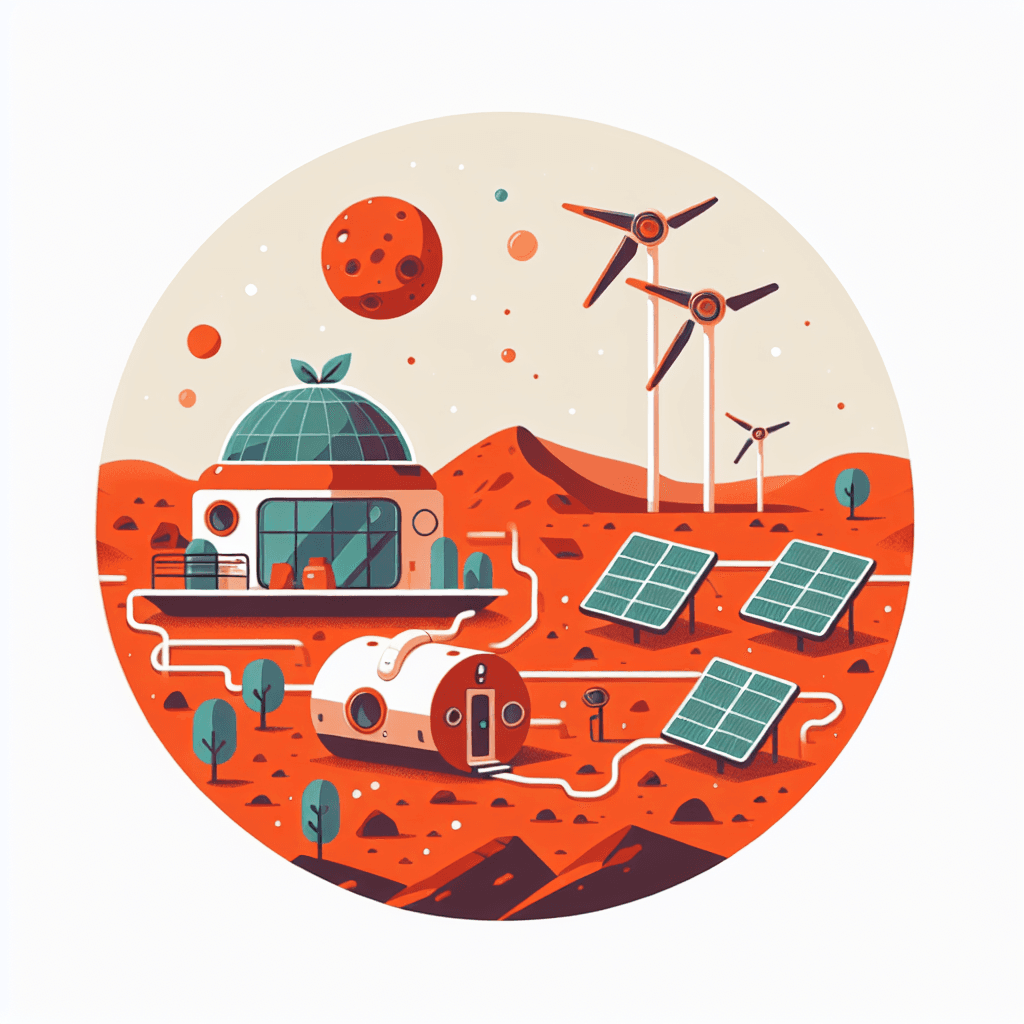
Renewable Energy for Martian Habitats
Inquiry Framework
Question Framework
Driving Question
The overarching question that guides the entire project.How can we design and implement sustainable energy solutions for a Martian habitat that effectively meet the challenges of the harsh Martian environment while utilizing renewable resources?Essential Questions
Supporting questions that break down major concepts.- What are the major challenges of sustaining human life on Mars?
- How can we design an energy-efficient habitat suitable for the Martian environment?
- How do different renewable energy sources compare in terms of effectiveness and feasibility for use on Mars?
- What is the role of mathematics and physics in optimizing energy solutions for a Martian habitat?
- How can technology be leveraged to implement and maintain energy systems on Mars?
Standards & Learning Goals
Learning Goals
By the end of this project, students will be able to:- Students will be able to identify and analyze the challenges of sustaining human life on Mars.
- Students will design and implement a sustainable energy solution for a Martian habitat using renewable resources.
- Students will evaluate and compare the effectiveness and feasibility of different renewable energy sources for use on Mars.
- Students will apply mathematical and scientific principles to optimize energy solutions for a Martian habitat.
- Students will research and propose technological solutions for maintaining energy systems on Mars.
NGSS
Common Core Standards
Entry Events
Events that will be used to introduce the project to studentsMars Energy Crisis Simulation
Students walk into a classroom transformed into a Mars habitat facing an energy crisis simulation. They're presented with data on limited resources and a video message from fictional astronauts requesting solutions. The goal is to design an efficient energy strategy to sustain long-term missions on Mars.Interview with a Martian: The Energy Perspective
An actor dressed as a Martian visits the classroom, discussing the planet's energy challenges and inviting students to participate in a galactic conference to present their solutions. This interactive session fosters curiosity and sets the stage for research-based problem-solving.Mars Renewable Energy Fair
The classroom is transformed into a Mars-themed energy fair, featuring booths with different renewable energy technologies. Experts (played by teachers or community members) demonstrate how these technologies might be adapted for Mars, fueling student curiosity to explore and innovate further.Portfolio Activities
Portfolio Activities
These activities progressively build towards your learning goals, with each submission contributing to the student's final portfolio.Creative Engineers: Energy Conversion Design
This activity involves designing a device or system that converts energy forms effectively to address Mars' energy needs, promoting creativity and engineering skills.Steps
Here is some basic scaffolding to help students complete the activity.Final Product
What students will submit as the final product of the activityA detailed design proposal that includes sketches or models, describing how the device converts energy forms.Alignment
How this activity aligns with the learning objectives & standardsMeets HS-PS3-3 by designing and refining devices for energy conversion within given constraints.Eco Innovators: Sustainable Solution Evaluation
In this activity, students evaluate and refine their energy solution to minimize environmental impacts on Mars, integrating environmental science principles.Steps
Here is some basic scaffolding to help students complete the activity.Final Product
What students will submit as the final product of the activityAn evaluation report detailing environmental impacts and refinement suggestions for the energy solution.Alignment
How this activity aligns with the learning objectives & standardsSupports HS-ESS3-4 by focusing on evaluating and refining technological solutions to reduce environmental impacts.Math Wizards: Graphing Energy Functions
Students apply mathematical modeling by graphing energy functions to analyze and optimize energy use strategies on Mars.Steps
Here is some basic scaffolding to help students complete the activity.Final Product
What students will submit as the final product of the activityA set of graphs and a mathematical analysis report on energy function optimization for Mars.Alignment
How this activity aligns with the learning objectives & standardsConnected to CCSS.MATH.HSF-IF.C.7 by modeling and graphing functions for energy optimization.Research Pioneers: Martian Energy Solution Proposal
Engaging students in a research-driven project where they consolidate all their findings into a comprehensive proposal for sustainable Martian energy solutions.Steps
Here is some basic scaffolding to help students complete the activity.Final Product
What students will submit as the final product of the activityA well-researched and detailed Martian Energy Solution Proposal ready for presentation.Alignment
How this activity aligns with the learning objectives & standardsAligns with CCSS.ELA-LITERACY.W.9-10.7 as it involves conducting research to solve a problem and synthesizing information.Rubric & Reflection
Portfolio Rubric
Grading criteria for assessing the overall project portfolioMartian Energy Solutions Rubric
Scientific Understanding
Evaluate the student's grasp of scientific concepts related to energy conversion and Martian environmental challenges.Concept Application
Effectively applies scientific and mathematical concepts to energy conversion solutions.
Exemplary
4 PointsShows extensive application of scientific principles in energy design and clear understanding of Martian environment challenges.
Proficient
3 PointsApplies scientific principles correctly to design, with good understanding of Mars' environmental challenges.
Developing
2 PointsApplies scientific concepts with partial understanding; some inconsistencies noted.
Beginning
1 PointsStruggles with basic scientific application and understanding of environmental challenges.
Environmental Impact Analysis
Analyzes and addresses potential environmental impacts of energy solutions on Mars.
Exemplary
4 PointsConducts a comprehensive analysis and proposes innovative solutions to minimize environmental impacts on Mars.
Proficient
3 PointsProvides solid analysis with good solutions to reduce environmental impacts.
Developing
2 PointsIdentifies some environmental impacts; solutions are underdeveloped.
Beginning
1 PointsLimited analysis with minimal solutions for environmental impacts.
Creativity and Innovation
Assess the originality and innovativeness of the proposed energy solutions.Design Creativity
The originality and inventiveness of the energy conversion design.
Exemplary
4 PointsPresents highly original and innovative design solutions with detailed creative elements.
Proficient
3 PointsDesigns possess innovative elements and show good creativity.
Developing
2 PointsDesigns show some creativity but lack originality.
Beginning
1 PointsDesigns are basic with minimal creative effort.
Integration of Technology
Effective integration of technology into energy solutions and presentations.
Exemplary
4 PointsIntegrates advanced technological solutions seamlessly within the energy project.
Proficient
3 PointsUses technology effectively within the energy project.
Developing
2 PointsTechnology use is partial or lacks integration.
Beginning
1 PointsStruggles to integrate technology into the project.
Research and Analysis
Evaluate the thoroughness of research and the depth of analysis in energy proposals.Research Depth
Depth and breadth of research conducted on Martian energy needs and solutions.
Exemplary
4 PointsDemonstrates exceptional research with a comprehensive synthesis of energy needs for Mars.
Proficient
3 PointsConducts thorough research with well-synthesized findings.
Developing
2 PointsResearch is adequate but lacks depth or synthesis.
Beginning
1 PointsLimited research with minimal synthesis of findings.
Mathematical Analysis
Effectiveness of mathematical modeling and graphing in energy optimization.
Exemplary
4 PointsUtilizes complex mathematical models proficiently to optimize energy solutions.
Proficient
3 PointsEffectively uses mathematical models and graphs for energy discussions.
Developing
2 PointsUses basic mathematical models; analysis lacks depth.
Beginning
1 PointsMinimal use of mathematical models and tools.