
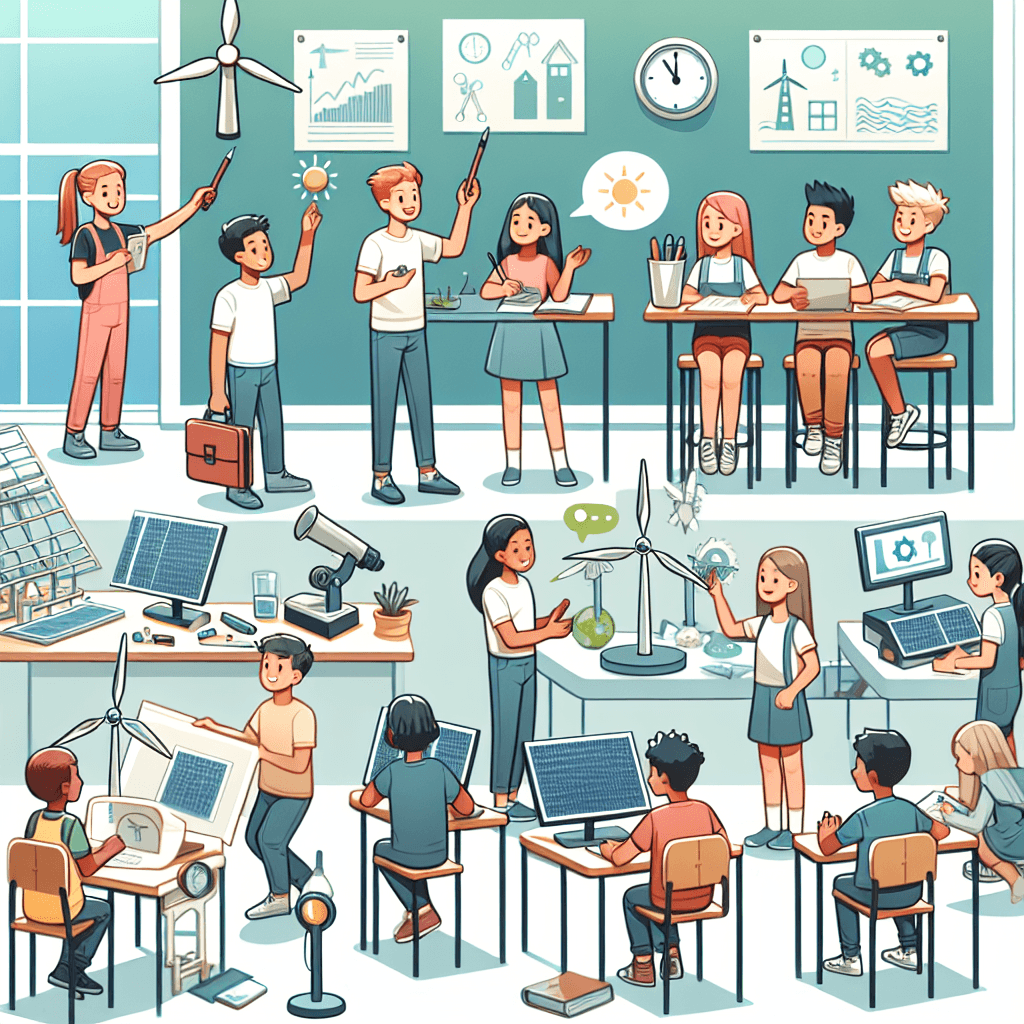
Renewable Energy Solutions: Design, Build, and Present
Inquiry Framework
Question Framework
Driving Question
The overarching question that guides the entire project.How can we design and build a renewable energy device to contribute to a more sustainable future, considering the advantages and disadvantages compared to non-renewable sources, and how can we improve its efficiency and effectiveness?Essential Questions
Supporting questions that break down major concepts.- What are the different types of renewable energy sources, and how do they work?
- How can we design and build a device that harnesses renewable energy?
- What are the advantages and disadvantages of using renewable energy compared to non-renewable energy sources?
- How can we improve the efficiency and effectiveness of our renewable energy device?
- How can renewable energy solutions contribute to a more sustainable future?
Standards & Learning Goals
Learning Goals
By the end of this project, students will be able to:- Research different renewable energy sources.
- Design and build a prototype of a renewable energy device.
- Test the prototype and collect data on its performance.
- Evaluate the advantages and disadvantages of renewable energy compared to non-renewable sources.
- Reflect on the effectiveness of the renewable energy device and suggest improvements.
- Apply science concepts to real-world sustainability challenges.
- Develop problem-solving, collaboration, and innovation skills.
Entry Events
Events that will be used to introduce the project to studentsRenewable Energy Fair Showcase
A local environmental group presents students with a challenge: design an interactive exhibit showcasing the benefits of renewable energy for the annual town fair. Students develop hands-on displays and presentations to educate the community, fostering creativity and communication skills.Portfolio Activities
Portfolio Activities
These activities progressively build towards your learning goals, with each submission contributing to the student's final portfolio.Renewable Energy Source Exploration
Students will begin by exploring the various types of renewable energy sources available. They will conduct preliminary research to understand how these sources work and their potential applications.Steps
Here is some basic scaffolding to help students complete the activity.Final Product
What students will submit as the final product of the activityA detailed research report outlining at least three different renewable energy sources, including descriptions of how they function, their potential uses, and any limitations.Alignment
How this activity aligns with the learning objectives & standardsLearning Goal: Research different renewable energy sources.Rubric & Reflection
Portfolio Rubric
Grading criteria for assessing the overall project portfolioRenewable Energy Source Exploration Rubric
Research and Analysis
Focuses on the depth and breadth of research, clarity of presentation, and critical analysis of renewable energy sources.Understanding of Renewable Energy Sources
Depth of understanding and accuracy of information presented about different renewable energy sources.
Exemplary
4 PointsDemonstrates comprehensive and accurate understanding of at least three renewable energy sources, including detailed explanations of their function, applications, and limitations. Research is thorough and well-cited.
Proficient
3 PointsDemonstrates a thorough understanding of at least three renewable energy sources, accurately explaining their function, applications, and limitations. Research is complete and includes proper citations.
Developing
2 PointsShows an emerging understanding of at least three renewable energy sources, with some inaccuracies or omissions in explanations of function, applications, or limitations. Research is adequate but may lack detail or proper citations.
Beginning
1 PointsShows a beginning understanding of renewable energy sources, with significant inaccuracies or omissions in explanations. Research is incomplete and lacks detail and proper citations.
Report Clarity and Organization
Clarity, organization, and completeness of the research report.
Exemplary
4 PointsReport is exceptionally clear, well-organized, and comprehensive. Information is presented logically with excellent use of visuals and supporting evidence. Demonstrates sophisticated understanding of the topic.
Proficient
3 PointsReport is clear, well-organized, and complete. Information is presented logically with good use of visuals and supporting evidence. Demonstrates thorough understanding of the topic.
Developing
2 PointsReport is somewhat clear and organized, but may be missing key information or presented illogically. Visuals and supporting evidence are limited. Demonstrates basic understanding of the topic.
Beginning
1 PointsReport is unclear, disorganized, and incomplete. Information is presented illogically with minimal or no visuals and supporting evidence. Demonstrates limited understanding of the topic.
Application and Limitation Analysis
Ability to identify and explain the potential applications and limitations of each energy source.
Exemplary
4 PointsDemonstrates an exceptional ability to identify and explain a wide range of potential applications and limitations for each energy source, showcasing insightful analysis and critical thinking.
Proficient
3 PointsDemonstrates a strong ability to identify and explain several potential applications and limitations for each energy source, showcasing clear analysis and critical thinking.
Developing
2 PointsDemonstrates some ability to identify and explain a few potential applications and limitations for each energy source, but may lack depth or critical thinking.
Beginning
1 PointsDemonstrates limited ability to identify and explain potential applications and limitations for each energy source, showing minimal analysis or critical thinking.