
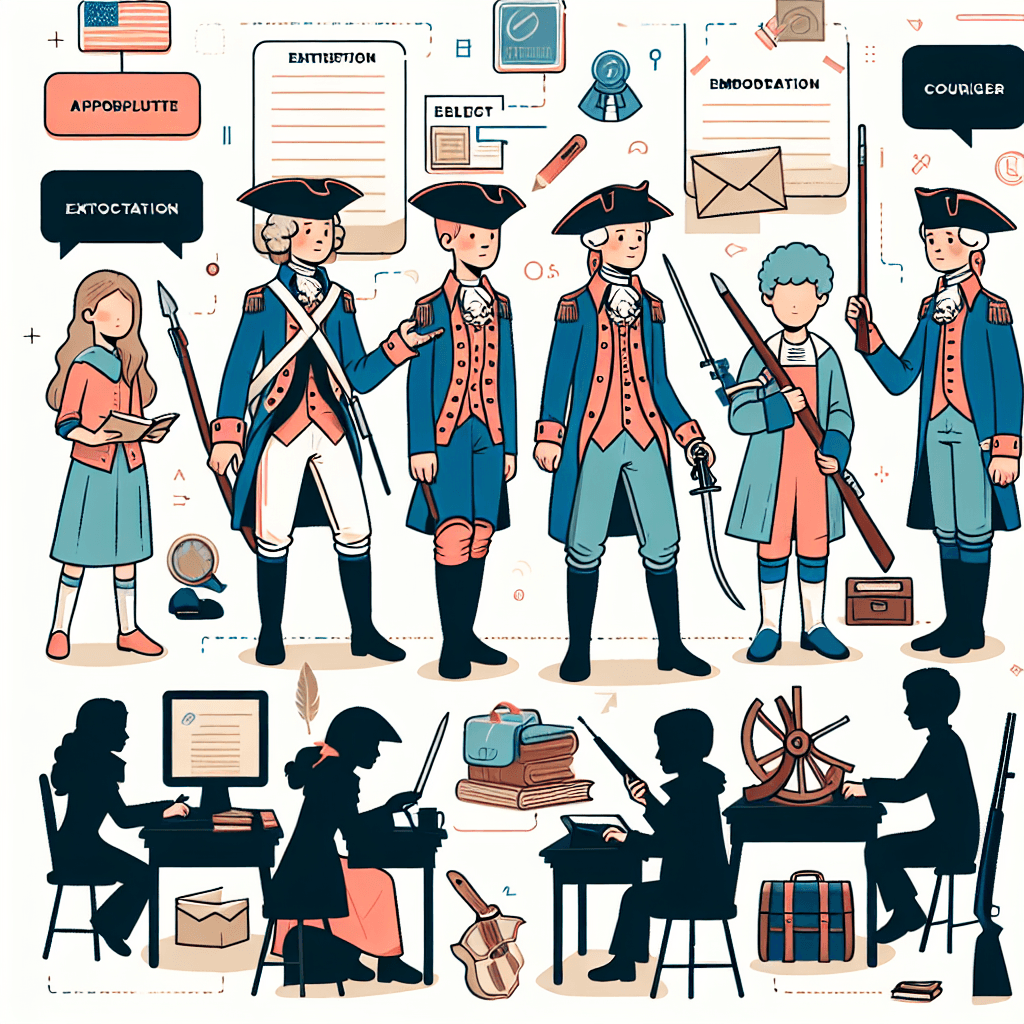
Revolutionary War Character Narrative Essay
Inquiry Framework
Question Framework
Driving Question
The overarching question that guides the entire project.How can you, as a character in the Revolutionary War, create a narrative essay from a journal entry that accurately reflects the daily life, key events, and ideological perspectives of that time?Essential Questions
Supporting questions that break down major concepts.- What was daily life like during the Revolutionary War, and how might this have impacted a person's perspective and experiences?
- How can you effectively transform a journal entry into a compelling narrative essay while accurately reflecting the historical context?
- In what ways can figurative language enhance the storytelling and characterization in a narrative about the Revolutionary War?
- What were the key events and compromises leading up to the Revolutionary War, and how can they be integrated into a personal narrative?
- How can understanding the perspectives of different political and cultural groups during the Revolutionary War period help in developing a historical character's voice and viewpoint?
- What are the main ideas conveyed in the Declaration of Independence, and how can they be reflected in a character's journal entry during the Revolutionary War?
Standards & Learning Goals
Learning Goals
By the end of this project, students will be able to:- Students will be able to write a well-organized narrative essay that captures the experiences and perspectives of a character from the Revolutionary War.
- Students will integrate information from multiple historical texts to create a coherent narrative that accurately portrays the era.
- Students will use figurative language, such as metaphors and similes, to enhance their storytelling and engage readers.
- Students will demonstrate correct spelling and use of conjunctions to produce clear and coherent writing.
- Students will understand the influence of various political and cultural groups during the Revolutionary War and express these in their narrative character development.
- Students will analyze and incorporate the causes and effects of key events leading up to the American Revolution in their narratives.
- Students will reflect concepts from the Declaration of Independence in their character's journal entries to provide depth and historical relevance.
Teacher-specified Standards
Entry Events
Events that will be used to introduce the project to studentsTime Capsule Discovery
Students discover a mysterious time capsule dating back to the Revolutionary War. Inside, they find items such as old letters, a soldier's journal, and a quill. This sparks their curiosity to create their own narrative from the perspective of a historical figure during the revolution, using figurative language and historical contexts.Interactive Role-Playing Game
Students participate in an interactive role-playing game where they choose to be a Loyalist or a Patriot. They must write journal entries and narratives based on their character's decisions and the opposing viewpoints, incorporating key historical events and figurative language to enhance their stories.Colonial Council Debate
Students are divided into groups representing different political and cultural factions of the Revolutionary War era. Each group creates a journal entry and narrative essay from their character's perspective, practicing the use of conjunctions and sentence variety to express complex ideas.Portfolio Activities
Portfolio Activities
These activities progressively build towards your learning goals, with each submission contributing to the student's final portfolio.Time Capsule Narrative Exploration
Students create a fictional narrative essay from a historical journal entry found in a Revolutionary War time capsule. Through this activity, they will learn to establish a narrative situation, integrate historical context, and develop characters.Steps
Here is some basic scaffolding to help students complete the activity.Final Product
What students will submit as the final product of the activityA fictional narrative essay based on a historical journal entry with integrated historical details and character development.Alignment
How this activity aligns with the learning objectives & standardsAligns with 5.W.RW.4 as it requires writing a narrative using descriptions and pacing to develop characters around a central conflict or experience.Role-Playing Perspective Journals
In an interactive role-playing game, students choose to be either a Loyalist or a Patriot, creating journal entries that reflect their character's viewpoint and experiences surrounding key Revolutionary War events.Steps
Here is some basic scaffolding to help students complete the activity.Final Product
What students will submit as the final product of the activityA series of journal entries reflecting the viewpoint of a character (Loyalist or Patriot) during the Revolutionary War.Alignment
How this activity aligns with the learning objectives & standardsSupports 5.W.RW.4 and 5.SS.1.3 by developing character perspectives and understanding the impact of political/cultural groups.Colonial Debate Narrative Synthesis
Students participate in a colonial council debate, then synthesize their group's arguments into a narrative essay that captures different perspectives on the Revolutionary War.Steps
Here is some basic scaffolding to help students complete the activity.Final Product
What students will submit as the final product of the activityA narrative essay showing various perspectives from a colonial council debate during the Revolutionary War.Alignment
How this activity aligns with the learning objectives & standardsCovers 5.SS.1.6 by analyzing compromises and conflicts, and 5.RC.NF.6e by integrating diverse historical texts.Metaphor & Simile Revolution
Students explore the use of metaphors and similes to enrich their storytelling by comparing historical events to more relatable concepts, enhancing narrative depth and reader engagement.Steps
Here is some basic scaffolding to help students complete the activity.Final Product
What students will submit as the final product of the activityEnhanced narrative essays and journal entries featuring original metaphors and similes related to the Revolutionary War.Alignment
How this activity aligns with the learning objectives & standardsAligns with 5.VD.WB.2a by recognizing and creating figurative language in context.Declaration Ideals Journal Reflection
Students delve into the Declaration of Independence, integrating its key concepts into their character's journal entries to reflect Revolutionary War ideals.Steps
Here is some basic scaffolding to help students complete the activity.Final Product
What students will submit as the final product of the activityJournal entries reflecting the ideals of the Declaration of Independence and its impact on Revolutionary figures.Alignment
How this activity aligns with the learning objectives & standardsMeets 5.SS.4.2 by integrating important Declaration concepts into narratives.Rubric & Reflection
Portfolio Rubric
Grading criteria for assessing the overall project portfolioRevolutionary War Narrative Assessment Rubric
Narrative Structure
Assesses the organization and development of the narrative, including the establishment of a situation, conflict, and resolution.Organization
Measures the ability to structure the narrative logically with a clear beginning, middle, and end.
Exemplary
4 PointsNarrative is exceptionally well-organized with a compelling introduction, a well-developed middle, and a satisfying conclusion.
Proficient
3 PointsNarrative is well-organized, has a clear beginning, middle, and end, but lacks some detail in transitions.
Developing
2 PointsNarrative has a basic structure but lacks clear transitions between sections.
Beginning
1 PointsNarrative is poorly organized with unclear or missing sections between beginning, middle, and end.
Character Development
Evaluates the depth and consistency in characters' thoughts, actions, and dialogue.
Exemplary
4 PointsCharacters are richly developed with consistent thoughts, actions, and dialogue that enhance the narrative.
Proficient
3 PointsCharacters are well developed with mostly consistent thoughts, actions, and dialogue.
Developing
2 PointsCharacters are somewhat developed with basic or inconsistent thoughts, actions, and dialogue.
Beginning
1 PointsCharacters lack development and consistency in their portrayal.
Historical Context and Accuracy
Assesses the integration of historical facts and concepts into the narrative.Historical Integration
Measures the incorporation of accurate historical details and concepts from the Revolutionary War.
Exemplary
4 PointsHistorical details are seamlessly integrated into the narrative, enhancing authenticity and depth.
Proficient
3 PointsIncludes accurate historical details that support the narrative, but may lack depth.
Developing
2 PointsSome historical details are evident but inconsistently applied or integrated.
Beginning
1 PointsMinimal historical detail included, with inaccuracies affecting authenticity.
Figurative Language
Evaluates the use of metaphors and similes to enrich the narrative and enhance reader engagement.Use of Figurative Language
Measures the effectiveness and creative use of metaphors and similes in narrative.
Exemplary
4 PointsMetaphors and similes are used creatively and effectively, greatly enhancing the narrative.
Proficient
3 PointsUses metaphors and similes effectively but may not significantly enhance the narrative.
Developing
2 PointsAttempts to use metaphors and similes, but they are either basic or ineffective.
Beginning
1 PointsMinimal use of figurative language, with little impact on the narrative.
Writing Conventions
Assesses spelling, grammar, and the use of conjunctions to ensure clarity and coherence.Spelling and Grammar
Evaluates the correct use of grammar, punctuation, and spelling in writing.
Exemplary
4 PointsConsistently uses correct spelling, grammar, and punctuation with minimal errors.
Proficient
3 PointsGenerally uses correct spelling and grammar with occasional errors that do not impede understanding.
Developing
2 PointsSeveral errors in spelling and grammar that occasionally impede understanding.
Beginning
1 PointsFrequent errors in spelling and grammar that significantly impede understanding.
Sentence Variety
Measures the use of various sentence structures for engagement and clarity.
Exemplary
4 PointsUses a wide variety of sentence structures effectively to enhance reader interest and clarity.
Proficient
3 PointsUses some variety in sentence structures; generally effective.
Developing
2 PointsLimited variety in sentence structures; some sentences may be awkward or unclear.
Beginning
1 PointsLittle to no variety in sentence structure, resulting in redundancy and confusion.