
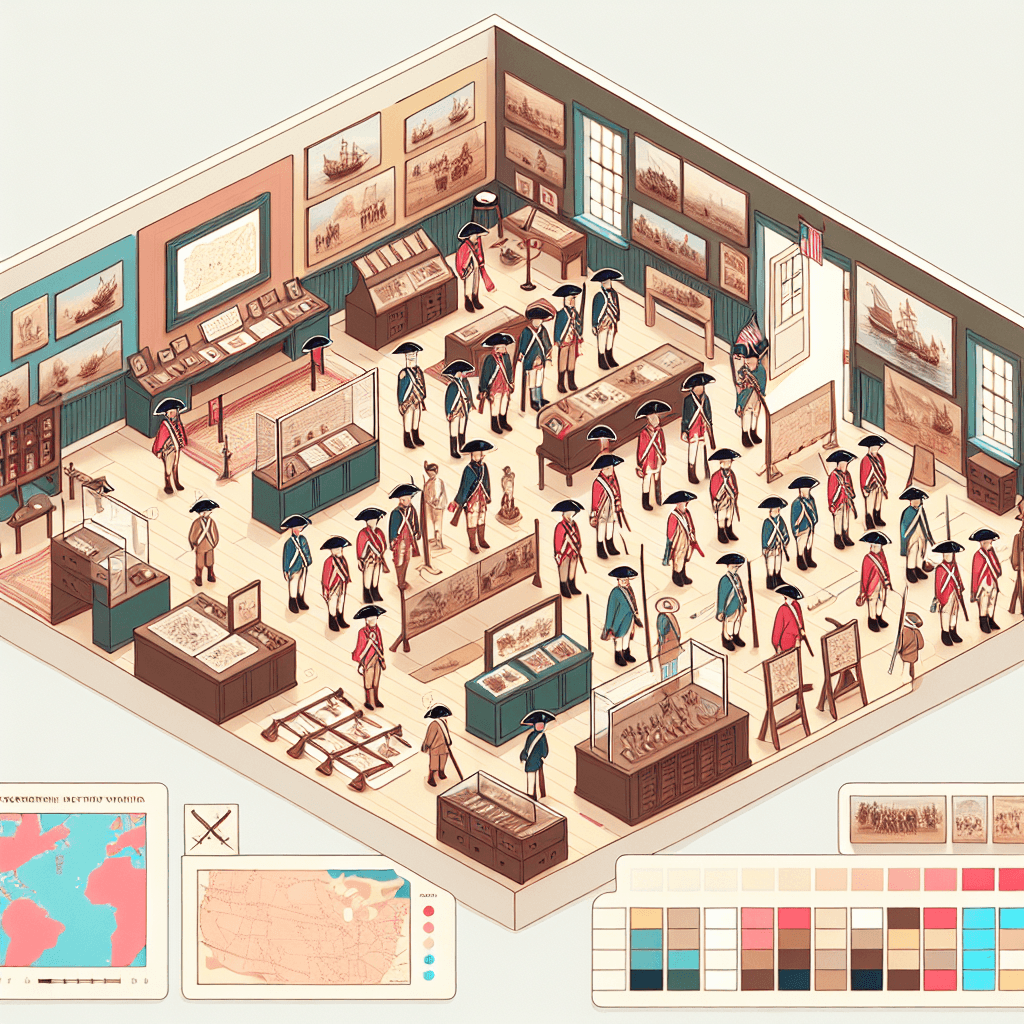
Revolutionary War: Design a Museum Exhibit
Inquiry Framework
Question Framework
Driving Question
The overarching question that guides the entire project.How can we, as historians, design a museum exhibit that captures the pivotal moments, key figures, and causes of the American Revolution, and demonstrates its lasting impact on the identity and values of the United States?Essential Questions
Supporting questions that break down major concepts.- What were the major causes of the American Revolution?
- Who were the key figures involved in the American Revolution, and what roles did they play?
- How did the events leading up to the war influence the colonists' decision to fight for independence?
- What were the turning points of the war, and how did they impact the outcome?
- How did the American Revolution shape the identity and values of the newly formed United States?
Standards & Learning Goals
Learning Goals
By the end of this project, students will be able to:- Students will be able to identify and describe the major causes of the American Revolution.
- Students will be able to identify and explain the roles of key figures involved in the American Revolution.
- Students will be able to analyze the events leading up to the war and explain how they influenced the colonists' decision to fight for independence.
- Students will be able to describe the turning points of the war and explain how they impacted the outcome.
- Students will be able to evaluate how the American Revolution shaped the identity and values of the newly formed United States.
- Students will be able to design a museum exhibit that effectively communicates the pivotal moments, key figures, and causes of the American Revolution to a specific audience.
Teacher Provided Standard
Entry Events
Events that will be used to introduce the project to studentsThe Time Capsule Challenge
A mysterious crate arrives at the classroom, labeled "From 1776." Inside are replicas of artifacts (letters, newspapers, tea) and a challenge: "Decode these relics to understand why a revolution was fought and design an exhibit that brings these voices to life."Revolutionary Rumble: A Town Hall Debate
Students participate in a mock "Town Hall Debate" where they role-play colonists with differing viewpoints on independence. The goal is to persuade their peers, using historical arguments, and then design an exhibit showcasing these diverse perspectives.A Picture Tells a Thousand Stories
Students are presented with a series of images depicting different aspects of colonial life (e.g., a bustling port, a family farm, a political meeting). They must choose one image and develop an exhibit that explores the stories and perspectives of the people in that scene.Portfolio Activities
Portfolio Activities
These activities progressively build towards your learning goals, with each submission contributing to the student's final portfolio.Revolutionary Roadmap: Timeline of Conflict
Students will research and create a timeline of the key events leading up to the American Revolution. This will help them understand the sequence of events and the underlying causes of the war.Steps
Here is some basic scaffolding to help students complete the activity.Final Product
What students will submit as the final product of the activityA detailed timeline of pre-Revolutionary events with descriptions of their significance.Alignment
How this activity aligns with the learning objectives & standardsThis activity aligns with learning goal 1 and standard T1—5.1-5 by requiring students to identify and describe the major causes of the American Revolution.Heroes of the Revolution: Trading Card Challenge
Students will choose a key figure from the American Revolution and create a "trading card" that highlights their contributions and significance. This will help them understand the roles of different individuals in the war.Steps
Here is some basic scaffolding to help students complete the activity.Final Product
What students will submit as the final product of the activityA trading card featuring a key figure from the American Revolution, including their name, portrait, key contributions, and a brief biography.Alignment
How this activity aligns with the learning objectives & standardsThis activity aligns with learning goal 2 and standard T1—5.1-5 by requiring students to identify and explain the roles of key figures involved in the American Revolution.Voices of Revolution: Primary Source Analysis & Exhibit Proposal
Students will analyze primary source documents (e.g., letters, speeches, pamphlets) from the period leading up to the war and write a short essay explaining how these documents influenced the colonists' decision to fight for independence. They will then use this analysis to propose a section of their museum exhibit.Steps
Here is some basic scaffolding to help students complete the activity.Final Product
What students will submit as the final product of the activityAn analytical essay and a museum exhibit proposal outlining the section’s theme, key artifacts, and interpretive text.Alignment
How this activity aligns with the learning objectives & standardsThis activity aligns with learning goals 3 & 6 and standard T1—5.1-5 by requiring students to analyze the events leading up to the war and explain how they influenced the colonists' decision to fight for independence, culminating in a design proposal for a museum exhibit section.Turning Points: Interactive Exhibit Design
Students will research a turning point of the American Revolution (e.g., Battle of Saratoga, Valley Forge) and design an interactive exhibit element that explains its significance and impact on the outcome of the war.Steps
Here is some basic scaffolding to help students complete the activity.Final Product
What students will submit as the final product of the activityA detailed design proposal for an interactive exhibit element, including a description of the activity, materials needed, and learning objectives.Alignment
How this activity aligns with the learning objectives & standardsThis activity aligns with learning goals 4 & 6 and standard T1—5.1-5. Students will describe the turning points of the war and explain their impact while designing a corresponding interactive exhibit element.Legacy of Revolution: Shaping a Nation's Identity
Students will explore how the American Revolution shaped the identity and values of the newly formed United States. They will then create a presentation outlining these values and how they will be represented in their museum exhibit.Steps
Here is some basic scaffolding to help students complete the activity.Final Product
What students will submit as the final product of the activityA presentation outlining the key values of the newly formed United States and how they will be represented in the museum exhibit.Alignment
How this activity aligns with the learning objectives & standardsThis activity aligns with learning goals 5 & 6 and standard T1—5.1-5 by requiring students to evaluate how the American Revolution shaped the identity and values of the newly formed United States and to incorporate these findings into their final museum exhibit design.Rubric & Reflection
Portfolio Rubric
Grading criteria for assessing the overall project portfolioRevolutionary War Museum Exhibit Rubric
Content Knowledge and Communication
Assesses the student's understanding of the American Revolution and their ability to communicate this knowledge effectively.Historical Accuracy and Depth
Accuracy and depth of research on the causes, key figures, and events of the American Revolution.
Exemplary
4 PointsDemonstrates comprehensive and accurate knowledge of the American Revolution, including intricate details and diverse perspectives, exceeding expectations.
Proficient
3 PointsDemonstrates a solid and accurate understanding of the American Revolution, including key details and multiple perspectives.
Developing
2 PointsDemonstrates a basic understanding of the American Revolution, but with some inaccuracies or omissions.
Beginning
1 PointsDemonstrates a limited understanding of the American Revolution, with significant inaccuracies or omissions.
Presentation and Clarity
Clarity, organization, and persuasiveness of the final product (timeline, trading card, essay, proposal, presentation).
Exemplary
4 PointsPresents information in a highly clear, organized, and persuasive manner, effectively engaging the audience and demonstrating a deep understanding of the subject matter.
Proficient
3 PointsPresents information in a clear, organized, and persuasive manner, demonstrating a good understanding of the subject matter.
Developing
2 PointsPresents information in a somewhat clear and organized manner, but may lack persuasiveness or clarity in certain areas.
Beginning
1 PointsPresents information in a disorganized and unclear manner, making it difficult to understand the key concepts.
Creativity and Innovation
Creativity and innovation in the design and presentation of the museum exhibit components.
Exemplary
4 PointsDemonstrates exceptional creativity and innovation in the design of the museum exhibit components, creating a unique and engaging experience for visitors.
Proficient
3 PointsDemonstrates creativity and innovation in the design of the museum exhibit components, creating an engaging experience for visitors.
Developing
2 PointsDemonstrates some creativity in the design of the museum exhibit components, but may lack innovation or originality.
Beginning
1 PointsDemonstrates a lack of creativity in the design of the museum exhibit components, resulting in a bland or uninspired presentation.
Evidence-Based Interpretation
Effective integration of primary source analysis and historical evidence to support interpretations and exhibit design choices.
Exemplary
4 PointsMasterfully integrates primary source analysis and historical evidence to create compelling and insightful interpretations, demonstrating a sophisticated understanding of historical context.
Proficient
3 PointsEffectively integrates primary source analysis and historical evidence to support interpretations, demonstrating a strong understanding of historical context.
Developing
2 PointsPartially integrates primary source analysis and historical evidence, but interpretations may lack depth or connection to historical context.
Beginning
1 PointsFails to integrate primary source analysis or historical evidence, resulting in unsubstantiated interpretations.
Process and Collaboration
Focuses on assessing the student's growth mindset, collaboration skills, and work habits.Collaboration and Teamwork
Ability to collaborate effectively with peers, share ideas, and contribute to the overall success of the project.
Exemplary
4 PointsDemonstrates exceptional leadership and collaboration skills, actively facilitating group discussions and inspiring peers to achieve common goals.
Proficient
3 PointsCollaborates effectively with peers, actively contributing to group discussions and sharing ideas to achieve common goals.
Developing
2 PointsParticipates in group discussions, but may struggle to share ideas effectively or contribute consistently to the project.
Beginning
1 PointsStruggles to collaborate with peers, hindering group discussions and impeding progress toward common goals.
Engagement and Curiosity
Demonstrates engagement, curiosity, and a willingness to learn throughout the project.
Exemplary
4 PointsDemonstrates exceptional engagement, curiosity, and a proactive approach to learning, consistently seeking new knowledge and insights.
Proficient
3 PointsDemonstrates engagement, curiosity, and a willingness to learn, actively participating in project activities and seeking new knowledge.
Developing
2 PointsDemonstrates some engagement and curiosity, but may lack initiative or enthusiasm for learning.
Beginning
1 PointsDemonstrates a lack of engagement or curiosity, hindering learning and progress throughout the project.
Time Management and Responsibility
Demonstrates effective time management and adherence to deadlines throughout the project.
Exemplary
4 PointsManages time exceptionally well, consistently completing tasks ahead of schedule and exceeding expectations.
Proficient
3 PointsManages time effectively, consistently completing tasks on time and meeting expectations.
Developing
2 PointsManages time adequately, completing most tasks on time but occasionally missing deadlines.
Beginning
1 PointsStruggles to manage time effectively, frequently missing deadlines and falling behind on tasks.