
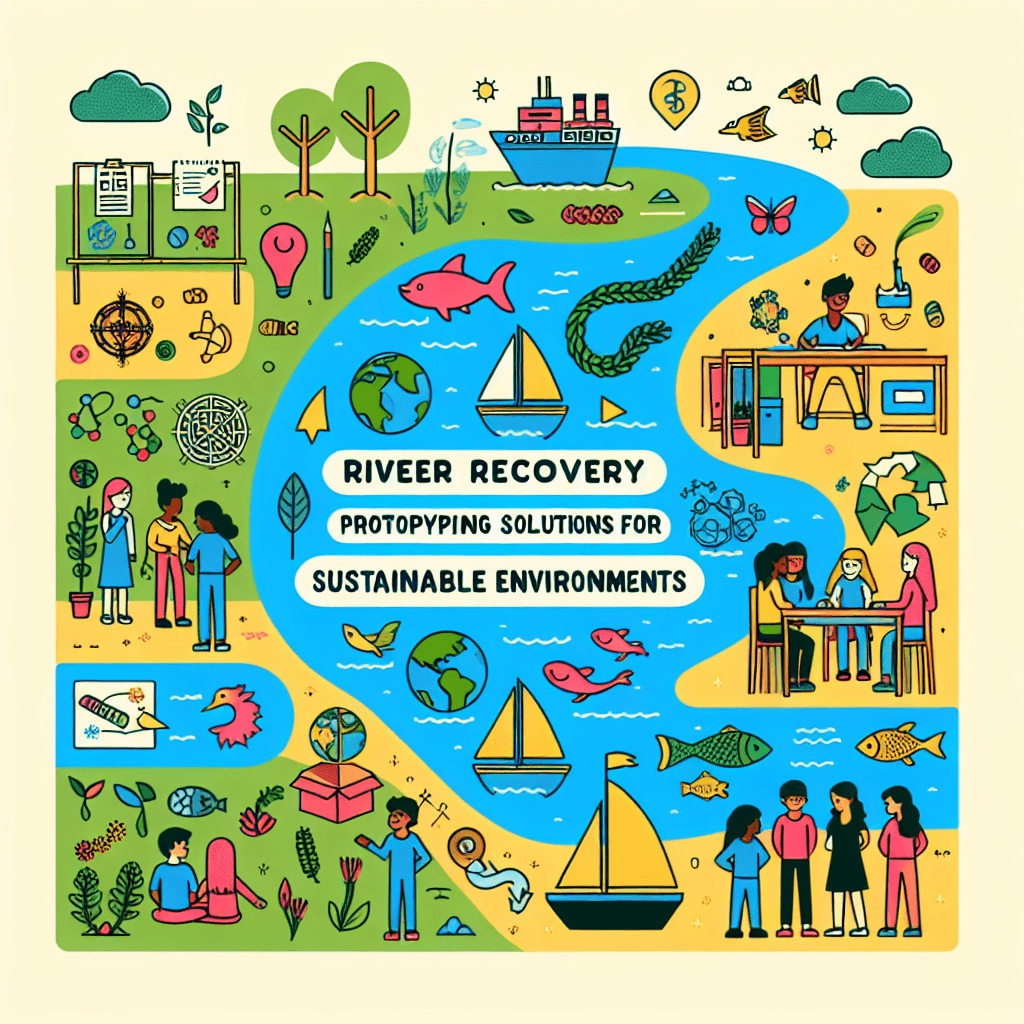
River Recovery: Prototyping Solutions for Sustainable Trade and Environments
Inquiry Framework
Question Framework
Driving Question
The overarching question that guides the entire project.How can we, as global innovators, design technologies to restore Eastern Hemisphere rivers and transform plastic waste into sustainable economic opportunities for local communities?Essential Questions
Supporting questions that break down major concepts.- How have human activities in the Eastern Hemisphere modified river ecosystems, and what are the long-term consequences for those regions?
- In what ways does the physical geography of a river (such as current and location) influence the way people live, work, and manage waste?
- How can we redefine "waste" as a resource to create sustainable trade and economic opportunities in developing communities?
- How do different cultures and societies in the Eastern Hemisphere balance the need for economic growth with the necessity of environmental preservation?
- How can innovative technology be used to restore the balance between human activity and the natural environment?
Standards & Learning Goals
Learning Goals
By the end of this project, students will be able to:- Analyze and map the environmental impact of human activity on specific river systems within the Eastern Hemisphere.
- Design and build a functional prototype of a plastic extraction device tailored to the physical geography of a chosen river.
- Develop a sustainable economic business model that demonstrates how recycled plastic can be transformed into tradeable goods for local communities.
- Evaluate the ethical and economic balance between industrial growth and environmental preservation in developing nations.
- Communicate a persuasive proposal for a community-based 'circular economy' that addresses both environmental restoration and local trade.
State Social Studies Standards (6th Grade)
C3 Framework for Social Studies State Standards
Next Generation Science Standards (NGSS)
Common Core State Standards (ELA/Literacy)
Entry Events
Events that will be used to introduce the project to studentsThe River Chokehold Simulation
A giant floor map of the Eastern Hemisphere is 'flooded' with thousands of pieces of single-use plastic, physically blocking the trade routes of the Rhine and Yangtze rivers. Students are tasked as 'Global Trade Analysts' to calculate the economic loss when the environment is too modified to support transit, sparking a need for immediate extraction solutions.Portfolio Activities
Portfolio Activities
These activities progressively build towards your learning goals, with each submission contributing to the student's final portfolio.River Autopsy: Mapping the Plastic Pulse
In this foundational activity, students act as environmental detectives. They will choose one major river in the Eastern Hemisphere (e.g., the Yangtze, Ganges, or Rhine) and investigate how human industrialization and urbanization have modified its physical state. Students will identify 'hotspots' of plastic accumulation and trace them back to specific human activities like manufacturing, lack of waste infrastructure, or high-density shipping routes.Steps
Here is some basic scaffolding to help students complete the activity.Final Product
What students will submit as the final product of the activityAn 'Environmental Impact Pulse Map' featuring annotations that link specific human activities to physical changes in the river ecosystem.Alignment
How this activity aligns with the learning objectives & standardsDirectly aligns with SS.6.G.2.1 (Human activities modify the physical environment) by requiring students to identify specific industrial and urban activities that have altered the river's natural state.The Geography Blueprint: Designing for the Flow
Now that students understand how humans have modified the river, they must learn how the river's physical geography dictates the solution. Students will analyze the physical characteristics of their chosen river (depth, current speed, bank structure) to determine the 'constraints' for their extraction device. This activity bridges geography and engineering, showing that human technology must adapt to the natural environment.Steps
Here is some basic scaffolding to help students complete the activity.Final Product
What students will submit as the final product of the activityA 'Technical Constraint Blueprint' that includes a detailed sketch of the proposed device and a justification of how its features respond to the river's physical geography.Alignment
How this activity aligns with the learning objectives & standardsAligns with SS.6.G.2.1 (Physical environments influence human activities) and NGSS.MS-ETS1-1 (Design criteria and constraints). It emphasizes how the river's physical traits—like current speed and depth—force humans to adapt their technology.Trash-to-Trade: The Circular Economy Workshop
In this activity, students transition from environmental restoration to economic innovation. They will research how plastic waste can be processed into new materials (like 3D printer filament, bricks, or textiles). Students will design a 'Trade Model' for a local community along their river, explaining how the extracted plastic can be turned into a product that lowers the cost of goods or creates new jobs, thereby fostering a 'circular economy.'Steps
Here is some basic scaffolding to help students complete the activity.Final Product
What students will submit as the final product of the activityA 'Recycled Resource Catalog' and a 'Community Trade Flowchart' showing how waste becomes wealth.Alignment
How this activity aligns with the learning objectives & standardsAligns with C3.D2.Eco.1.6-8 and C3.D2.Eco.14.6-8 by asking students to redefine 'waste' as a valuable resource and create a model for local trade and economic exchange.Prototype Pilot: Building for the Basin
Students will now build a low-fidelity physical prototype of their extraction device using recycled materials. They must test their device in a simulated river environment (a trough or stream) to see if it can successfully capture 'plastic' (beads or scraps) without being destroyed by the 'current' (water flow). This activity tests the students' ability to solve the environmental modification they identified in Activity 1.Steps
Here is some basic scaffolding to help students complete the activity.Final Product
What students will submit as the final product of the activityA functional physical prototype and a 'Testing Log' documenting successes, failures, and necessary iterations.Alignment
How this activity aligns with the learning objectives & standardsAligns with SS.6.G.2.1 and NGSS.MS-ETS1-1. This activity represents the culmination of 'human activity' (engineering) attempting to restore the 'physical environment' while being limited by its traits.The Global Recovery Pitch: Restoring the Balance
For the final portfolio piece, students will combine their research, designs, and economic models into a formal 'River Recovery Proposal.' This proposal is addressed to a mock 'Global Trade and Environment Council.' It must explain how their device restores the balance between human activity and the natural environment, and why their trade model is a sustainable choice for the region's future.Steps
Here is some basic scaffolding to help students complete the activity.Final Product
What students will submit as the final product of the activityA 'Great River Recovery Proposal' (Digital Slide Deck or Written Report) that synthesizes environmental science, geography, and economics.Alignment
How this activity aligns with the learning objectives & standardsAligns with CCSS.ELA-LITERACY.WHST.6-8.2 (Informative/explanatory writing) and synthesizes all previous standards by requiring a comprehensive explanation of the environmental and economic impact of the project.Rubric & Reflection
Portfolio Rubric
Grading criteria for assessing the overall project portfolioThe Great River Recovery: Portfolio Rubric
Geographic Thinking & Analysis
Assesses the student's ability to analyze the reciprocal relationship between humans and the physical environment in the Eastern Hemisphere (SS.6.G.2.1).Human-Environment Interaction (Mapping)
Analyzes the cause-and-effect relationship between human industrial/urban activities and the physical degradation of Eastern Hemisphere river systems.
Exemplary
4 PointsProvides a sophisticated analysis of multiple human activities, tracing complex socio-economic drivers to specific environmental modifications with precision. Map is highly detailed and annotated with expert-level insight.
Proficient
3 PointsClearly identifies three specific human activities and explains how they have modified the river's physical state. Pulse map includes accurate annotations and clear cause-effect links.
Developing
2 PointsIdentifies basic human activities and general modifications, but links between the two are inconsistent or lack specific detail. Pulse map is partially complete.
Beginning
1 PointsLists general pollutants or activities without establishing a clear cause-and-effect relationship to the river's physical geography. Pulse map is incomplete.
Geographic Influence on Design
Evaluates how the physical geography (current, depth, terrain) of a specific river dictates the design requirements and constraints for human technology.
Exemplary
4 PointsDemonstrates advanced understanding of fluid dynamics or river morphology; design features show innovative adaptation to complex physical constraints.
Proficient
3 PointsIdentifies three specific environmental constraints and justifies how the device design features respond directly to the river's physical geography.
Developing
2 PointsMentions physical features of the river, but the design adaptations are only vaguely connected to those specific environmental constraints.
Beginning
1 PointsFails to connect the device design to the river's geography, or constraints listed are not relevant to the chosen river's physical traits.
Engineering & Innovation
Evaluates the application of engineering design principles and the ability to solve environmental problems through technology (NGSS.MS-ETS1-1).Functional Prototyping
Builds a physical prototype that addresses societal needs (plastic removal) while functioning within the simulated physical environment.
Exemplary
4 PointsPrototype is exceptionally durable and efficient, capturing debris effectively while maintaining stability; shows high-level craftsmanship and creative use of materials.
Proficient
3 PointsPrototype is functional and successfully captures debris in a simulated environment; design choices align with the constraints identified in the blueprint.
Developing
2 PointsPrototype is partially functional but struggles with stability or debris capture in the simulated environment; materials used show limited effectiveness.
Beginning
1 PointsPrototype fails to function in the simulated environment or does not reflect the design sketches provided in the blueprint.
Scientific Testing & Iteration
Uses evidence from testing trials to document performance, identify failures, and suggest evidence-based improvements.
Exemplary
4 PointsTesting log provides comprehensive data across multiple trials with a sophisticated plan for iterative improvement based on specific physical observations.
Proficient
3 PointsRecords clear observations from three trials in a testing log, noting successes and failures and identifying necessary design iterations.
Developing
2 PointsTesting log is completed but lacks specific data or fails to clearly identify why certain aspects of the design succeeded or failed.
Beginning
1 PointsTesting log is minimal or missing; no clear evidence that the student used the simulation to inform their design.
Economic & Global Literacy
Assesses the ability to explain how technological choices and economic systems are prompted by human priorities and values (C3 Framework).Circular Economy Modeling
Redefines waste as a resource by designing a trade model that provides economic value to a local community in the Eastern Hemisphere.
Exemplary
4 PointsDevelops a highly innovative trade model that creates a true 'closed-loop' system, addressing multiple community needs and showing deep economic insight.
Proficient
3 PointsCreates a clear and logical product catalog and trade flowchart that demonstrates how recycled plastic becomes a valuable good for local trade.
Developing
2 PointsProvides a basic idea for a recycled product, but the trade flowchart or the economic link to the local community's needs is weak or unclear.
Beginning
1 PointsThe trade model is illogical or fails to explain how the recycled material benefits the local community's economy.
Communication & Advocacy
Evaluates the student's ability to communicate complex information and advocate for a sustainable future (CCSS.ELA-LITERACY.WHST.6-8.2).Argumentation & Evidence Integration
Synthesizes research, design, and economic modeling into a coherent, persuasive proposal for environmental and social recovery.
Exemplary
4 PointsDelivers a compelling, professional-grade proposal that seamlessly integrates environmental science, geography, and economics with persuasive authority.
Proficient
3 PointsWrites a clear informative/explanatory text that addresses the statement of need, technology/geography link, and economic impact with relevant evidence.
Developing
2 PointsProduces a proposal that covers the required sections but lacks detail, cohesive transitions, or a strong connection between the three main areas of focus.
Beginning
1 PointsThe proposal is incomplete, disorganized, or fails to communicate a clear argument for how the project addresses the river's recovery.
Strategic Communication
Communicates ideas clearly and professionally, using appropriate vocabulary and visual aids to support the 'Global Recovery Pitch.'
Exemplary
4 PointsPresentation is highly engaging, uses vocabulary with precision, and features professional-level visual aids (slides, charts, or models).
Proficient
3 PointsPresentation is well-organized and clearly delivered, using subject-specific vocabulary and effective visuals to support the main points.
Developing
2 PointsPresentation is somewhat disorganized or delivery is unclear; visuals are present but do not significantly enhance the understanding of the proposal.
Beginning
1 PointsPresentation is difficult to follow, lacks visual support, or shows little preparation in communicating the project's goals.