
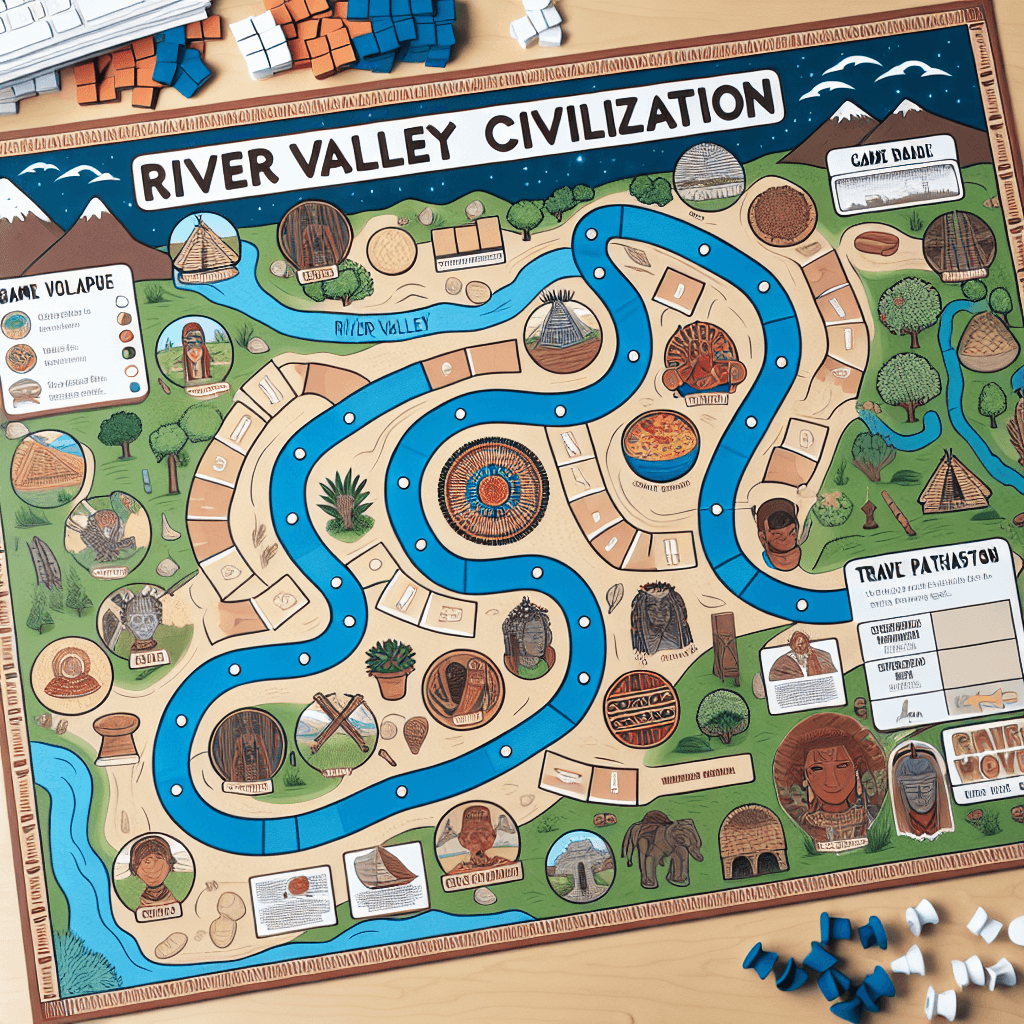
River Valley Civilization Board Game Design Challenge
Inquiry Framework
Question Framework
Driving Question
The overarching question that guides the entire project.How can we design a board game that accurately represents the key characteristics, cultural influences, and geographical impacts on early river valley civilizations while enabling players to explore the social structures, technologies, and historical evidence relevant to these ancient societies?Essential Questions
Supporting questions that break down major concepts.- What are the key characteristics that define a civilization and how can these be represented in a board game?
- How did geography and the environment influence the development of river valley civilizations?
- In what ways did the cultures, technologies, and social structures of early river valley civilizations compare and contrast with one another?
- How do artifacts and historical records help us understand ancient river valley civilizations?
- What role did trade, agriculture, and religion play in the sustainability and expansion of river valley civilizations?
Standards & Learning Goals
Learning Goals
By the end of this project, students will be able to:- Students will design a board game that accurately integrates historical facts about river valley civilizations.
- Students will compare and contrast at least two river valley civilizations including Mesopotamia, Nile, Indus, or Yellow River valleys.
- Students will demonstrate understanding of the geographical influences on the development of river valley civilizations.
- Students will explore the social structures, technologies, and cultural elements of early river valley civilizations through game design.
- Students will analyze archaeological and historical evidence to inform game design decisions.
Social Studies Standards
Common Core Standards
Entry Events
Events that will be used to introduce the project to studentsArchaeologist for a Day
Transform the classroom into an archaeological dig site with students finding "artifacts" from river valley civilizations. Each artifact has a QR code that leads to digital clues and multimedia about the societies, sparking a story-based exploration into each civilization.Interactive World Map Quest
Use an interactive digital world map to track trade routes, resource exchanges, and cultural expansions of river valley civilizations. Students will engage with maps to uncover how these connections influenced societal development, prompting deep dives into each civilization's legacy.Portfolio Activities
Portfolio Activities
These activities progressively build towards your learning goals, with each submission contributing to the student's final portfolio.Artifact Analysis Adventure
Students will investigate artifacts related to river valley civilizations and use evidence to develop interpretations of these historical developments. They will explore artifacts found in the classroom and use digital resources to gather historical context and significance.Steps
Here is some basic scaffolding to help students complete the activity.Final Product
What students will submit as the final product of the activityA comprehensive artifact analysis report detailing historical significance and context.Alignment
How this activity aligns with the learning objectives & standardsAligns with SS.6-8.3 and RH.6-8.2 by using archaeological evidence to develop interpretations and summaries.Board Game Design Blueprint
Students will synthesize their understanding of river valley civilizations into the design of a board game, including all necessary components such as a game board, rules, and playing pieces that represent cultural, technological, and geographical elements.Steps
Here is some basic scaffolding to help students complete the activity.Final Product
What students will submit as the final product of the activityA fully-designed board game prototype representing river valley civilizations.Alignment
How this activity aligns with the learning objectives & standardsSupports SS.6-8.3, RH.6-8.7, and CCSS.ELA-LITERACY.CCRA.W.7 by incorporating historical evidence and research into creative design.Peer Feedback and Revision Roundtable
Students present their board games to peers to gather feedback on historical accuracy, engagement, and educational value. This step involves critical review and enhancement of game design.Steps
Here is some basic scaffolding to help students complete the activity.Final Product
What students will submit as the final product of the activityA refined board game incorporating peer feedback and improved design elements.Alignment
How this activity aligns with the learning objectives & standardsAligns with CCSS.ELA-LITERACY.CCRA.W.7 and RH.6-8.2 by using research and peer evaluations to enhance content accuracy and presentation.Civilization Comparison Challenge
Students will compare and contrast at least two river valley civilizations. This activity involves visual and textual information, requiring students to create a Venn diagram comparing societies such as Mesopotamia, Nile, Indus, or Yellow river valleys.Steps
Here is some basic scaffolding to help students complete the activity.Final Product
What students will submit as the final product of the activityA detailed Venn diagram comparing two chosen river valley civilizations.Alignment
How this activity aligns with the learning objectives & standardsAligns with SS.6-8.2 and RH.6-8.7 through analyzing historical developments and integrating visual information.Rubric & Reflection
Portfolio Rubric
Grading criteria for assessing the overall project portfolioRiver Valley Civilizations Board Game Design Rubric
Historical Accuracy and Research
Evaluates the depth and accuracy of historical content integrated into the board game, including research from artifacts and texts.Use of Historical Evidence
The board game incorporates accurately cited historical facts and evidence.
Exemplary
4 PointsIncorporates a wide range of accurate historical facts from multiple sources, demonstrating comprehensive understanding and research depth.
Proficient
3 PointsIncludes accurately cited historical facts from relevant sources, showing thorough research and understanding.
Developing
2 PointsUses some historical facts, though with limited source variety and occasional inaccuracies.
Beginning
1 PointsIncorporates few facts with inaccuracies or minimal application of research.
Connection to Civilizations
Reflects an understanding of the key characteristics and comparisons of river valley civilizations.
Exemplary
4 PointsInsightfully represents complex characteristics and insightful comparisons of civilizations.
Proficient
3 PointsAccurately represents key characteristics and makes valid comparisons.
Developing
2 PointsRepresents some characteristics with basic comparisons, but lacks depth.
Beginning
1 PointsMinimal representation and comparison, lacking clarity and accuracy.
Creative Design and Engagement
Assesses the creativity and engagement of the game's design, including rule clarity, storytelling, and visual presentation.Game Design Creativity
The originality and creativity of the board game design.
Exemplary
4 PointsDemonstrates exceptional creativity with unique elements that enhance player engagement.
Proficient
3 PointsShows creative elements that make the game enjoyable and engaging.
Developing
2 PointsIncorporates some creative aspects, but lacks overall originality.
Beginning
1 PointsDisplays minimal creativity or originality in game design.
Rule Clarity and Storytelling
Clarity of game rules and effectiveness of storytelling within the game context.
Exemplary
4 PointsRules are clearly defined and storytelling elements deeply enrich the context of play.
Proficient
3 PointsRules are clear, and storytelling adds to the player's experience.
Developing
2 PointsSome rules are unclear, and storytelling is basic.
Beginning
1 PointsRules are unclear or incomplete, and storytelling is weak or absent.
Collaboration and Revision
Evaluates student collaboration during peer feedback and the implementation of constructive criticism into game design.Collaboration in Design
Engagement and contribution in group tasks and peer feedback sessions.
Exemplary
4 PointsActively leads group discussions, values peer input, and enhances the project collaboratively.
Proficient
3 PointsParticipates actively and contributes meaningfully to group tasks.
Developing
2 PointsParticipates sporadically with limited contribution to the group.
Beginning
1 PointsMinimal participation or relies on others to complete tasks.
Incorporation of Feedback
Use of peer feedback to revise and improve the game design.
Exemplary
4 PointsIntegrates feedback to make substantial, innovative improvements.
Proficient
3 PointsUses feedback to make effective revisions and improvements.
Developing
2 PointsIncorporates some feedback but with limited effectiveness.
Beginning
1 PointsShows minimal use of feedback, with few or ineffective changes.