
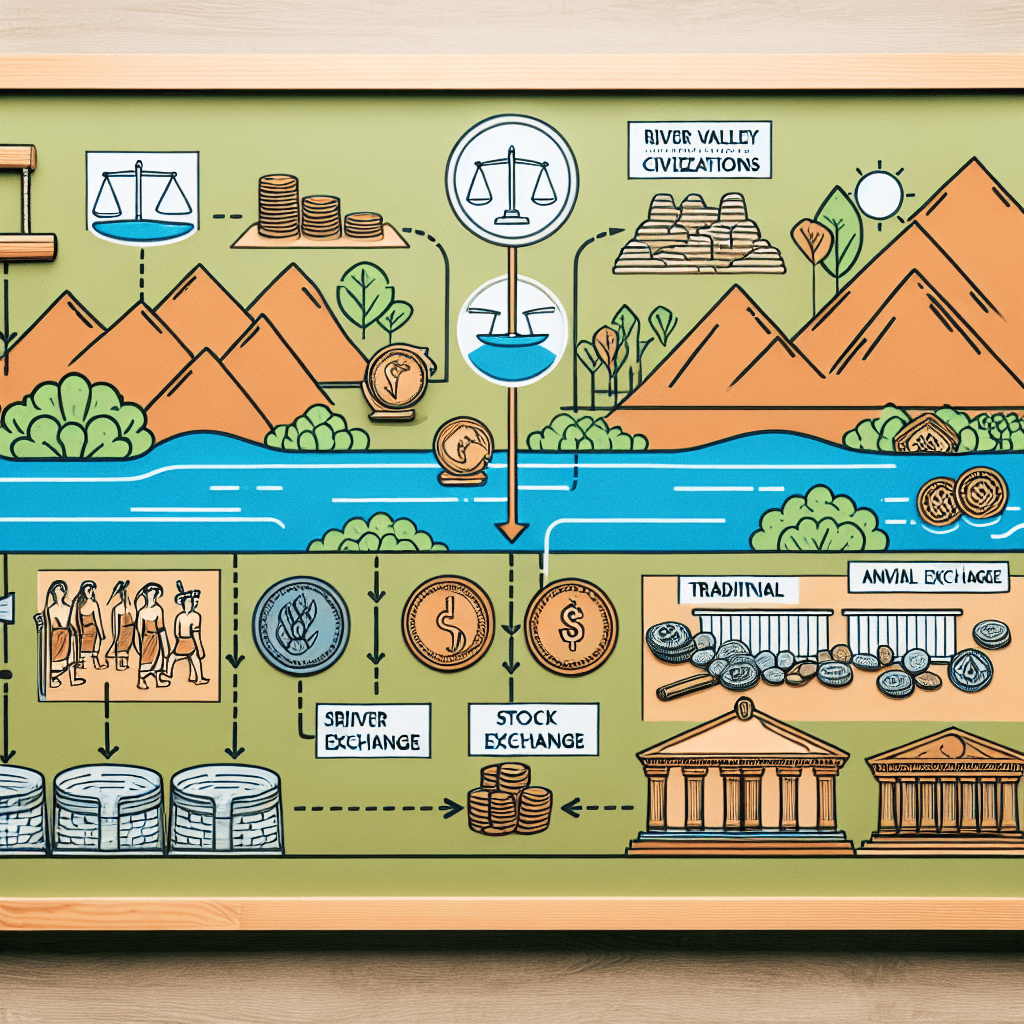
River Valley Stock Exchange: Investing in Ancient Civilizations
Inquiry Framework
Question Framework
Driving Question
The overarching question that guides the entire project.How did the interplay of trade, agriculture, specialization, and geography shape the economic success and societal development of River Valley Civilizations, and what lessons can we learn from their economic models?Essential Questions
Supporting questions that break down major concepts.- How did trade affect the development of River Valley Civilizations?
- What role did agriculture play in the economies of River Valley Civilizations?
- How did specialization of labor contribute to economic growth in River Valley Civilizations?
- How did geography influence economic activities in River Valley Civilizations?
Standards & Learning Goals
Learning Goals
By the end of this project, students will be able to:- Students will understand the role of trade in the development of River Valley Civilizations.
- Students will learn how geography influenced economic activities in River Valley Civilizations.
- Students will analyze how specialization of labor contributed to economic growth.
- Students will be able to explain market conditions and economic activity affected the growth of River Valley Civilizations.
Ohio Social Studies Standards
Entry Events
Events that will be used to introduce the project to studentsAncient Artifact Auction
Students examine and bid on 'artifacts' (props or images) representing different River Valley businesses. This sparks curiosity about their value, trade, and the civilizations' economies.Portfolio Activities
Portfolio Activities
These activities progressively build towards your learning goals, with each submission contributing to the student's final portfolio.Civilization Stock Analysis
Students select a River Valley Civilization (Mesopotamia, Egypt, Indus Valley, or China) and research its primary economic activities, including trade, agriculture, and specialization of labor. They will identify key businesses or industries that would be represented in a stock exchange.Steps
Here is some basic scaffolding to help students complete the activity.Final Product
What students will submit as the final product of the activityA detailed report outlining the economic activities and key businesses/industries of the selected River Valley Civilization.Alignment
How this activity aligns with the learning objectives & standardsAddresses the standard by requiring students to research and explain the economic activities that influenced the growth of River Valley Civilizations.Stock Creation & Prospectus
Students create their own "stock" for one of the businesses/industries identified in Activity 1. They will develop a prospectus (an informational document) that details the company's history, its role in the civilization, potential for growth, and risks. This activity simulates the initial offering of stock in a company.Steps
Here is some basic scaffolding to help students complete the activity.Final Product
What students will submit as the final product of the activityA stock prospectus for a River Valley Civilization business, including the company's name, logo, history, growth potential, and risks.Alignment
How this activity aligns with the learning objectives & standardsExplores market conditions and economic activity by having students create a stock and prospectus, considering factors that would influence its value and success.The Trading Floor Simulation
Students participate in a mock stock exchange where they "invest" in the stocks created by their classmates. This activity will involve tracking stock prices, responding to market events (e.g., a drought affecting agricultural businesses), and making informed decisions about buying and selling stock.Steps
Here is some basic scaffolding to help students complete the activity.Final Product
What students will submit as the final product of the activityA record of all stock transactions made during the simulation, including the initial investment, trades, and final profit/loss.Alignment
How this activity aligns with the learning objectives & standardsSimulates market conditions and economic activity, allowing students to experience firsthand how these factors affected the growth and success of businesses in River Valley Civilizations.Economic Impact Analysis
After the trading simulation, students analyze the performance of different stocks and the overall "economy" of their simulated River Valley Civilization. They will write a report discussing which factors led to the success or failure of certain businesses, and how these outcomes reflect the historical realities of the civilization.Steps
Here is some basic scaffolding to help students complete the activity.Final Product
What students will submit as the final product of the activityA written analysis of the economic factors that influenced the success or failure of businesses in the simulated River Valley Civilization, with connections to historical realities.Alignment
How this activity aligns with the learning objectives & standardsRequires students to explain how market conditions and economic activity affected the growth of River Valley Civilizations, based on their experiences in the stock exchange simulation.Rubric & Reflection
Portfolio Rubric
Grading criteria for assessing the overall project portfolioRiver Valley Stock Exchange Portfolio Rubric
Civilization Stock Analysis
Research and report on the economic activities and key businesses of a chosen River Valley Civilization.Economic Activities
Accuracy and depth of research into the civilization's primary economic activities.
Exemplary
4 PointsProvides a comprehensive and insightful analysis of the civilization's economic activities, demonstrating a deep understanding of their significance. Connects these activities to modern economic concepts.
Proficient
3 PointsProvides a thorough analysis of the civilization's economic activities, demonstrating a solid understanding of their significance.
Developing
2 PointsProvides a basic overview of the civilization's economic activities, but may lack depth or detail.
Beginning
1 PointsProvides a limited or inaccurate description of the civilization's economic activities.
Key Businesses/Industries
Identification of crucial businesses or industries relevant to the civilization's economy.
Exemplary
4 PointsIdentifies and analyzes multiple key businesses/industries with insightful explanations of their importance and interrelationships within the civilization's economy.
Proficient
3 PointsIdentifies several key businesses/industries with clear explanations of their importance to the civilization's economy.
Developing
2 PointsIdentifies a few businesses/industries, but explanations of their importance may be limited or unclear.
Beginning
1 PointsStruggles to identify relevant businesses/industries or provide clear explanations of their role.
Stock Creation & Prospectus
Creation of a stock prospectus for a chosen business, detailing its history, potential, and risks.Company History & Role
Accuracy and completeness of the company's historical context and its role in the civilization.
Exemplary
4 PointsProvides a compelling and accurate narrative of the company's history and its integral role in the civilization, demonstrating a deep understanding of its impact.
Proficient
3 PointsProvides an accurate and detailed account of the company's history and its role in the civilization.
Developing
2 PointsProvides a basic overview of the company's history and its role, but may lack detail or accuracy.
Beginning
1 PointsProvides a limited or inaccurate account of the company's history and its role.
Growth Potential & Risks
Realistic assessment of the company's potential for growth and potential risks, based on historical context.
Exemplary
4 PointsOffers a nuanced and insightful analysis of the company's growth potential and potential risks, demonstrating a sophisticated understanding of historical context and market dynamics.
Proficient
3 PointsProvides a clear and well-supported assessment of the company's growth potential and potential risks, based on historical context.
Developing
2 PointsIdentifies some potential for growth and risks, but the assessment may be superficial or lack strong support.
Beginning
1 PointsStruggles to identify potential for growth and risks, or the assessment is unrealistic.
The Trading Floor Simulation
Participation in the stock exchange simulation, demonstrating informed investment decisions.Investment Decisions
Soundness of investment decisions based on stock prospectuses and market events.
Exemplary
4 PointsConsistently makes informed and strategic investment decisions, demonstrating a deep understanding of market dynamics and risk management. Justifies choices with clear reasoning.
Proficient
3 PointsMakes generally sound investment decisions based on available information and market events.
Developing
2 PointsMakes some questionable investment decisions, indicating a limited understanding of market dynamics.
Beginning
1 PointsMakes consistently poor investment decisions, demonstrating a lack of understanding of market dynamics.
Transaction Tracking
Accuracy and completeness of the record of stock transactions.
Exemplary
4 PointsMaintains a meticulously accurate and complete record of all stock transactions, demonstrating excellent organizational skills.
Proficient
3 PointsMaintains an accurate and complete record of most stock transactions.
Developing
2 PointsMaintains a record of some stock transactions, but it may be incomplete or contain errors.
Beginning
1 PointsFails to maintain an adequate record of stock transactions.
Economic Impact Analysis
Analysis of the economic factors influencing business success or failure in the simulation.Factor Identification
Identification of key economic factors (e.g., geography, resources, technology) influencing business outcomes.
Exemplary
4 PointsIdentifies and analyzes a wide range of key economic factors with insightful explanations of their impact on business outcomes, drawing clear connections to historical context.
Proficient
3 PointsIdentifies several key economic factors and explains their impact on business outcomes.
Developing
2 PointsIdentifies a few economic factors, but explanations of their impact may be limited or unclear.
Beginning
1 PointsStruggles to identify relevant economic factors or provide clear explanations of their impact.
Historical Connections
Connection of simulation outcomes to the historical realities of River Valley Civilizations.
Exemplary
4 PointsDraws strong and insightful connections between the simulation outcomes and the historical realities of River Valley Civilizations, demonstrating a deep understanding of their economic systems.
Proficient
3 PointsDraws clear connections between the simulation outcomes and the historical realities of River Valley Civilizations.
Developing
2 PointsMakes some connections between the simulation outcomes and historical realities, but they may be superficial or lack strong support.
Beginning
1 PointsStruggles to connect the simulation outcomes to the historical realities of River Valley Civilizations.