
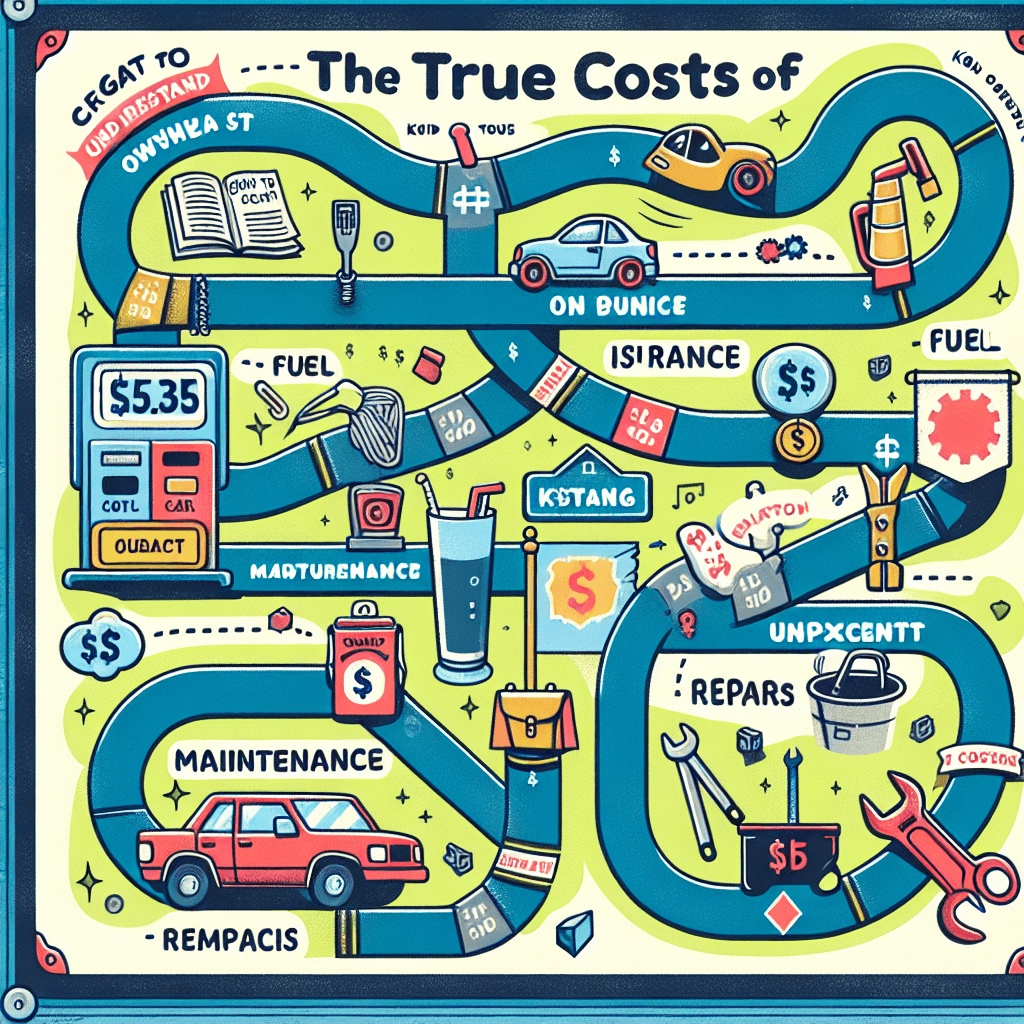
Roadmap to Reality: The True Cost of Car Ownership
Inquiry Framework
Question Framework
Driving Question
The overarching question that guides the entire project.How can we design a sustainable transportation plan that balances our automotive 'dreams' with our financial 'realities'?Essential Questions
Supporting questions that break down major concepts.- What are the 'hidden' costs of vehicle ownership beyond the initial purchase price?
- How does the choice of a vehicle impact a person’s ability to meet long-term financial goals and savings targets?
- What is the mathematical difference between 'want' and 'need' in a personal budget?
- How can data and financial analysis help us make responsible decisions about our lifestyle and transportation?
Standards & Learning Goals
Learning Goals
By the end of this project, students will be able to:- Students will accurately calculate the Total Cost of Ownership (TCO) for two vehicles, including financing, insurance, fuel, and maintenance, to understand the true financial commitment of vehicle ownership.
- Students will apply mathematical modeling to create a balanced monthly budget that integrates transportation costs while adhering to a strict savings requirement.
- Students will evaluate the concept of opportunity cost by comparing the long-term financial impact of a 'dream car' versus a 'budget-friendly' alternative.
- Students will synthesize financial data and personal priorities to justify a responsible purchasing decision using evidence-based reasoning.
Teacher Specified Standards
Common Core State Standards - Mathematics
National Health Education Standards
Entry Events
Events that will be used to introduce the project to studentsCar Matchmaker: The Baggage Edition
Students participate in a 'Speed Dating' event where they are 'matched' with cars based solely on aesthetics and horsepower. After the 'first date' (the dream phase), they receive the 'Financial Baggage' file for that car (annual maintenance, tax, title, license, and insurance) and must decide if they can afford a 'second date' or if they need to 'break up' and find a more financially compatible vehicle.Portfolio Activities
Portfolio Activities
These activities progressively build towards your learning goals, with each submission contributing to the student's final portfolio.The Reality Checkpoint
Students are assigned a 'Reality Profile' containing a specific monthly net income. They must research a second, 'Budget-Appropriate' vehicle that could realistically fit within a standard household budget (typically suggesting transportation shouldn't exceed 15-20% of income). They will perform the same loan calculations as they did for the dream car.Steps
Here is some basic scaffolding to help students complete the activity.Final Product
What students will submit as the final product of the activityA 'Financial Compatibility Profile' for the budget car, including the monthly payment and how it fits as a percentage of their assigned monthly income.Alignment
How this activity aligns with the learning objectives & standardsAligns with DRIVER.ED.1.2 (Construct a balanced budget) and DRIVER.ED.1.1 (Document vehicle scenarios). This introduces the 'Reality' constraint and requires students to find a vehicle that fits a specific financial profile.The True Cost Deep Dive
Ownership is more than just a car payment. In this activity, students investigate the 'Hidden Costs': fuel, insurance, and maintenance. They will calculate monthly fuel costs based on the car's MPG and an average commute, get insurance estimates, and factor in routine maintenance (oil changes, tires).Steps
Here is some basic scaffolding to help students complete the activity.Final Product
What students will submit as the final product of the activityThe 'True Cost Ledger'—a side-by-side comparison table showing the Total Cost of Ownership (TCO) for both the Dream Car and the Budget Car.Alignment
How this activity aligns with the learning objectives & standardsAligns with DRIVER.ED.1.1 (100% completion of cost categories) and CCSS.MATH.CONTENT.HSN.Q.A.1 (Interpreting units like MPG and annual premiums). This addresses the 'hidden' costs of ownership.The Budget Battleground
Using their assigned 'Reality Profile' income, students must now build a full monthly budget. They must include their Budget Car's Total Cost of Ownership while ensuring they meet a mandatory 15% savings goal. They will then attempt to 'force' the Dream Car into the same budget to see what other life necessities (rent, food, entertainment) must be sacrificed.Steps
Here is some basic scaffolding to help students complete the activity.Final Product
What students will submit as the final product of the activityA 'Balanced Life Budget' spreadsheet or infographic showing two columns: 'The Budget Life' vs. 'The Dream Life.'Alignment
How this activity aligns with the learning objectives & standardsAligns with DRIVER.ED.1.2 (Balanced monthly budget with savings) and NHES.5.12.1 (Financial health and stress management). Students must prioritize 'needs' and 'savings' over 'wants.'The Showdown: Want vs. Need
In this final activity, students analyze the data they have collected. They will write a reflection comparing the long-term financial health of both scenarios, specifically looking at how much 'extra' the dream car costs over 5 years and how that impacts their ability to save for future goals (like a house or travel). They end by making a final, justified choice.Steps
Here is some basic scaffolding to help students complete the activity.Final Product
What students will submit as the final product of the activityA 'Driver's Financial Manifesto'—a formal presentation or report that includes the data tables, the budget comparison, and a written justification of their final vehicle choice.Alignment
How this activity aligns with the learning objectives & standardsAligns with DRIVER.ED.1.3 (Compare financial outcomes) and DRIVER.ED.1.4 (Justify vehicle choice with evidence). This is the summative assessment where students synthesize their data.The Dream Car Blueprint
Students start by identifying their 'Dream Car' without any financial restrictions. They will research the MSRP, explore financing options, and calculate a monthly loan payment based on current interest rates. This activity sets the baseline for the 'Want' side of the project and introduces students to the complexity of auto financing.Steps
Here is some basic scaffolding to help students complete the activity.Final Product
What students will submit as the final product of the activityThe 'Dream Car Spec Sheet' which includes the vehicle make/model, MSRP, interest rate, loan term, and the calculated monthly principal and interest payment.Alignment
How this activity aligns with the learning objectives & standardsAligns with DRIVER.ED.1.1 (Calculate and document costs) and CCSS.MATH.CONTENT.HSN.Q.A.1 (Using units to solve problems). Students begin the foundational research for their 'Want' scenario.Rubric & Reflection
Portfolio Rubric
Grading criteria for assessing the overall project portfolioThe Road to Reality: Vehicle Ownership & Financial Literacy Rubric
Financial Modeling and Calculation
This category evaluates the student's ability to research, calculate, and document the comprehensive costs associated with vehicle ownership.Financial Data Accuracy and Research
Precision and completeness in calculating the Total Cost of Ownership (TCO) for both the Dream Car and the Budget-Appropriate Car, including MSRP, interest rates, fuel, insurance, and maintenance.
Exemplary
4 PointsCalculations for both vehicles are 100% complete and accurate. Units (MPG, %, $) are used flawlessly. Research is cited from highly credible sources. The 'True Cost Ledger' is exceptionally organized and easy to interpret.
Proficient
3 PointsCalculations for both vehicles are complete and mostly accurate. Units are used correctly. Research is based on reliable sources. The 'True Cost Ledger' provides a clear side-by-side comparison.
Developing
2 PointsCalculations are attempted for both vehicles but contain minor errors in math or unit application. Some cost categories (e.g., maintenance or insurance) may be estimated poorly or based on vague sources.
Beginning
1 PointsCalculations are incomplete or contain significant mathematical errors. Fails to document all required cost categories for one or both vehicles. Research sources are missing or unreliable.
Strategic Budgeting and Reality Alignment
This category assesses the student's ability to apply financial data to a real-world living scenario, prioritizing needs over wants.Budgetary Synthesis and Resource Allocation
The ability to construct a balanced monthly budget that integrates all vehicle costs while strictly maintaining a 15% savings goal and covering all fixed living expenses.
Exemplary
4 PointsThe 'Balanced Life Budget' is flawlessly executed. It demonstrates a sophisticated understanding of trade-offs, showing exactly how the 'Dream Car' impacts other life areas with zero mathematical errors. Savings goals are met or exceeded.
Proficient
3 PointsThe budget is balanced and includes all required categories (Rent, Food, Savings, Car). The 15% savings goal is met. The 'Budget Life' vs. 'Dream Life' comparison clearly shows the financial impact of the choice.
Developing
2 PointsThe budget is mostly complete but may have minor balancing errors. The 15% savings goal is present but may be calculated incorrectly, or some fixed costs (like food or utilities) are unrealistically low to make the car fit.
Beginning
1 PointsThe budget is unbalanced (negative balance) or fails to include the mandatory 15% savings. Key living expenses are omitted, making the financial model unrealistic.
Comparative Analysis
This category focuses on the student's ability to analyze data sets to understand the long-term impact of financial decisions.Opportunity Cost Analysis
The quality of the written or numerical analysis comparing the long-term financial outcomes (Opportunity Cost) of the two vehicle choices.
Exemplary
4 PointsProvides a profound analysis of the 5-year 'Opportunity Cost.' Calculations are precise, and the analysis makes insightful connections between car choice and long-term life goals (e.g., home ownership, travel).
Proficient
3 PointsClearly calculates the 5-year price difference between the two cars. The comparison identifies specific financial advantages of the budget-appropriate choice over the dream car.
Developing
2 PointsProvides a basic comparison of the two cars but lacks a deep analysis of the 5-year impact. Focuses mostly on the monthly difference rather than long-term financial health.
Beginning
1 PointsComparison is superficial or mathematically incorrect. Fails to identify the long-term financial consequences of choosing the more expensive vehicle.
Decision Making and Personal Wellness
This category evaluates the final synthesis of the project, focusing on decision-making skills and the connection between finance and health.Evidence-Based Justification and Wellness Reflection
The ability to justify a final vehicle choice using specific data and to reflect on how financial decisions impact personal health and stress levels.
Exemplary
4 PointsJustification is expertly defended with multiple data points from the project. The reflection on financial stress and health (NHES 5.12.1) is nuanced, showing a deep understanding of the link between financial stability and well-being.
Proficient
3 PointsJustification for the final choice is supported by at least three specific financial reasons. Includes a clear explanation of how financial stress from an unaffordable car can impact physical or mental health.
Developing
2 PointsChoice is stated with some evidence, but the reasoning is thin or inconsistent with the data provided in earlier steps. The health/stress connection is mentioned but lacks detail.
Beginning
1 PointsChoice is based on personal preference ('I just want it') rather than the financial data generated. Fails to address the health or stress implications of the decision.