
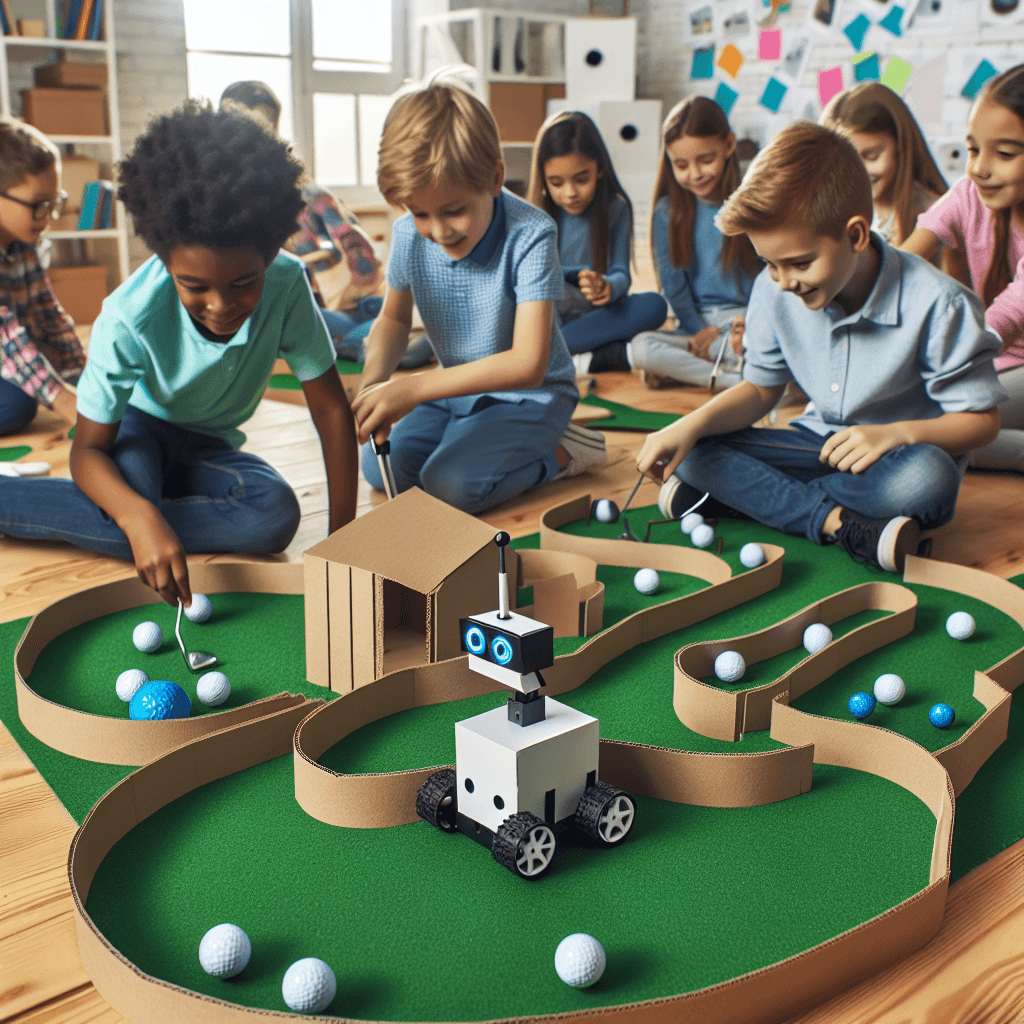
Robo-Golf: Building Mini-Golf Courses
Inquiry Framework
Question Framework
Driving Question
The overarching question that guides the entire project.How can we design and build an accessible and engaging mini-golf course that uses simple machines and robotics to create unique challenges and enhance gameplay?Essential Questions
Supporting questions that break down major concepts.- How can we use simple machines to create interesting challenges on a mini-golf course?
- What are the different types of simple machines and how can they be combined to control the motion of a golf ball?
- How can we design our mini-golf course to be accessible and fun for everyone?
- How do robots use sensors and programming to interact with their environment?
- How can we incorporate robotics into our mini-golf course design to add unique challenges and enhance gameplay?
- What design elements contribute to an engaging and enjoyable mini-golf experience?
- How can we test and improve the design of our mini-golf course and robotic elements?
- What are the engineering design process steps we can use to design our mini-golf course?
Standards & Learning Goals
Learning Goals
By the end of this project, students will be able to:- Students will be able to design and build a mini-golf course that incorporates simple machines to manipulate the motion of a golf ball.
- Students will be able to identify and explain the function of different types of simple machines within their mini-golf course design.
- Students will be able to program a robot to interact with its environment and perform specific tasks related to the mini-golf course.
- Students will be able to apply the engineering design process to design, build, test, and refine their mini-golf course and robotic elements.
- Students will be able to collaborate effectively within a team to complete the project and present their final product.
Entry Events
Events that will be used to introduce the project to studentsTrick Shot Mania
Students watch a video showcasing professional mini-golf trick shots, sparking brainstorming about how they can recreate and innovate these tricks using robotics and simple machines in their designs.Portfolio Activities
Portfolio Activities
These activities progressively build towards your learning goals, with each submission contributing to the student's final portfolio.Simple Machine Brainstorm
Students will explore different types of simple machines and brainstorm how they can be incorporated into their mini-golf course designs. They will create sketches and annotations explaining the function of each simple machine and how it can create a unique challenge or enhance gameplay.Steps
Here is some basic scaffolding to help students complete the activity.Final Product
What students will submit as the final product of the activityAnnotated sketches of simple machines and their application in mini-golf course design.Alignment
How this activity aligns with the learning objectives & standardsStudents will be able to identify and explain the function of different types of simple machines within their mini-golf course design.Mini-Golf Course Construction
Students will collaborate in teams to design and build a miniature golf course model incorporating chosen simple machines.Steps
Here is some basic scaffolding to help students complete the activity.Final Product
What students will submit as the final product of the activityA physical model of a mini-golf course incorporating simple machines.Alignment
How this activity aligns with the learning objectives & standardsStudents will be able to design and build a mini-golf course that incorporates simple machines to manipulate the motion of a golf ball.Robo-Golfer Programming
Students will learn basic programming concepts and apply them to program a robot to interact with their mini-golf course model.Steps
Here is some basic scaffolding to help students complete the activity.Final Product
What students will submit as the final product of the activityA programmed robot that interacts with the mini-golf course model.Alignment
How this activity aligns with the learning objectives & standardsStudents will be able to program a robot to interact with its environment and perform specific tasks related to the mini-golf course.Course Refinement and Testing
Students will test their mini-golf course and robotic elements, identifying areas for improvement and refining their designs for optimal gameplay and accessibility.Steps
Here is some basic scaffolding to help students complete the activity.Final Product
What students will submit as the final product of the activityA refined mini-golf course model with integrated robotic elements.Alignment
How this activity aligns with the learning objectives & standardsStudents will be able to apply the engineering design process to design, build, test, and refine their mini-golf course and robotic elements.Final Presentation
Students will finalize their mini-golf course and robotic elements, preparing a presentation showcasing their work and demonstrating the integration of simple machines, robotics, and accessibility features.Steps
Here is some basic scaffolding to help students complete the activity.Final Product
What students will submit as the final product of the activityA final presentation showcasing the completed mini-golf course project.Alignment
How this activity aligns with the learning objectives & standardsStudents will be able to collaborate effectively within a team to complete the project and present their final product.Rubric & Reflection
Portfolio Rubric
Grading criteria for assessing the overall project portfolioRobo-Golf Mini-Golf Course Design and Build Rubric
Understanding of Simple Machines
Measures the student's knowledge and application of simple machines in design.Identification and Explanation
Evaluate the ability to identify and explain the function of different types of simple machines used in the design.
Exemplary
4 PointsComprehensively identifies and explains the function of each simple machine, providing detailed insights into their impact on the mini-golf course design.
Proficient
3 PointsAccurately identifies and explains the function of each simple machine, showing clear understanding of their role in the design.
Developing
2 PointsPartially identifies and explains the function of some simple machines, with basic understanding demonstrated.
Beginning
1 PointsStruggles to identify and explain the function of simple machines, with minimal understanding evident.
Integration into Design
Assess how well simple machines are integrated and function in the design of the mini-golf course.
Exemplary
4 PointsSimple machines are innovatively integrated into the design, creatively enhancing gameplay and showing deep understanding.
Proficient
3 PointsSimple machines are effectively integrated into the design, contributing positively to gameplay.
Developing
2 PointsSimple machines are partially integrated into the design, with varying levels of impact on gameplay.
Beginning
1 PointsSimple machines show minimal integration into the design, with little impact on gameplay.
Robotics Programming and Application
Evaluates the development and application of robotics programming to enhance the mini-golf course.Programming Skills
Assess the level of skill in programming robots to perform tasks related to the mini-golf course.
Exemplary
4 PointsProgramming is sophisticated, with robots demonstrating seamless integration into the mini-golf course.
Proficient
3 PointsProgramming is correct and functional, with robots effectively performing intended tasks.
Developing
2 PointsProgramming is basic, with robots managing to perform some intended tasks.
Beginning
1 PointsProgramming lacks clarity, with robots struggling to perform tasks adequately.
Innovative Application
Measure the creativity and innovation in the application of robotics to enhance gameplay.
Exemplary
4 PointsUses robotics in an innovative manner to create unique, engaging gameplay challenges.
Proficient
3 PointsUses robotics effectively to enhance gameplay with creative elements.
Developing
2 PointsUses robotics in a basic manner, adding some elements to gameplay.
Beginning
1 PointsShows limited use of robotics in enhancing gameplay.
Engineering Design Process
Assesses the use of the engineering design process from concept to refinement.Design and Construction
Evaluate how well the design and construction phases are executed, incorporating feedback and testing.
Exemplary
4 PointsDesign and construction are exceptionally well-executed, showing detailed planning and comprehensive testing and refinements.
Proficient
3 PointsDesign and construction are well-executed, with effective use of testing and feedback for improvements.
Developing
2 PointsDesign and construction are partially executed, with some evidence of testing or refinement.
Beginning
1 PointsDesign and construction are incomplete or lack evidence of testing and refinement.
Problem-Solving and Refinement
Assess the capability to identify issues and implement effective refinements to enhance the project.
Exemplary
4 PointsEffectively identifies issues and applies innovative solutions to optimize the project.
Proficient
3 PointsAccurately identifies issues and applies workable solutions, showing evidence of problem-solving.
Developing
2 PointsIdentifies some issues with basic problem-solving applied to refine the project.
Beginning
1 PointsStruggles to identify issues or apply refinements to the project.
Team Collaboration and Presentation
Measures effectiveness of teamwork and the quality of the final presentation.Collaboration Skills
Evaluate the ability to collaborate effectively within a team setting.
Exemplary
4 PointsDemonstrates leadership and exemplary collaboration, contributing significantly to the team's success.
Proficient
3 PointsContributes effectively to the team, showing good collaboration skills.
Developing
2 PointsParticipates in team activities, showing basic collaboration skills.
Beginning
1 PointsNeeds support to collaborate effectively within the team.
Presentation Quality
Assess the clarity, engagement, and thoroughness of the final project presentation.
Exemplary
4 PointsPresentation is highly engaging, clear, and comprehensive, showcasing outstanding communication skills.
Proficient
3 PointsPresentation is clear and informative, demonstrating good communication skills.
Developing
2 PointsPresentation is basic, covering key points with some clarity.
Beginning
1 PointsPresentation lacks clarity and thoroughness, needing improvement.