
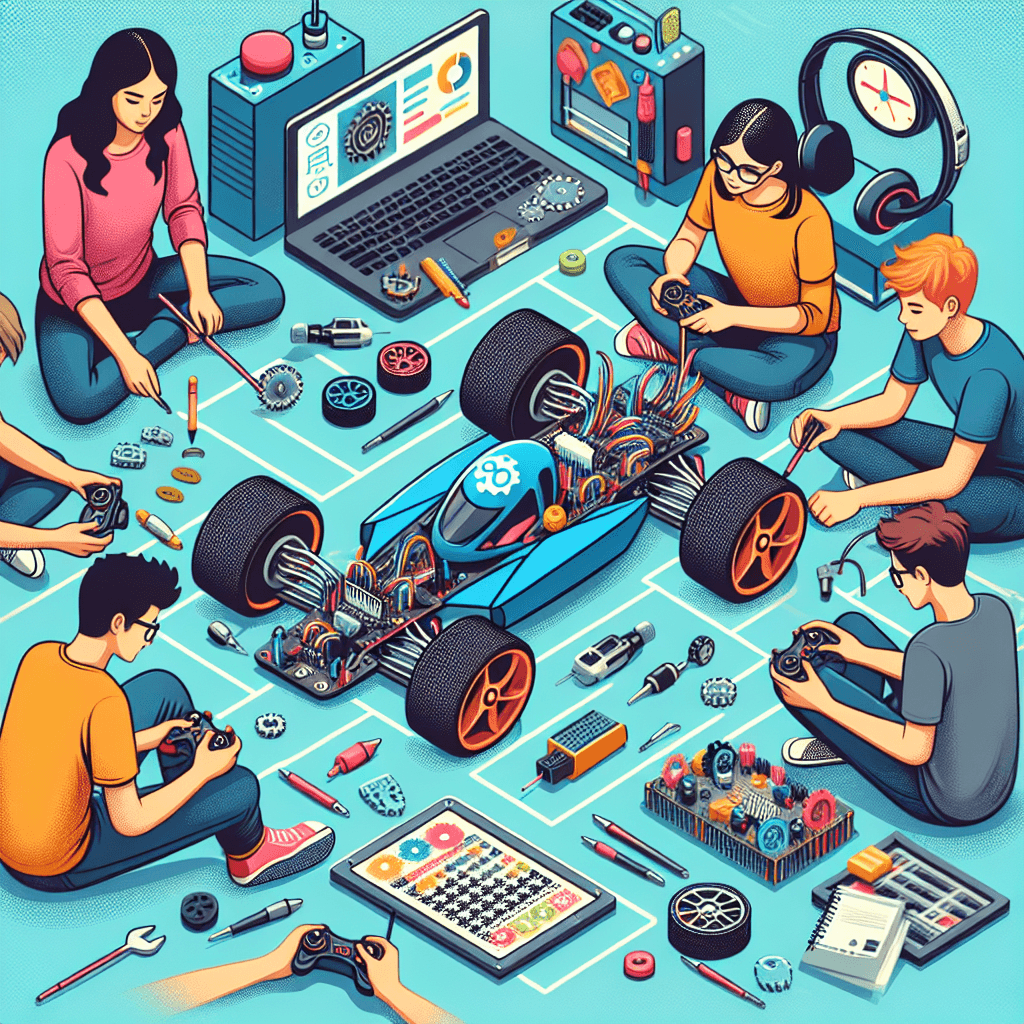
Robo-Racers: Build and Code Arduino RC Cars
Inquiry Framework
Question Framework
Driving Question
The overarching question that guides the entire project.How can we design and program a fully functional remote control car using Arduino, considering the necessary components, construction steps, and safety measures?Essential Questions
Supporting questions that break down major concepts.- What is Arduino and how can it be used in programming remote control cars?
- How do remote control systems work, and what components are necessary for their construction?
- What are the steps involved in designing and building a remote control car from scratch?
- How can programming be used to control the movement and functions of a remote control car?
- What safety and technical considerations must be taken into account when designing and building electronic devices?
Standards & Learning Goals
Learning Goals
By the end of this project, students will be able to:- Understand and apply basic programming concepts to create a functional Arduino-controlled remote car.
- Identify and explain the components required to build a remote control system.
- Design, build, and evaluate a remote control car using systematic engineering processes.
- Program the Arduino microcontroller to control the movement and functions of a remote control car.
- Understand and apply safety measures in the creation of electronic devices.
State Technology Standards
Next Generation Science Standards (NGSS)
Common Core English Language Arts Standards
Common Core Math Standards
Entry Events
Events that will be used to introduce the project to studentsRobo-Racer Challenge Kickoff
Start with an exciting live demonstration of a professional remote-controlled car race. Invite a local expert or racing enthusiast to show off their high-speed creations. As students watch, challenge them to think about the technology behind the scenes and how they might engineer similar or even better versions with Arduino. This immersive experience lets students connect theory to a real-world application, sparking curiosity about the project's possibilities.Portfolio Activities
Portfolio Activities
These activities progressively build towards your learning goals, with each submission contributing to the student's final portfolio.Arduino Explorer
Students will understand what an Arduino is and how it functions. Through research and exploration, they will identify its components and uses, setting a firm foundation for their remote-controlled car project.Steps
Here is some basic scaffolding to help students complete the activity.Final Product
What students will submit as the final product of the activityA detailed mind map illustrating Arduino's components, uses, and functionalities.Alignment
How this activity aligns with the learning objectives & standardsCS.7-1 - Understand basic programming concepts and utilize microcontrollers.Component Detective
In this activity, students will explore the necessary components for building a remote control car. They will identify and understand the role of each part in building a functional car.Steps
Here is some basic scaffolding to help students complete the activity.Final Product
What students will submit as the final product of the activityA comprehensive logbook detailing each component's function and importance in the remote-controlled car.Alignment
How this activity aligns with the learning objectives & standardsCS.7-2 - Apply understanding of circuits and electronic components.Design Lab
Students will sketch and outline their remote control car designs using basic engineering concepts and considerations. They'll apply mathematical concepts in their designs, prepping them for the build phase.Steps
Here is some basic scaffolding to help students complete the activity.Final Product
What students will submit as the final product of the activityA blueprint of the car design with detailed measurements and notes on component placement.Alignment
How this activity aligns with the learning objectives & standardsENG-7.MS-ETS1-2 - Evaluate design solutions using engineering processes; CCSS.Math.7.G.B.6 - Solve mathematical problems involving measurements.Code Commander
In this activity, students will develop their programming skills needed to control their Arduino-powered car. They'll write and test codes, ensuring that they can manage the fundamental movements of their car.Steps
Here is some basic scaffolding to help students complete the activity.Final Product
What students will submit as the final product of the activityA portfolio of tested codes that control various car functions.Alignment
How this activity aligns with the learning objectives & standardsCS.7-1 - Use programming concepts to create functional programs on microcontrollers.Safety Architect
Students will analyze the safety and technical considerations required in building a remote control car. They'll establish guidelines to ensure a safe and efficient building process.Steps
Here is some basic scaffolding to help students complete the activity.Final Product
What students will submit as the final product of the activityA safety guideline document tailored to electronic projects like remote control cars.Alignment
How this activity aligns with the learning objectives & standardsCS.7-2 - Troubleshoot electronic projects; CCSS.ELA-Literacy.RST.6-8.3 - Follow multistep procedures.Build and Test Mastery
In this final activity, students will apply everything they've learned to build and test their Arduino-controlled remote control cars. They'll evaluate their success based on pre-determined criteria and constraints.Steps
Here is some basic scaffolding to help students complete the activity.Final Product
What students will submit as the final product of the activityA fully functional Arduino remote-controlled car demonstrated in a class showcase.Alignment
How this activity aligns with the learning objectives & standardsENG-7.MS-ETS1-2 - Evaluate design solutions; CCSS.ELA-Literacy.RST.6-8.3 - Follow technical construction steps.Rubric & Reflection
Portfolio Rubric
Grading criteria for assessing the overall project portfolioRobo-Racers Project Rubric
Programming and Code Development
Assesses students' understanding and application of programming concepts to control the Arduino-powered car.Code Accuracy and Functionality
Evaluates the correctness and effectiveness of the code written to control various car functions.
Exemplary
4 PointsCode is error-free, highly efficient, and successfully controls all specified car functions.
Proficient
3 PointsCode contains minor errors but effectively controls most car functions.
Developing
2 PointsCode has some errors and controls some of the car functions as intended.
Beginning
1 PointsCode has significant errors and fails to control most car functions.
Code Documentation
Assesses the quality of code documentation and explanation of programming logic.
Exemplary
4 PointsCode is thoroughly documented with clear, concise explanations of programming logic.
Proficient
3 PointsCode is adequately documented with explanations for most parts.
Developing
2 PointsCode includes limited documentation and explanation of logic.
Beginning
1 PointsCode lacks documentation and logical explanations.
Components and Circuit Knowledge
Evaluates understanding of electronic components and circuits necessary for building the remote control car.Component Functionality
Assesses ability to explain the role and function of each component in the system.
Exemplary
4 PointsProvides detailed and accurate explanations of all components and their functions.
Proficient
3 PointsExplains functions of most components accurately.
Developing
2 PointsPartially explains component functions with some inaccuracies.
Beginning
1 PointsStruggles to explain the functions of most components.
Design and Engineering Process
Evaluates the design process and application of engineering principles in the car's creation.Design Innovation and Planning
Assesses creativity and strategic planning in car design and blueprint creation.
Exemplary
4 PointsDemonstrates innovative designs with thorough planning and excellent use of engineering principles.
Proficient
3 PointsCreates practical designs with clear planning using engineering principles.
Developing
2 PointsProduces basic designs with some planning and limited use of engineering principles.
Beginning
1 PointsDesigns lack coherence and effective planning.
Safety and Technical Considerations
Assesses understanding and application of safety measures in the electronic building process.Safety Practices
Evaluates identification of safety hazards and implementation of guidelines.
Exemplary
4 PointsIdentifies all potential hazards and implements comprehensive safety guidelines.
Proficient
3 PointsRecognizes most hazards and follows established safety guidelines.
Developing
2 PointsIdentifies some hazards, with limited application of safety guidelines.
Beginning
1 PointsFails to identify hazards and apply safety guidelines adequately.
Construction and Testing
Assesses ability to build and evaluate the remote control car against established criteria.Build Quality and Functionality
Evaluates the quality of car construction and its ability to function as intended.
Exemplary
4 PointsConstructs a high-quality, fully functional car meeting all design criteria.
Proficient
3 PointsBuilds a functional car that meets most design criteria.
Developing
2 PointsBuilds a partially functional car with basic adherence to design criteria.
Beginning
1 PointsCar construction is non-functional and does not meet design criteria.