
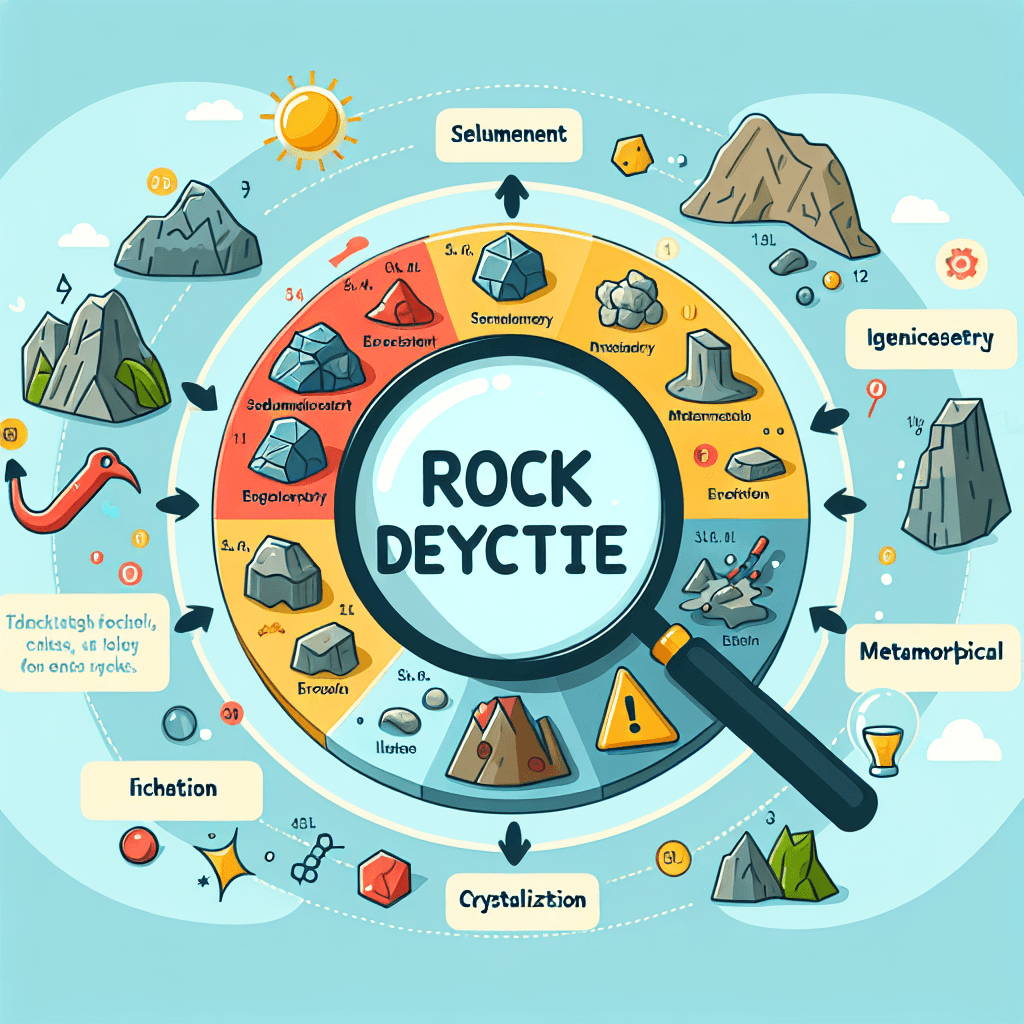
Rock Detective: Uncovering the Rock Cycle
Inquiry Framework
Question Framework
Driving Question
The overarching question that guides the entire project.How can we, as rock detectives, explore and analyze local rocks to uncover their formation history, transformations, and role in the rock cycle?Essential Questions
Supporting questions that break down major concepts.- What are the main types of rocks and how are they formed?
- How can we identify different types of rocks in our local environment?
- What role does weathering and erosion play in the rock cycle?
- How do rocks transform from one type to another in the rock cycle?
- Why is the rock cycle important to Earth's surface and ecosystems?
Standards & Learning Goals
Learning Goals
By the end of this project, students will be able to:- Students will be able to identify and classify local rocks into sedimentary, igneous, and metamorphic categories.
- Students will understand the processes of weathering, erosion, and deposition, and their role in the rock cycle.
- Students will develop skills to model the rock cycle and describe the transformations of rocks from one type to another.
- Students will understand the importance of the rock cycle to Earth's surface processes and ecosystems.
- Students will enhance observational and analytical skills by examining rock samples.
Next Generation Science Standards
Entry Events
Events that will be used to introduce the project to studentsMystery Package Arrival
A mysterious package arrives in the classroom, filled with different types of rocks, each labeled with a question about its origin or part in the rock cycle. Students are tasked with identifying each rock and its journey through the cycle, piquing their curiosity about geology and rock transformations.Portfolio Activities
Portfolio Activities
These activities progressively build towards your learning goals, with each submission contributing to the student's final portfolio.Rock Investigation Kit
Students will learn to observe and measure rock properties to identify and classify them. They will have a collection of local rocks as part of their 'Detective Kit,' which they will analyze to determine if they are sedimentary, igneous, or metamorphic rocks.Steps
Here is some basic scaffolding to help students complete the activity.Final Product
What students will submit as the final product of the activityA classification chart of local rocks, labeled by type (sedimentary, igneous, metamorphic) with documented observations and measurements.Alignment
How this activity aligns with the learning objectives & standardsAligns with NGSS.5-PS1-3; students make observations and measurements to identify materials based on their properties.Rubric & Reflection
Portfolio Rubric
Grading criteria for assessing the overall project portfolioRock Detective Portfolio Assessment Rubric
Observation and Measurement
Assessing students' ability to accurately observe and measure rock properties as part of their investigative process.Accuracy of Measurements
Measures the precision of students' recorded measurements for rock attributes.
Exemplary
4 PointsStudent provides highly precise measurements for all rock samples, using tools effectively and showing exceptional attention to detail.
Proficient
3 PointsStudent provides accurate measurements for most rock samples, correctly using tools and observing detail.
Developing
2 PointsStudent provides basic measurements with minor inaccuracies, showing some understanding of tools and detail.
Beginning
1 PointsStudent struggles with obtaining accurate measurements, showing limited understanding of tools and detail.
Detailed Observations
Evaluates the student's ability to note important details such as color, texture, and layers in rock samples.
Exemplary
4 PointsObservations are comprehensive and detailed, with keen attention to color, texture, and layer description for each rock sample.
Proficient
3 PointsObservations are thorough, with sufficient attention to color, texture, and layer description for most rock samples.
Developing
2 PointsObservations are basic, with partial attention to detail in color, texture, and layer description.
Beginning
1 PointsObservations are minimal and lack detail regarding color, texture, and layers.
Classification Skills
Evaluation of students' ability to classify rocks accurately into sedimentary, igneous, or metamorphic categories based on observations and measurements.Accuracy of Rock Classification
Measures the correctness of assigned rock types based on observed and measured data.
Exemplary
4 PointsAll rocks are classified correctly with clear, evidence-based rationale connecting observations to classification.
Proficient
3 PointsMost rocks are classified correctly with appropriate rationale based on observations.
Developing
2 PointsSome rocks are classified correctly, though rationale may lack alignment with observations.
Beginning
1 PointsMany rocks are classified incorrectly with little or no rationale based on observations.
Analytical Thinking
Assessing students' ability to analyze and synthesize information into a coherent understanding of the rock cycle.Understanding of Rock Cycle
Evaluates how well the student understands and explains the processes of the rock cycle.
Exemplary
4 PointsStudent demonstrates a deep understanding of the rock cycle, clearly articulating processes and transformations between rock types with evidence.
Proficient
3 PointsStudent shows a thorough understanding of the rock cycle and processes with clear explanations.
Developing
2 PointsStudent shows basic understanding of the rock cycle but explanations might lack depth.
Beginning
1 PointsStudent shows limited understanding and cannot clearly explain rock cycle processes.