
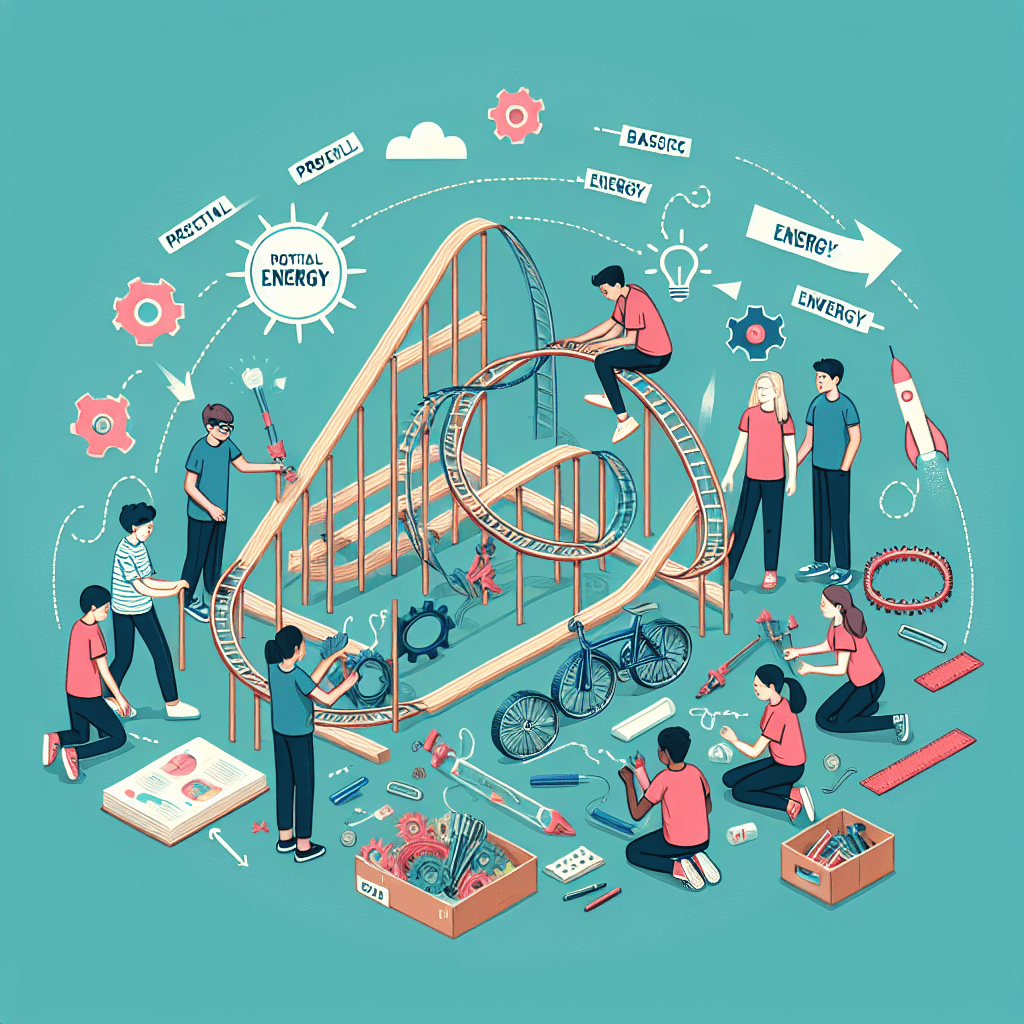
Roller Coaster Energy Challenge
Inquiry Framework
Question Framework
Driving Question
The overarching question that guides the entire project.How can you design and build a roller coaster that effectively demonstrates the Law of Conservation of Energy, focusing on the interplay between kinetic and potential energy, especially in relation to its loops?Essential Questions
Supporting questions that break down major concepts.- What is kinetic energy and how does it differ from potential energy within a mechanical system?
- How can the Law of Conservation of Energy be demonstrated through the construction and functioning of a roller coaster?
- What specific design features of a roller coaster influence the distribution of kinetic and potential energy, especially in relation to loops?
Standards & Learning Goals
Learning Goals
By the end of this project, students will be able to:- Students will understand and apply the principles of kinetic and potential energy within mechanical systems.
- Students will use computational thinking to assess and explain energy conservation in a roller coaster setting.
- Students will design and build a model roller coaster demonstrating energy transformations and conservation principles.
- Students will analyze the impact of roller coaster design elements, such as loops, on energy distribution.
State Science Standards
NGSS
Entry Events
Events that will be used to introduce the project to studentsRoller Coaster Engineer for a Day
Students receive a mysterious package containing blueprints, a letter from a top amusement park, and a set of materials. They are tasked with creating a prototype roller coaster with a loop, analyzing the kinetic and potential energy at various points, and submitting their design for an upcoming park exhibit. This event immediately ties to real-world engineering and physics applications, sparking curiosity about what it takes to design thrilling rides.Portfolio Activities
Portfolio Activities
These activities progressively build towards your learning goals, with each submission contributing to the student's final portfolio.Roller Coaster Design Challenge
Students begin by brainstorming and sketching their initial roller coaster designs, focusing on accommodating a loop. This activity will bridge theoretical concepts with practical design skills as they consider energy transformations.Steps
Here is some basic scaffolding to help students complete the activity.Final Product
What students will submit as the final product of the activityA detailed sketch of the roller coaster design with annotations on kinetic and potential energy at critical points, especially the loop.Alignment
How this activity aligns with the learning objectives & standardsAligns with standards PS.PSc.7.2 and HS-PS3-2 by developing a model demonstrating energy distribution in a mechanical system.Energy Analysis Planner
Students will calculate anticipated kinetic and potential energy at various points of their roller coaster designs, applying mathematical concepts to real-world scenarios.Steps
Here is some basic scaffolding to help students complete the activity.Final Product
What students will submit as the final product of the activityAn energy chart that calculates and compares potential and kinetic energy values at identified points along the coaster.Alignment
How this activity aligns with the learning objectives & standardsApplies PS.PSc.7.2 by employing mathematics to interpret energy transformations and conservation.Prototype Construction Workshop
Students translate their designs into physical roller coaster models, using materials provided in their mysterious packages to construct a prototype with at least one loop.Steps
Here is some basic scaffolding to help students complete the activity.Final Product
What students will submit as the final product of the activityA physical roller coaster prototype featuring a loop that exhibits the interplay of kinetic and potential energy.Alignment
How this activity aligns with the learning objectives & standardsRelates to HS-PS3-1 by developing a physical model that illustrates energy changes within a system.Energy Transformation Investigation
Students conduct investigations to analyze real-time energy transformation on their model roller coasters, validating their theoretical energy calculations and the Law of Conservation of Energy.Steps
Here is some basic scaffolding to help students complete the activity.Final Product
What students will submit as the final product of the activityA comprehensive report highlighting observed vs. calculated energy transformations and verifying energy conservation.Alignment
How this activity aligns with the learning objectives & standardsSupports HS-PS3-2 by using investigations to illustrate energy conversions and supporting theoretical calculations with empirical evidence.Roller Coaster Exhibition & Reflection
Students present their roller coaster models and findings in a classroom exhibition, demonstrating their understanding of energy conservation and transformations.Steps
Here is some basic scaffolding to help students complete the activity.Final Product
What students will submit as the final product of the activityAn engaging exhibition demonstrating roller coaster functionality and a reflective component encompassing learned outcomes.Alignment
How this activity aligns with the learning objectives & standardsIntegrates PS.PSc.7.2 and NGSS standards by presenting a comprehensive understanding of energy conservation principles in an engaging, communicative format.Rubric & Reflection
Portfolio Rubric
Grading criteria for assessing the overall project portfolioHigh School Science Roller Coaster Project Rubric
Conceptual Understanding
Evaluating students' grasp of the kinetic and potential energy concepts and the Law of Conservation of Energy.Energy Principles
Understanding of kinetic and potential energy and their transformation within a roller coaster system.
Exemplary
4 PointsDemonstrates a comprehensive and sophisticated understanding of kinetic and potential energy with clear, detailed explanations and examples.
Proficient
3 PointsShows a thorough understanding of kinetic and potential energy with appropriate explanations and examples.
Developing
2 PointsShows emerging understanding of energy concepts with basic explanations, possibly lacking depth.
Beginning
1 PointsShows initial understanding of energy concepts with minimal explanations, often incorrect.
Conservation of Energy
Understanding and explanation of the Law of Conservation of Energy as applied to a roller coaster system.
Exemplary
4 PointsSophisticated explanation with multiple examples demonstrating energy conservation across different coaster segments.
Proficient
3 PointsClear and accurate explanation with examples demonstrating energy conservation in key areas.
Developing
2 PointsBasic explanation with limited examples; some segments may not accurately reflect conservation principles.
Beginning
1 PointsMinimal or flawed explanation of energy conservation principles, often missing key components.
Design and Application
Evaluating the effectiveness and creativity in designing a roller coaster that showcases energy principles.Design Sketch and Annotations
Quality and detail of the roller coaster design sketch, focusing on energy points.
Exemplary
4 PointsSketch is exceptionally detailed with clear annotations showing precise energy points and transitions.
Proficient
3 PointsDetailed sketch with annotations that clearly identify key energy points.
Developing
2 PointsBasic sketch with some annotations; missing details may confuse energy locations.
Beginning
1 PointsIncomplete sketch with minimal annotations, often unclear or incorrect.
Prototype Construction
Execution and functionality of the roller coaster prototype.
Exemplary
4 PointsPrototype is fully functional with few to no errors, accurately demonstrating energy transformations.
Proficient
3 PointsPrototype displays minor issues but demonstrates key energy concepts effectively.
Developing
2 PointsPrototype has several issues affecting functionality; some energy concepts are poorly demonstrated.
Beginning
1 PointsPrototype is primarily non-functional, demonstrating little practical understanding of design concepts.
Analytical and Presentation Skills
Assessing students’ ability to analyze, report, and present their findings effectively.Energy Analysis and Interpretation
The ability to calculate, document, and interpret energy values throughout the coaster.
Exemplary
4 PointsEnergy calculations are comprehensive, accurate, and well-interpreted, with clear, insightful explanations.
Proficient
3 PointsCalculations are accurate and interpretations relevant, mostly correctly explaining energy transformations.
Developing
2 PointsBasic calculations and interpretations; some errors present.
Beginning
1 PointsInaccurate energy calculations with limited or flawed interpretations.
Presentation and Reflection
Clarity, engagement, and depth of final presentation and reflection on the project’s outcomes.
Exemplary
4 PointsPresentation is highly engaging and clear, with profound reflection on learning processes and outcomes.
Proficient
3 PointsClear and engaging presentation with substantial reflection on learning outcomes.
Developing
2 PointsPresentation has basic clarity with some reflection; lacks engagement or depth in insights.
Beginning
1 PointsPresentation lacks clarity and reflection, showing minimal engagement with the audience or materials.