
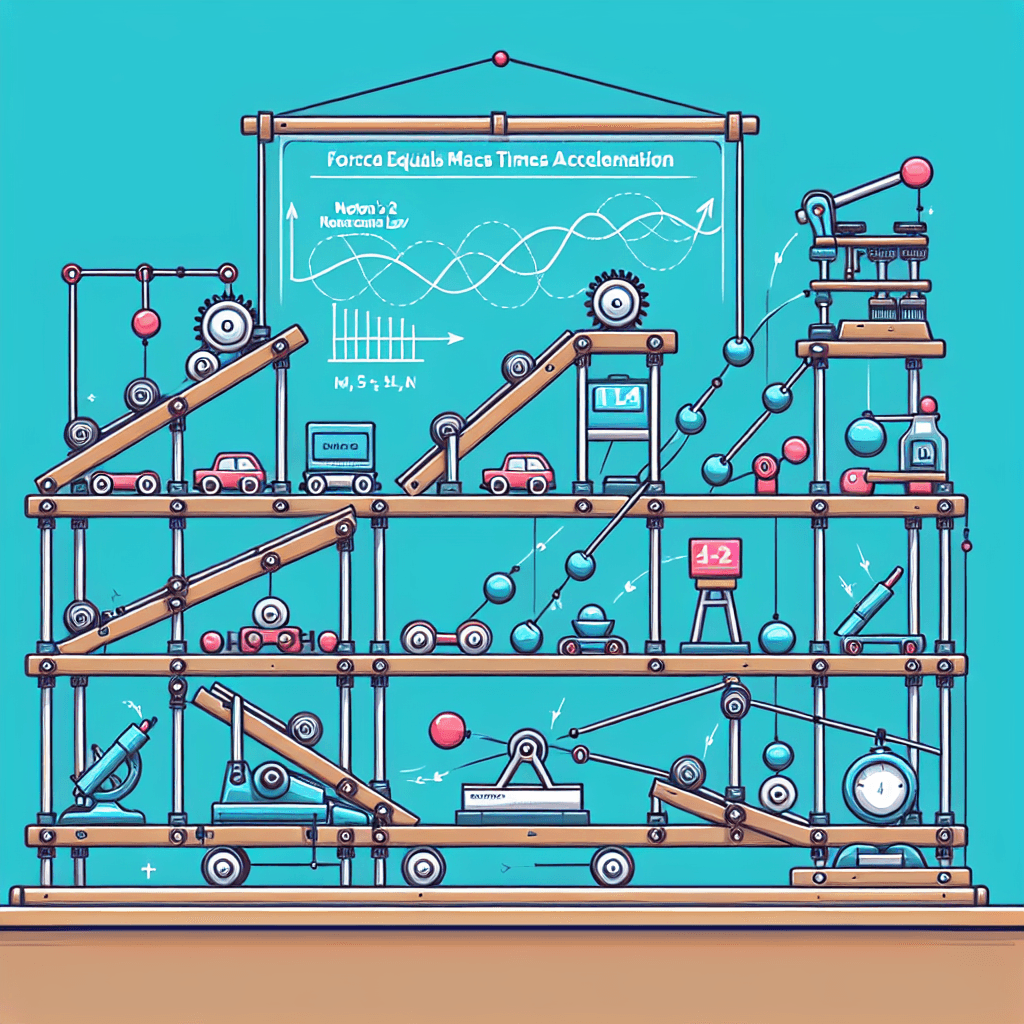
Rube Goldberg Machines: Newton's 2nd Law in Action
Inquiry Framework
Question Framework
Driving Question
The overarching question that guides the entire project.How can you design a Rube Goldberg machine to demonstrate Newton's Second Law of Motion while understanding the role and impact of various forces such as friction and net force in its operation?Essential Questions
Supporting questions that break down major concepts.- What is a Rube Goldberg machine and how can it be used to demonstrate Newton's Second Law of Motion?
- How does understanding forces and motion help in the design and functioning of a Rube Goldberg machine?
- What are some examples of forces that can be used in a Rube Goldberg machine, and how do they relate to Newton's Second Law?
- How can we calculate the net force acting on an object within a Rube Goldberg machine setup?
- What role does friction play in the movement of objects in a Rube Goldberg machine?
- How can we optimize a Rube Goldberg machine to demonstrate the principles of Newton's Second Law effectively?
Standards & Learning Goals
Learning Goals
By the end of this project, students will be able to:- Understand and apply Newton's Second Law in designing and explaining the function of a Rube Goldberg machine.
- Identify and explain the role of different forces, such as friction and gravity, which contribute to the operation of the machine.
- Calculate the net force acting on an object within a Rube Goldberg setup and predict its motion.
- Optimize a Rube Goldberg machine's design to effectively demonstrate the principles of Newton's Second Law and the forces involved.
- Develop skills in scientific reasoning and problem-solving through the hands-on construction and testing of a complex machine.
NGSS
Entry Events
Events that will be used to introduce the project to studentsThe Domino Chain Reaction Challenge
Start the entry event with a thrilling domino chain reaction setup. As students watch the dominos fall in sequence, introduce the concept of Rube Goldberg machines and challenge them to create their own, using Newton’s 2nd law to incorporate motion and force.Portfolio Activities
Portfolio Activities
These activities progressively build towards your learning goals, with each submission contributing to the student's final portfolio.Forces and Motion Exploration
Introduce students to the concepts of force and motion through hands-on experimentation. This activity will lay the foundation for understanding the principles of Newton's Second Law and its application in real-world scenarios.Steps
Here is some basic scaffolding to help students complete the activity.Final Product
What students will submit as the final product of the activityA set of experiment notes and observations that demonstrate understanding of Newton's Second Law.Alignment
How this activity aligns with the learning objectives & standardsAligns with MS-PS2-1 by helping students understand and apply Newton's Second Law through experimental observation.Rube Goldberg Machine Blueprint Planning
Guide students in the planning phase of their Rube Goldberg machine project, emphasizing the identification and integration of various forces that manifest Newton’s Second Law.Steps
Here is some basic scaffolding to help students complete the activity.Final Product
What students will submit as the final product of the activityA detailed blueprint of a Rube Goldberg machine with labeled forces and corresponding motions for each step.Alignment
How this activity aligns with the learning objectives & standardsSupports MS-PS2-2 by having students plan an investigation that shows how the change in motion is influenced by the sum of forces.Net Force Calculation Workshop
Develop students' skills in calculating net force by using mathematical tools and real-world scenarios. This workshop will prepare them to analyze forces within their Rube Goldberg machines.Steps
Here is some basic scaffolding to help students complete the activity.Final Product
What students will submit as the final product of the activityA collection of solved problems and force calculations demonstrating mastery of net force analysis.Alignment
How this activity aligns with the learning objectives & standardsAligns with MS-PS2-2 by reinforcing the ability to calculate predicted changes in motion based on net force.Friction and Gravity Investigation
Engage students in a deep dive into friction and gravity by testing how these forces interact within their Rube Goldberg machine models.Steps
Here is some basic scaffolding to help students complete the activity.Final Product
What students will submit as the final product of the activityAdjusted Rube Goldberg machine plans optimized for friction and gravity considerations.Alignment
How this activity aligns with the learning objectives & standardsSupports MS-PS2-4 by focusing on gravitational interactions and how they depend on object masses.Rube Goldberg Machine Construction and Testing
Facilitate the actual construction of the Rube Goldberg machines, with an emphasis on applying learned concepts of forces and motion to demonstrate Newton's Second Law.Steps
Here is some basic scaffolding to help students complete the activity.Final Product
What students will submit as the final product of the activityA fully constructed Rube Goldberg machine that effectively demonstrates Newton's Second Law in action.Alignment
How this activity aligns with the learning objectives & standardsCovers MS-PS2-1 and MS-PS2-2 by implementing solutions to demonstrate the effects of Newton's Second Law through practical application.Rubric & Reflection
Portfolio Rubric
Grading criteria for assessing the overall project portfolioRube Goldberg Machine Project Rubric
Understanding of Newton's Second Law
Evaluates students' grasp of Newton's Second Law and ability to articulate its principles through experiments and explanations.Theory Explanation
Measures the student's understanding of Newton's Second Law through explanation and application in experiments.
Exemplary
4 PointsArticulates a sophisticated explanation of Newton's Second Law with multiple examples from experiments, showing deep understanding and application.
Proficient
3 PointsSubstantially explains Newton's Second Law with relevant examples from experiments, showing clear understanding and application.
Developing
2 PointsProvides a basic explanation of Newton's Second Law with some examples, showing emerging understanding and application.
Beginning
1 PointsShows minimal explanation of Newton's Second Law and struggles with real-world application.
Experimental Notes
Evaluates the relevance and detail of experiment notes to demonstrate principles of Newton's Second Law.
Exemplary
4 PointsNotes are thorough, clearly demonstrating principles of Newton’s Second Law with precise observations.
Proficient
3 PointsNotes are detailed, clearly demonstrating principles of Newton’s Second Law with relevant observations.
Developing
2 PointsNotes show some detail and relevance but lack depth in demonstrating Newton's Second Law.
Beginning
1 PointsIncomplete or irrelevant notes that do not clearly demonstrate understanding of Newton’s Second Law.
Rube Goldberg Machine Design and Construction
Assesses the creativity, accuracy, and functionality of the Rube Goldberg machine design and execution.Design Creativity and Complexity
Evaluates the creativity and complexity of the Rube Goldberg machine design, including the variety of forces used.
Exemplary
4 PointsDesign demonstrates an exceptional level of creativity and complexity, incorporating a wide variety of forces effectively.
Proficient
3 PointsDesign shows substantial creativity and complexity with well-incorporated forces.
Developing
2 PointsDesign reflects some creativity and complexity but lacks thorough force integration.
Beginning
1 PointsDesign lacks creativity and complexity, with minimal force integration.
Accuracy of Force Application
Measures the precision and correctness in the application of forces within the machine design.
Exemplary
4 PointsAccurate application of forces is demonstrated with high precision throughout the machine's steps, aligned with Newton’s Second Law.
Proficient
3 PointsForces are applied accurately in most steps of the machine, showing understanding of Newton’s Second Law.
Developing
2 PointsForces are applied with some accuracy but inconsistently affect the machine's operation.
Beginning
1 PointsForces are inaccurately applied, hindering the machine's function and demonstration of principles.
Functionality and Optimization
Assess how well the constructed machine functions and the extent of iterative improvements based on testing.
Exemplary
4 PointsMachine functions seamlessly with exceptional execution and iterative optimizations that significantly enhance performance.
Proficient
3 PointsMachine functions effectively with clear improvements based on testing observations.
Developing
2 PointsMachine functions with some issues; optimization efforts show limited improvements.
Beginning
1 PointsMachine is incomplete or ineffective, with minimal evidence of optimization.
Scientific Reasoning and Problem Solving
Evaluates the application of scientific reasoning and problem-solving skills throughout the project.Data Interpretation and Analysis
Measures the ability to analyze data and interpret results from experiments and machine tests.
Exemplary
4 PointsDemonstrates exceptional ability to analyze data and interpret results, with insightful conclusions drawn from evidence.
Proficient
3 PointsEffectively analyzes data and interprets results, supporting conclusions with evidence.
Developing
2 PointsAnalyzes data with limited interpretation, showing emerging ability to draw conclusions.
Beginning
1 PointsShows minimal analysis and interpretation of data, struggling to draw valid conclusions.
Collaboration and Communication
Assesses the student's ability to work collaboratively and communicate ideas effectively.
Exemplary
4 PointsDemonstrates leadership in collaboration, with exceptional communication and contribution to group work.
Proficient
3 PointsContributes effectively in collaborative situations, with clear communication of ideas.
Developing
2 PointsParticipates in collaboration with basic communication skills and variable contribution.
Beginning
1 PointsMinimal participation and communication in collaborative activities.